A year on a set of rounds is still kinda unicorn magic. For the cost, at worst a year is probably breaking even as far as what you would pay to replace rounds over 12 months. I’m hoping that this shutdown is over and I’m working again so that I can take advantage of a black Friday sale and pick up a few sets of TI’s.
5 Likes
My nearly year old strings are TI Jazz rounds, definitely Unicorn Magic
Yeah thats a better analogy than what I used. I will grant that flats might sound better than dead rounds.
4 Likes
Every bass player: “I love the sound of a P-bass with flats.”
No bass player ever: “I love the sound of a P-bass with dead rounds.”
6 Likes
I don’t know about that, but I really hope you get 100% of your back pay.
5 Likes
Thank you. For whatever laws passed by congress are worth anymore, they passed a law after the last month+ long shutdown guaranteeing it. We’ll see.
5 Likes
Yeah - at first I was like “they still sound good to me, so is this really needed?” but now I’m more like “lemme get some new rounds, and if it’s only to see how they will sound”.
4 Likes
I just found this on YT and it demonstrates the difference between the sound of old and new strings really well. Here, the old strings sound better to my ears as the new ones which sound way too snappy.
3 Likes
Cool! Thanks for the link! I prefer the bright sound of the new strings, but the old sound nice too!
2 Likes
I doubt that. I mean there might be an objective test that determines when a string is totally dead, but, otherwise, it is ALL a subjective conclusion that says “now it is time”.
Here is a very non-scientific scientific diagram that “explains” it all 
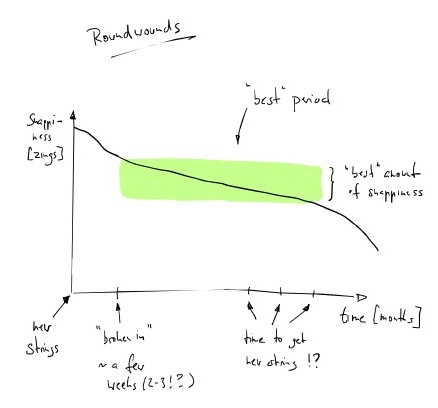
Personally, I don’t like the amount of zings coming from a brand new string, and I prefer them after a few weeks of being broken in. How long they last depends on many factors (already discussed in the thread), but once they’re below your threshold of zings then that is the time to change. Your green area can be shorter and narrower (or longer and wider) than somebody else’s, and the slope can be dependent on manufacturer, usage, etc.
Anyway, let your ears decide and not Thomann or some dude on YT 
6 Likes
Oh for sure. Imagine though, a plugin or cheap o-scope that analyzed a sample given at x=0,y=maximum snappiness - basically you record baseline data from the new set of strings. It could measure levels at each of the overtones and track them against the fundamental level. Later, when you subjectively feel you are entering the green zone, measure again and note the values. When you fall out of the green zone, measure again. Next time around, use the data gathered to hypothesize how close you are to falling out of the green zone.
Is it practical? Hell no, and it’s not meant to be a suggestion for something someone should actually do. 
I’m not going for practical, I’m going for “it should be possible”. (And I still contend that, practical or not, it should indeed be possible.)
By all means, let your ears be your guide in the real world. I’m just curious about the data.
4 Likes
Hah, yes, you may be right - it is not impossible, and someone should make that app 
3 Likes
I was like this on my old acoustic guitar. Whenever I put new string son I hated them for the first few weeks. No matter what brand I used they always sounded too bright and tinny to me. I much preferred the softer sound after a couple of weeks playing.
2 Likes
Hmm, maybe you could take the slope of the relative volume of the fundamental to the second, and third, etc octave. I’m not sure if that’s linear or if you’d need to do a second derivative rate of change of the slope analysis to get useful data.
An app like that would be super awesome. And even better if it could record every week a minute of playing exactly the same song with the strings, such that one could hear how the sound changes over time.
1 Like
There’s an easy solution to that…
I like the sound of strings that are about a week old with the tone knob at about 80%
2 Likes
Aaah, very interesting. Thank you! 
I didn’t think of this relation.
Yup. The first frequencies it rolls off are the highest ones.
So new strings with the tone back to ~80% gets a rich sound with lots of harmonics, but mutes just the highest and “harshest” frequencies.
So that old/new string video linked… I didn’t like the tone of either take because both had full tone. Those old strings sounded super muddy and crunchy to me. There is no way to take that out. They already sounded very flat. The new ones were a bit sharper and harsher than I would prefer, but it is easy to tame that with tone nob, or just dial back the treble pre on an active bass.
2 Likes
That caption with that photo makes this person - at my first impression - the most unreliable tone-knobber.
Like… I just have a rusty Pbass… what does my tone knob do?
Not: what does a tone knob do on a 20 string whale-fin, circle-chambered space ship.
I love the internet.
Also, always makes me appreciate captain Josh and his vids.
4 Likes
LOL. Yeah. I just did an image search for “Tone Knob”, and that was the first one that came up that wasn’t just a picture from an ad.
1 Like