Yeah that’s a totally cool service to offer.
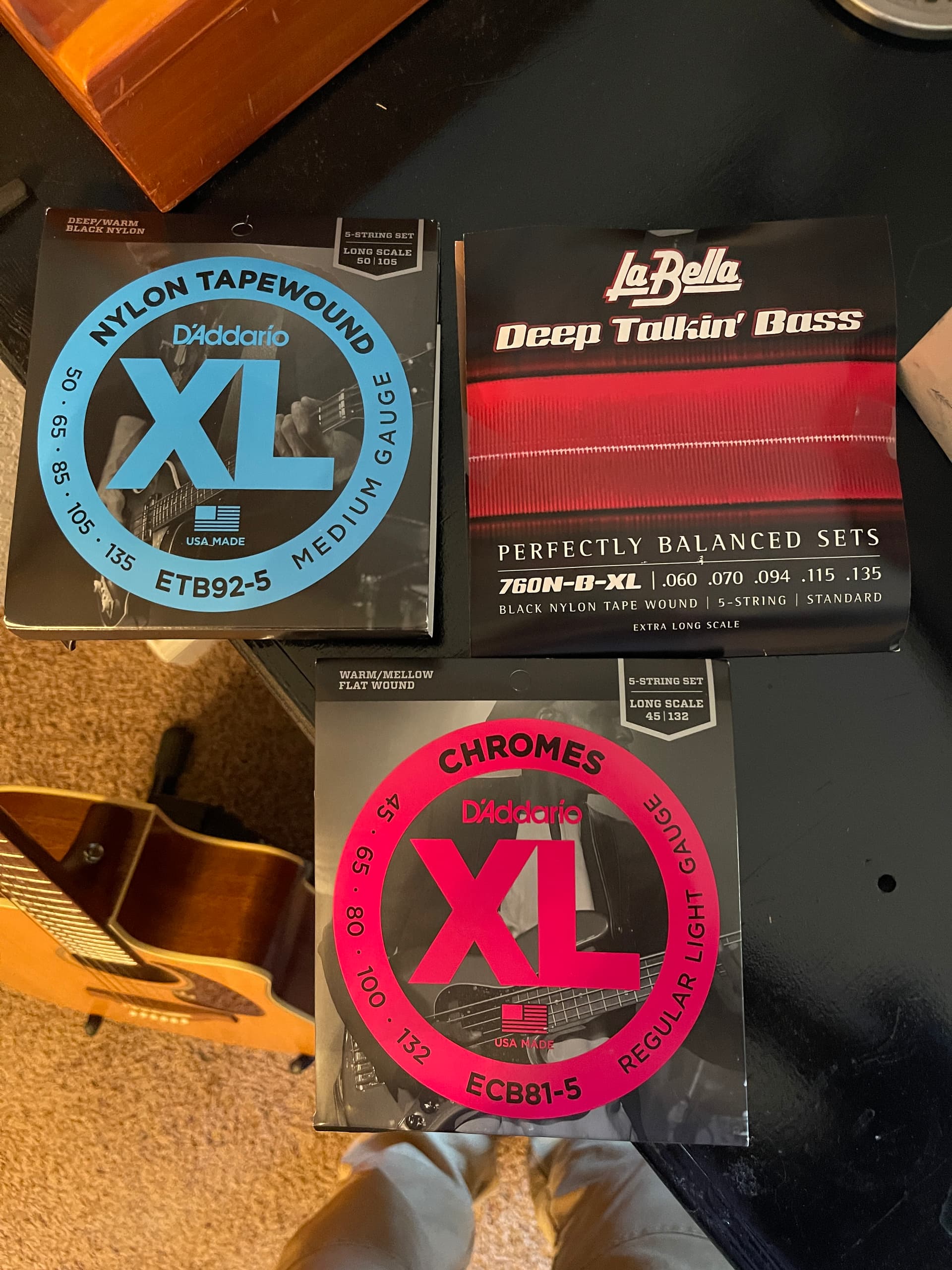
I moved to a 5er last year when I began to realize that much of the music I play is either new Country or Gospel. I have my Ibanez 505E strung with D’Addairo XL Chromes at the moment, but swap out to LaBella DTB’s depending on the style of music (mainly Country or Rock) that I’ll be playing. My Fretless Lakland Skyline 5’er pretty much stays strung with D’Addario XL Tape Wounds since they play and sound awesome - especially in some of the Gospel and Blues that incorporate more slides. Also, these strings really help emulate more of a smooth deepness in tone “somewhat” comparable to an upright. This is by far my most “fun” bass to play since I get absolutely zero fret buzz (duh - no frets to buzz anyway)
Here’s the strings that I use on my 5’ers….
2 Likes
I’ve got the “little” brother of your bass: the Sterling Stingray 5 HH. While mine come with the 45-125 nickel rounds strings (they don’t say the brand or model, but I would hope it’s the EB Super Slinkies) it looks like the Ray35HH comes with the EB 2836 Regular Slinkies 45-130. I kind of get what you mean about the B string as I get that on mine a bit, too. Was going to change out to probably flats, maybe tape-wounds.
As far as the pickups, I find myself mostly sticking with either bridge only for more traditional Stingray growly tone, or the next up, which is the outer 2 pickups for a more smooth thump. inner 2 and full both seems kinda blah to me. Full neck is just slightly less growly than the bridge pickup.
Now that I would actually enjoy. I actually like the idea of a fretless 5’er better.
You’re using exclusively flats on your 5? (That’s actually not a bad idea, given my proclivity that, I think I mostly want to use it for Jazz, neo-soul, and hip hop.)
Yeah. I expected the 2 inner to sound more P-like, but it really doesn’t.
The 2-full… it sounds like it’s trying to do to much. Maybe if I needed just pure weight for metal, but I feel like I’d do better with one H and some fuzz or distortion.
Yes…. Given the genre’s of music and the styles of play that I’m involved in, I use mainly flats. I do have a couple 4 string bass’s strung with rounds when I need that tone though…
I do find myself playing my 5 string bass’s way more than my 4 string bass’s now that I’ve become more comfortable with them. My problem now is when I grab a four string bass, I’m thrown off a bit and have to get my fingers re-established because I’ve gotten so use to having that B string there fretboard…
As for the fretless, I went with a fretboard that had lines on it that give me a visual of where the frets would be. Helps quite a bit and also helps when it comes to set up and checking intonation. It is definitely so cool to play though. I actually find it easier to play, but more “ear” effort is needed in order to make sure you are accurate in your fretting finger placement on the fretboard - so easy to go flat or sharp just a bit since there are no frets..
1 Like
Forcing yourself to like something you don’t like is never a good idea, especially when we’re talking about trying to bond with a bass that simply doesn’t deliver what you want.
1 Like
I’m thinking more and more that it’s these strings that I don’t like. At least this fresh and on this bass.
I think the round winding is… coarser… on the EB’s than on the D’A’s. So I’m getting a lot more strings noise sliding my hands along the bass. Especially on the B and E. I like the highs less on these than on the D’As. More tinny, less sparkly.
If I’m not using this for metal, I think I may need to try with flats.
I’m also more used to a passive tone control. That’s easier for me to tame too-bright strings.
I’ve got a fretless bass. I love it. My favorite instrument to play, but not as much call for it.
2 Likes
Alright my friend, sorry for a late response but please give my feedback a passing thought. The value of all 5 strings has very little to do (IMHO) with the deeps of the B-string. Think more about the ease of playing with the extra string. You can literally change your home position for a TON of songs. I originally learned Tom Sawyer in the 5th string starting position and it was SO much easier to play. Almost all of the Jimi Hendrix stuff is way more fun to play starting from a 5th string home position and sounds more round and full from there. With those thoughts put “out there” I will say I don’t dig dual humbuckers split as far away as the Sterling does–move them a bit closer together and I’m on board of that boat. I actually prefer a humbucker either replaced for a neck pickup on a J-bass; or, a frankenstein of a humbucker between a P and a J on a PJ bass. But I’m weird like that. Problem for me is the lack of thump or lack of something simpler to add clarity to the brights with distortion. Double HH has too many options for me and that’s why I avoid them.
Double HH x=200 too many options on a 5 string! I would probably force all of my mix on the bass itself to be either one end or the other. All P side or more towards the J (bridge) side. One or the other… I’d get too much clank or wrong-twang otherwise.
To your other questions: I’d suggest replaying anything “blues” with the 5th string. The ability to add some softly made low tones, saving your fretting hand from moving all over the continent, allows you to be way more expressive and enjoy the groove more. To inspire I’d look less at an artist or even a song, I’d lean more to what can help you sustain your groove longer. 5 string is pretty great, but, I did sell mine after 20 years. Why? It was crazy-heavy, I wasn’t playing live as often, and I missed my 4 string Musicmaster bass that I sold off like a stupid-idiot 15 years ago. That was a few years ago, I’ve had to relearn lines I could insta-play on the 5 string but overall I miss how fast I could learn a song with a guitarist by being in a similar “ball-park” when playing with them.
2 Likes
I have never liked EB Slinkys at all. They aren’t as bad as Warwick Reds but they definitely don’t feel or sound as good as D’Addario or Elixir to me. Kind of unfair comparison with the elixirs though.
First thing first, the Sterling bass is wired in Series the Stingray is wired in parallel, a ten minute fix can really change your perspective.
There’s no secret I’m a huge MusicMan fanboi I’m happy with the deep low B. I know the overkill HH can take so,e getting used to but I know this, unless you can get a good flip out of this you’ll regret it as soon as you let it go. On the HH my favorite position is either 2 or 4.
1 Like
Interesting. I will try that.
What is the effect of series vs. parallel? Does changing that mess with the ability to use positions 2 & 4?
My primary bass is a Reverend Raymond. Passive. Humbucker in the Ray position, with a Reverend Jazz Bomb humbucking blade, just a touch closer to the neck than a P. Which sounds great.
Will do more of this.
Had a good time last night playing “Feel Good Inc.” without having to retune. Yay!
Still not wild about these strings. Definitely going to replace them. Question is, with rounds or flats. Leaning flats. D’A Chrome to get that flat sound but maybe a bit brighter than Labella Deep-Talkin’.
No 2 and 4 is splitting coils and not using the full humbucker which on the neck position can sound too thick the 4 position only use the bottom of the neck pickup makes it much cleaner and also adding warmth to the tone. This is my most favorite pickup config HS.
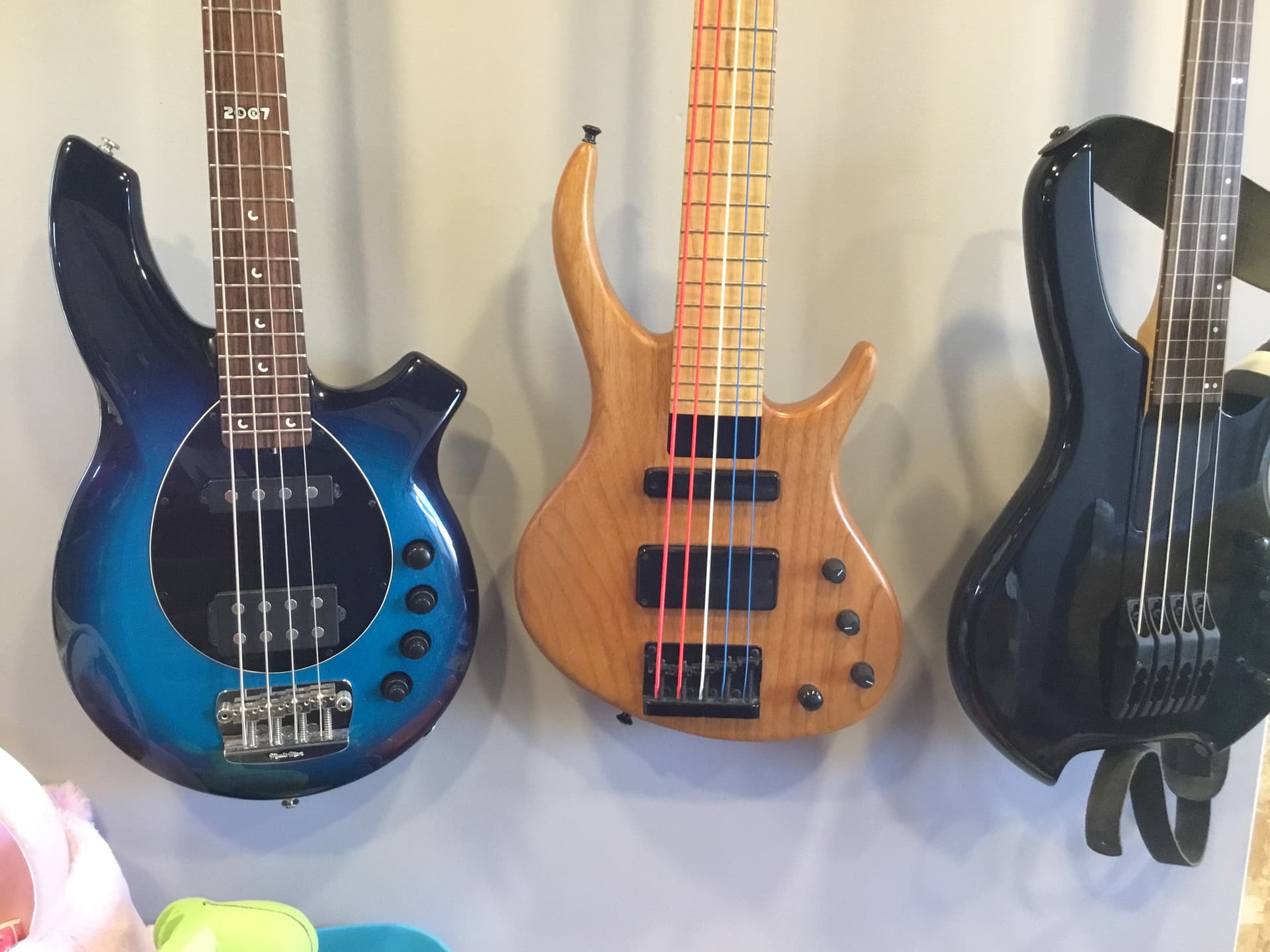
Position 2 does somewhat the opposite, it’s the R&B setting where the clarity of the bridge pickup adds to the warmth of the full neck pickup.
Parallel wiring while offers less output but provides more clarity to the tone which makes the Stingray the top choice for many slappers because of the rich and crisps tone.
I put brighter strings on my HH and it seems to balanced out really well.

I can use an amp to get more output. I can’t use it to get more clarity. I can muddy up a clear tone. I can’t sharpen a muddy one.
What is the wiring change to move the Pups from series to parallel?
I’m trying to find a good wiring diagram, and not getting much of use. This is the best I’ve found so far:
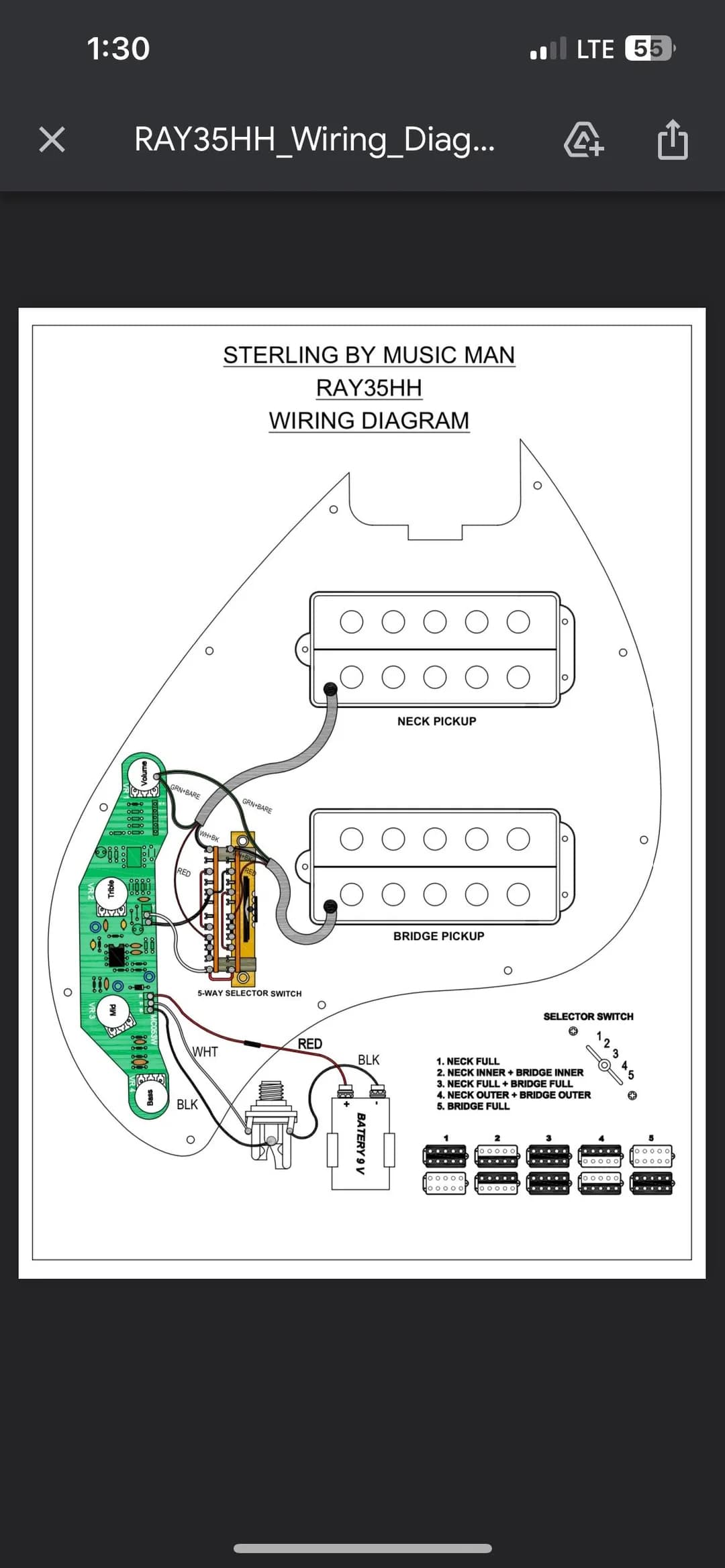
So… the switch controls pickup selection. So I presume it’s moving some wire connection on that, but I don’t know enough to know which one.
1 Like
Try this one
1 Like
Aha. I see. They added a push/pull switch to go between series and parallel. I wish they explained which position is which… I’d want parallel to be default, and then pull for series (if I actually want it).
Found this page that has diagrams and directions for either independent S/P switches for each pup, or a simple diagram to just keep it Parallel the whole time.
https://www.talkbass.com/threads/sbmm-ray4-hh-pickup-wiring-diagram-and-modifications.1564929/
Currently leaning just wiring the thing up Parallel. Or if not, do the Push/Pull switch like the video shown above.
1 Like
Sucks you are disappointed. I’ve owned one of those and don’t remember having any particular gripes about the B string. I always do full setups on my basses. Have you messed around with the setup and pickup height? I’m a B string snob and find Musicman 5’ers, even the import lines, to be generally quite good. There is no comparison between my Stingray 5HH and my Dingwall though. The B string on the Dingwall is impressive. The thing that bugs me about Stingray’s is the G string sliding off the fretboard at every opportunity. It’s ridiculous. The only brand I’ve ever had to “adjust” my playing to in order to keep the G string on the fretboard.
I think that basically all of my complaints will be fixed by changing strings (probably to flats) and rewiring the pups into parallel.
Now questions are:
- Flats or Rounds? Which ones? (Currently leaning D’A Chrome Flats)
- Just wire it into parallel? Or use a push/pull switch? Currently leaning switch, with down being parallel and up series.
That’s a subjective take.
Blues and jazz bass legends didn’t have an issue shifting positions on a 4-string, whether on an upright or electric instrument. In fact, single-string lines are very expressive in tonality and feel, ranging from low to very high registers. Unlocking that agility is a matter of practicing the technique until it becomes second nature. It’s much more of an “and” versus an “either/or” that increases a player’s ability far mire than always playing in a static position.
Playing across the neck can definitely be effective in many cases, but it is by far not the only, or better, way to play.
I experienced this on my 5HH as well. It’s really the only one I’ve played other than a couple quick noodles at the store so I don’t know how normal it is or not. It appears to be the same distance from the edge as my 4 string, so not sure what’s going on. My thought is my hand and fingers curl around the neck a bit differently due to the extra neck width and flatness and was just something to get used to. I don’t think it’s really done it after the first few times and I adjusted for it. But I just don’t give it much thought, tbh.
2 Likes
It often sounds better too. One example is chugging or galloping basslines often sound (and, frankly, work) better moving up and down the scale on a single string. And they can certainly be more straightforward to play that way.
A good example is Muse’s Hysteria. The entire thing could be played in a box up around the 10th fret (even just on a 4-string). But it just sounds and works better to play the descending parts staying on the A and D strings.
On the other hand, as I mentioned before, on trying several 34" basses with B strings, I have never found one that had good (to me) sounding timbre above the 7th fret of the B string, and some start to dull out around the 5th.
But yeah, longer scale or multiscale would help immensely there. Also mostly an issue with roundwounds as flats are more dull sounding overall than bright rounds.
1 Like