Here is an engineering explanation:
First mode natural frequency of a non-rotating, body like a string, is described by a simple formula which is only dependent upon stiffness and mass.
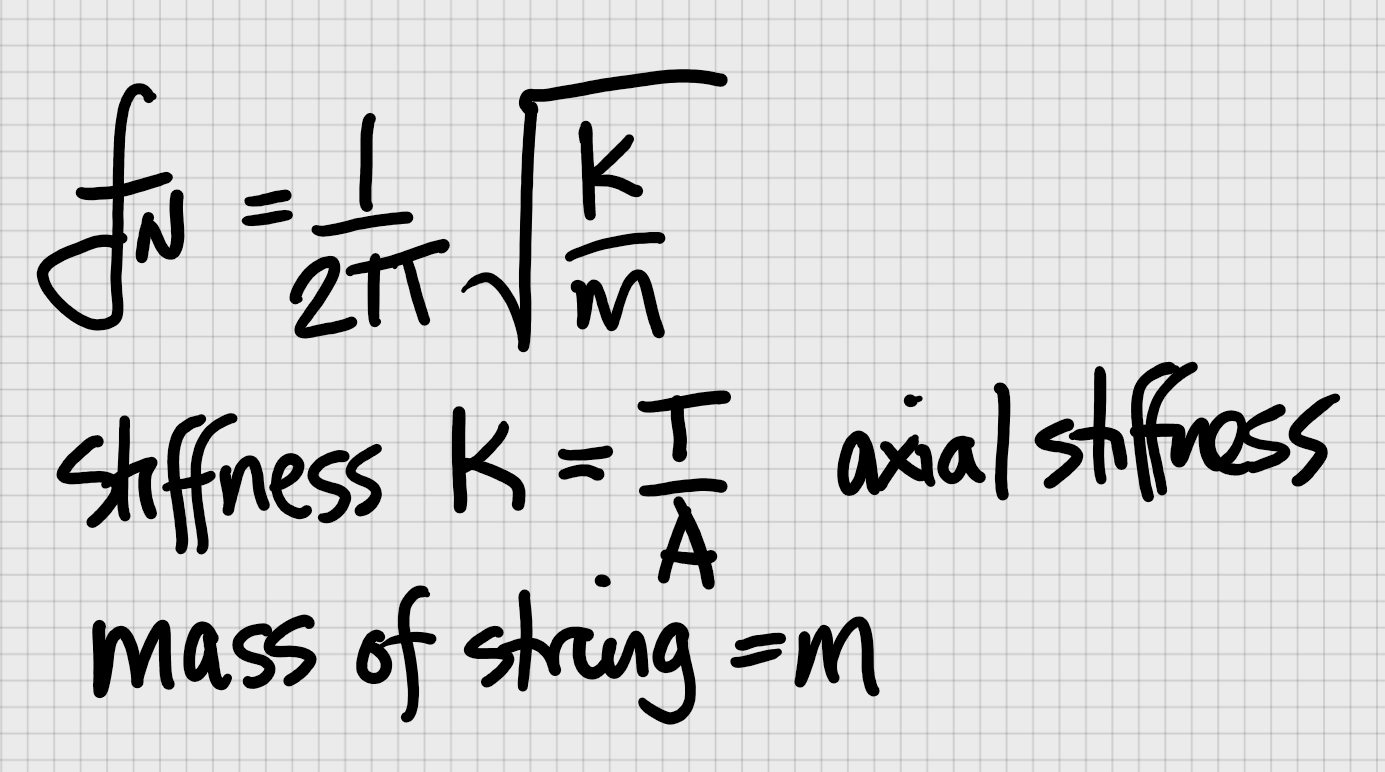
So, increasing stiffness, increases frequency. Increasing mass, decreases frequency.
Stiffness of an axial element (like a string) is dependent on Young’s modulus (a constant for steel) and tensile stress (tension divided by cross-sectional area).
As you tune the string up, it shortens, which increases the tension and pushes the frequency up. However, the distance between nut and bridge is fixed, so the amplitude of vibration (for a specific initial displacement) is constant.
Lower frequency is achieved by increasing the string diameter (and cross-sectional area) but eventually, making the string thicker means that you cannot pluck it, so it’s better to add mass (not density, the density of string steel is constant). That is why thicker strings have additional windings - they add mass but not stiffness, and thereby drop the frequency of vibration.
Hope that’s clearer than mud.