My Schecter has a roasted maple neck. It’s beautiful and definitely more stable than my other instruments. I live in the south where it gets very humid in the summer. I wouldn’t say roasted maple is “impervious”, but it’s very stable. I don’t have to mess with my truss rod, but I do have to tune the bass depending on if I’m heating the house or the AC is done. But that’s all. Retune once per season, truss rod stays out. It’s pretty nice, but I wouldn’t buy or avoid buying a bass I wanted based on that. More of an interesting side effect than a deciding factor for me…
Living in the Highlands of Scotland both our humidity and temperature can vary quite a lot from day to day. For example it was 14C yesterday and forecast for 24C for tomorrow. It’s gotten so when I pick up the bass each day I know pretty much which way I’ll have to tune it. But fortunately I rarely have to do the truss rod. A quick tweak once or twice a year seems to do it.
I have an Ibanez EHB 1500; it has a “9pc Pangapanga/Walnut neck w/Graphite reinforcement rods” and a Pangapanga fretboard. I have no idea if that composite neck is more stable or not.
During our winters the air indoors is often on the drier side and doesn’t change much. But now in the summer it might change almost daily. Two days ago I thought I needed to loosen the trussrod but decided to wait. But last night the A stopped rattling, so I didn’t adjust it yet and I’m glad I waited. I think Saturday will be the day, lots of rain and thunder coming, if the forecast doesn’t change.
I have never visited Scotland yet. But I hope to visit some day. It looks like a beautiful place.
Do you know The Twilight Sad? You mentioned Scotland and this band came to mind. I like it a lot.
It’s nice to know. Roasted mapple sounds like a great material for necks.
I agree this is not the most important criteria when buying an instrument. All the adjustments are just something we learn to live with, and probably after some time it won’t be a big deal.
I’ll disagree a little bit with that. After showing my 3rd and final ex the door 13 years ago, I decided it was finally time to pick up the bass again after decades of not playing. Stupidly, I bought a MIM reproduction of my first bass, a used '63 MIA Fender Jazz. I forgot what a PITA truss rod adjustments were (you have to remove the neck from the bass). Then I fell on ice while walking my dogs, suffering an impingement injury in the left shoulder. I could barely move my arm away from my body. After about 4 months, I was able to reach the first fret. Unfortunately, during that 4 month period, the string tension from the Pyramid Gold flats I’d restrung it with had turned the neck into a crescent moon. Even with the truss rod maxed out and the bridge saddles all the way down, it was unplayable. Rather than trying a major shimming job or buying a replacement neck, I spent the money on a shorty Gibson SG. That Mexican neck was a soft as a piece of pine. I learned that lesson the hard way. I now pay close attention to the neck wood and construction.
Equator dweller here. Humidity is constant, ranging from 70% to 100%. Just reporting my own experience but I have not experienced much need to adjust the truss rod on my basses, and I probably do so maybe every few years or so…. One time years ago, my bass got caught in a thunderstorm while it was sitting on its stand backstage… so yeah, that was not fun and I had to have the neck dried out, electronics etc changed, and adjusted but that was pretty freak…
Not just the removal of moisture from the wood cells but the actual collapse of the cell walls in roasted wood prevents absorption of moisture from changes in humidity conditions.
I can’t speak as to how your neck reacts, but I can as to mine: it’s stable as a stone.
Again, different manufacturers use different recipes for roasting their wood (relative variances in temperature, amount of roasting time, choice of specific wood stock, etc.), so different brand/model necks can conceivably react differently than one another.
What a horrible experience, the injury and the bent neck. I didn’t know that could happen. I have a friend who has a bass guitar but haven’t played it for years. I hope he won’t have this kind of surprise when he decides to play. It didn’t occurred to me that such damage could happen. I suppose the best way to safely store a bass would be to loosen the strings. But changes in humidity will still affect the tension of the neck. Would loosing the strings be enough?
I only have one bass guitar. After reading about this, I think if something happened and I couldn’t play it, I would keep checking on it regularly.
About the vintage models with their hidden trussrod screw, and having to remove the neck to adjust it, I can’t understand why on earth they ever designed it like that.
Interesting! I don’t know how much moisture a bass’ neck can take in from the air. Maybe after 70% air humidity, the wood’s cells will reach a point when they absord less and less?
I love that song! I listen to it very often, probably at least once a week I thought it would be fun to play it. I wish it were easier to find tabs + sheet music for the songs I like. I couldn’t find reliable ones for that song. There are some good covers on YouTube. I find it easier to see the notes than to look at someone playing and then figure it out from there.
Thanks for mentioning James and the Teenage Fanclub. I checked them out this morning and I like their music!
Have you heard Robert Smith’s cover of There’s a Girl in the Corner?
Hah! Now I came up with an idea that dramatically shortened the time it used to take to adjust the trussrod and tune the strings back!
What used to take most time was loosening and tightening the strings. So today I had this epiphany: while loosening the A and D strings, I turned the tuning pegs always exactly 180 degrees at a time, and I wrote down how many turns I rotated each one. Then I pulled the strings aside, quickly loosened a little the trussrod, placed the strings back over the nut, and then rotated the strings back the same number of times. After that, it was very easy and fast to tune all the strings again, because they weren’t far from the right notes.
The whole thing took me just a little more than 5 minutes!!
Before starting it, I had told my husband it would take me about half an hour, and we could have coffee afterwards. But the whole chore was over in just a few minutes.
This is the beginning of the way. In the future, you won’t need to write anything down; you’ll just know your strings need “x” turns of the tuning pegs to loosen them up enough to allow you to move them aside to access the truss rod nut.
When your environmental humidity remains stable and you adjust your truss rod, your neck will correspondingly remain stable. It is only when the relative humidity changes substantially that you’ll notice a need to tweak your truss rod.
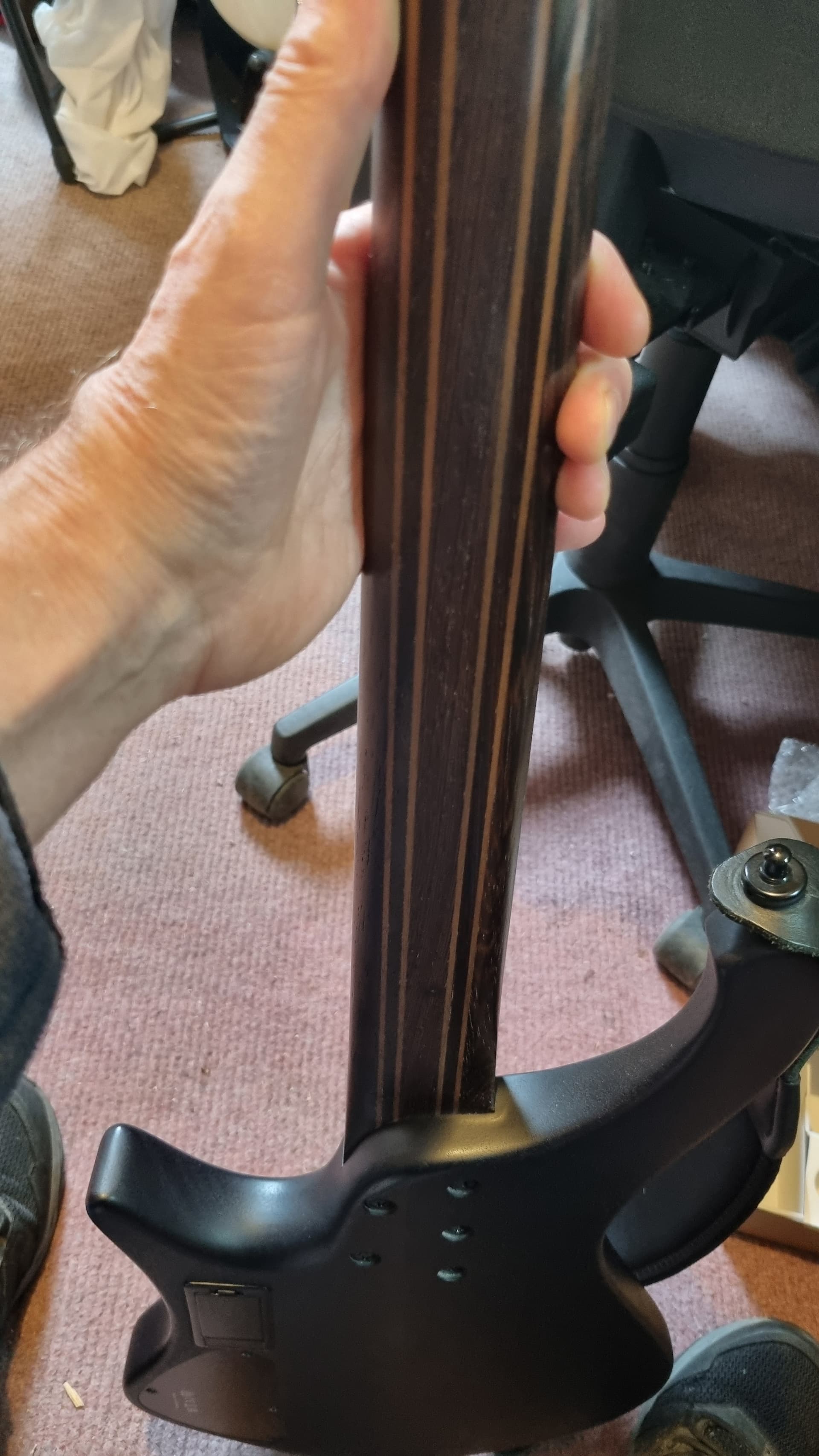
 What a horrible experience, the injury and the bent neck. I didn’t know that could happen. I have a friend who has a bass guitar but haven’t played it for years. I hope he won’t have this kind of surprise when he decides to play. It didn’t occurred to me that such damage could happen. I suppose the best way to safely store a bass would be to loosen the strings. But changes in humidity will still affect the tension of the neck. Would loosing the strings be enough?
 I thought it would be fun to play it. I wish it were easier to find tabs + sheet music for the songs I like. I couldn’t find reliable ones for that song. There are some good covers on YouTube. I find it easier to see the notes than to look at someone playing and then figure it out from there.


