I find that the bass fretboard is more difficult because it is larger. Also  for @DanW 's tips! Those will really speed up things!
Even when my fingers do find the right fret on their own, I still have to look at the fretboard to make sure they’re on the right part of the fret. Otherwise the buzz goblin will get me.
1 Like
I like Songsterr. I sometimes think I’m playing wrong and then realise the tab has the same note, but in a different location - eg I might be playing 5th fret on E string and tab has open A string.
MySongBook within Guitar Pro is pretty good as well. You need a subscription to get the best out of it, but when it’s on special, it doesn’t cost much. Some tab has the full band and sounds reasonable to play along to. Plus you’ve got the easy looping and slow down as part of Guitar Pro. Other things have that as well, but I use Guitar Pro to tab out ideas sometimes.
1 Like
that really made me smile as I was drinking my morning coffee!! thanks for sharing!
1 Like
it seems to me, only 5 months into lessons, it’s a 2-part issue:
muscle memory for the fretboard and memorizing the tab for the songs. right now, I can “sometimes” take my eyes off the fretboard, but I need to go back and forth between the tab and fretboard.
3 Likes
Oh for me it is different- I have the muscle memory etc; I simply like looking at the fretboard while playing and it’s a part of my overall experience. I have no need or desire to play without looking at it; I mean, my eyes have to be somewhere 
1 Like
I don’t want to sound stupid, but do you have the complete song tab memorized? I am trying, but maybe I should stick to one song until I have the complete song tab memorized??
1 Like
If you want to play from tabs or sheet music as they scroll past, memorizing the note sequences and positons will help immensely.
I usually learn a song part by
- memorizing the sequence of notes without a metronome or time
- play along small parts of the song slowly
- play a whole section like a chorus/verse,
- eventually play a section at full speed
- repeat that for all parts
- play at full speed while looking at the sheet music/tabs
Hope that helps!
PS: Learning a section like a verse speeds up memorizing stuff. Going note by note sometimes means that I don’t see a pattern that I can remember quickly. It can help to look at the chords behind the notes you play, too.
2 Likes
It’s not as hard as it sounds. Most songs have a few phrases that are repeated in patterns. So, you learn the riffs and then learn the song structure.
When learning a song it really helps to break down it’s structure and understand it.
4 Likes
As @howard says, it’s not nearly as hard as it might seem. Here is a piece that I have started working on for SoR band.
- Start by looking at the key signature and chord progression… We are in C Major and our basic progression is I, ii, IV, V
- In the intro we are just playing the roots, with some rhythm, except for the walk up to C in G->C
- The verse is the same progression, mostly doing roots and 5ths and the bar where we would have been playing G is a little different
- The chorus we get an extra bar of F and G (on roots with a fancier rhythm) and then we are back to CDFG with rhythms we have seen before. G is again a little different… but we can see that its chugging on the root until we go down an octave and then the same walk we do in the verse
- Bridge we need to do a little work because the chords are different and we not always on the root but are always on the our major triad (1,3,5) so while this could be a transcription error its certainly plausible. Rhythm wise we are just chugging 8th notes throughout
- Interlude we have the same rhythm in each measure and we are switching between 5th and root. I think if you mess up what is supposed to root ( G and A) and whats supposed to be 5th (D and E) think most people wont notice as long as the rhythm is right
- Key change, yay! I’m not here yet but it looks like everything is the same but shifted up 2 frets, which is exactly what we should expect
- Outro, 2 bars from the chorus and then an arpeggio over the D, our normal E bar, then our G bar an octave down, then G, D (5th), and A
That might seem like a lot of things, but each one is small and only one is really relevant at a time and each builds on the last in a way that is pretty intuitive when you are in it.
So you look at the key and progression. Then for each section you work on the notes in the bar relate to the chord. Play those notes together. Then play adjacent bars together, you will generally find that they flow together in a way that will flow together intuitively (maybe with a little practice) and sound nice together. Keep doing that until you have a whole section. Try playing it in rough time, before breaking out the metronome and playing it in time. Even if you want to play looking at the fret board I think not needing to do so will probably really pay off here. I’ve also found that I really need to count notes out loud to learn more complex timings correctly.
Once you have one section done move to the next, then play them together. Rinse and repeat until you are done.
Since my ultimate goal with this is to play on stage with other musicians, I’m intentionally not playing along with the original recording until I can play the whole thing with a metronome to avoid relying on cues that may not be there in a live setting.
Also I like to be able to move the notes around, so my current work flow is to either download the score and open it in MuseScore or copy the sheet music in MuseScore, but only use its default fretting as a starting point.
1 Like
unless you are reading music or tabs there really isn’t any drawback to this.
1 Like
Here’s a trick. Practice the riff for a few minutes, and I mean just a few minutes, before you go to bed. You’re brain is very receptive to muscle memory just before sleep. And do it every night.
If you over do it, you’ll just hit you’re second wind. Just a few minutes. Let your brain do the work while you sleep.
7 Likes
You can’t see the hotties when your starring at the fret board.
Its mostly a newb thing, put in a few hundred hours and get back to me.
1 Like
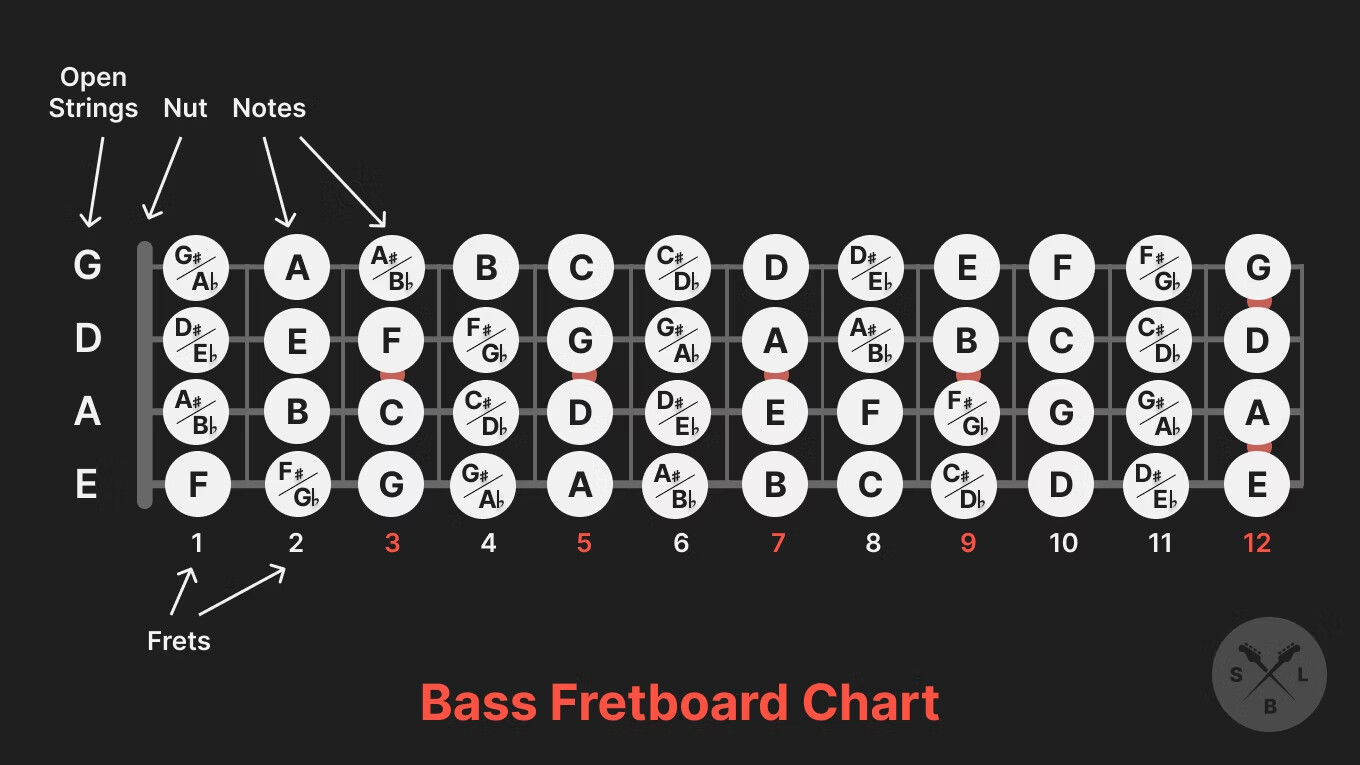
I play super short scale basses made by Birdsong bass founder/luthier Scott Beckwith (you can find him on the web) and they help everything TREMENDOUSLY. They are Stratocaster size. I intermittently look at the fret board, but occasionally I’m playing a very difficult tab that presents exactly the challenge that you speak of—if I look at the fretboard and look at my fingers then I lose the tab place. And let’s face it, it’s easy to get side-tracked if the tab you are playing is complicated, or you’re fatigued, or you’re hungry and have an errant thought like what you’re going to eat after this gig when you get home.  (It’s a real thing in my world). So….on those more complicated songs where I know I will not be able to take my eyes off of the tab or I’m in trouble, I do one of two things:
- I drill the tab so that I never have to look at it, and instead I learn by memorization and looking the entire time at my fretboard and fingers (not my usual choice) or
- I force myself to play WITHOUT looking at the fretboard at all. I keep my eyes diligently on the tab and following it intensely as I trust my fingers, the frets I’m finding, and the sound I’m producing to know I’m where I should be. If I LEARN the song in this manner from day 1, it works. I think that’s the key for me, personally, is to make myself learn it correctly from day 1– not learn it one way and try to adjust it later—that’s too hard for me. Challenging myself from the first step out of the gate to imprint it on my body and brain correctly from the start leads me to the greatest success every time. But that’s just me. It works the same for me and harmony if I’m learning a song. If I learn the harmony AS I’m learning the bass line, they imprint TOGETHER on my body and brain and I’m much more successful than trying to learn them independently of each other and blend them later. That’s much more awkward and disconnected for me. Again though, a super short scale bass is like playing a guitar. Muscle memory and reach seems to be so much more comfortable and easy. Scott Beckwith. Just Google Birdsong basses and pm him for info on the “Sport” super short scale bass. Awesome design and phenomenal sound. I play out at least 45 gigs a season with it and every gig someone comes up to me to marvel at the sound and design. I highly recommend it. It’s the right tool for me, that’s for sure.
1 Like
I’m five years in now and doing just fine thanks. How about you do you and not worry about what others who have been around the block prefer
1 Like
Boh stares at his fretboard quite often. And I’m pretty sure he know’s where all the notes are.
2 Likes
Pretty sure this guy (and indeed most classical guitarists) knows exactly where all the notes are on his fretboard but he (along with most guitarists) will spend most of the the time watching their fretboard and fingers very closely.
Don’t see the issue myself, your fretting fingers can be doing some pretty fancy work so it makes sense to watch them.
Do what works for you!
2 Likes
How? The same way everyone else did. Practice…lots and lots of practice.
1 Like
I’m stealing this! too funny 
1 Like