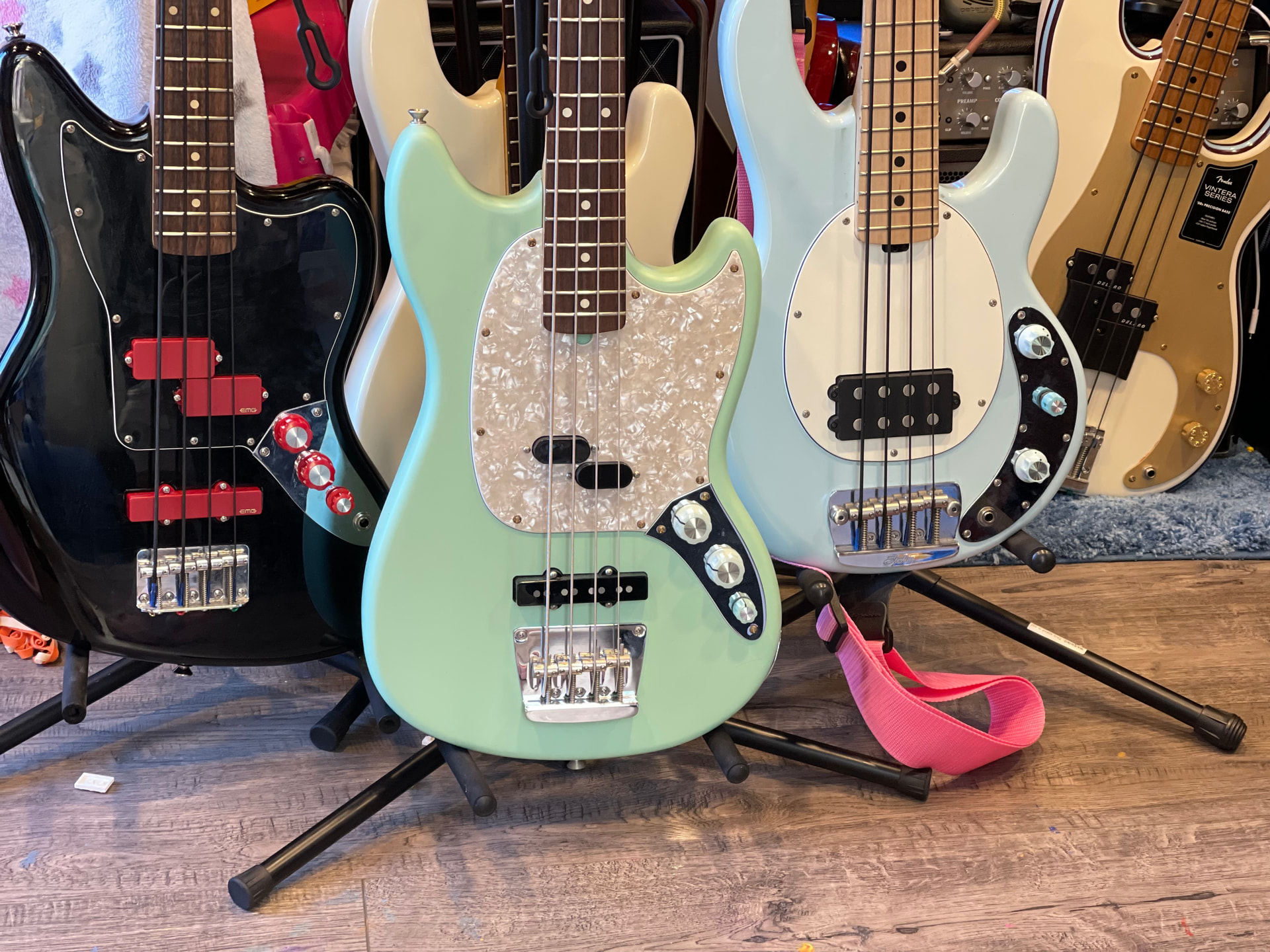
My Sterling stingray shortie and Joe Dart III shortie are both scaled down versions. Huh.
2 Likes
That’s true about my SBMM as well. But the ergos between it and the U5 are very apparent to me. The StingRay’s body feels noticeably bigger, especially when playing seated. Not as large as a standard long scale body, but not as small as a U5. Playing each with the same strap feels different as well.
I dig my U5 and SBMM Ray, but I rarely play them anymore as I feel cramped when I play shorties. My Mayones Jabbas, EBMM Cutlass and Sire M5 have been my preferred basses for years now, particularly my custom-build Mayones.
2 Likes
I can’t speak to a U5 as I don’t have one. I find mustangs very comfortable, maybe a bit cramped, but with my torn tendon in my wrist long scale is not an option so one makes do.
2 Likes
Another thing to consider the Mustang has 19 frets, beautiful spacing, U5 has 20 frets right in the middle and the SS has 22 frets, it’s the most compact. They are all share a medium radius of 9.5*
I like them much flatter if I could or better compound radius. All my Warwicks are 20* as the matter of fact all Warwicks are the same. 1.5” at the nut and 20*
2 Likes
Not quite sure what you mean - for a given scale length bridge to nut, the frets are all the same length per fret, regardless of how many there are. The difference is a 24 fret fretboard is longer (and extends towards the body/bridge more) than a 19 fret fretboard.
Changing the scale length influences fret spacing but the number of frets do not.
2 Likes
Correct, sorry I may have worded wrong. I find the SBMM to be the most compact because of the overall design, it’s the complete opposite of the Fallout as the SS is pretty much put the bridge at the very bottom of the body, the mustang with shorter fingerboard feel more spacious. Of course they are all 30” scale.
I’ll revisit this when I have enough rest in the morning it’s been a long day, 
1 Like
Ahh cool - that makes sense. For a moment I thought you meant the frets were tighter or something
2 Likes
That bring up an interesting question for me, the larger the radius the less curved the fretboard, and I’d think the more curve your fingers need to be in order not to touch and mute strings. One of the issues I sometimes run into is difficulty curving my fingers, so would that mean that I should have a larger radius fretboard?
1 Like
I love the feel of flatter radii.
2 Likes
A lot of people prefer flatter finger boards. One of the nicest things about 5 strings is the radius on their finger boards. I prefer them flatter myself.
2 Likes
Several of my basses have 9*-16**+ compound radius. I like it. If you have “trouble with curve” stay away from upright bass. 
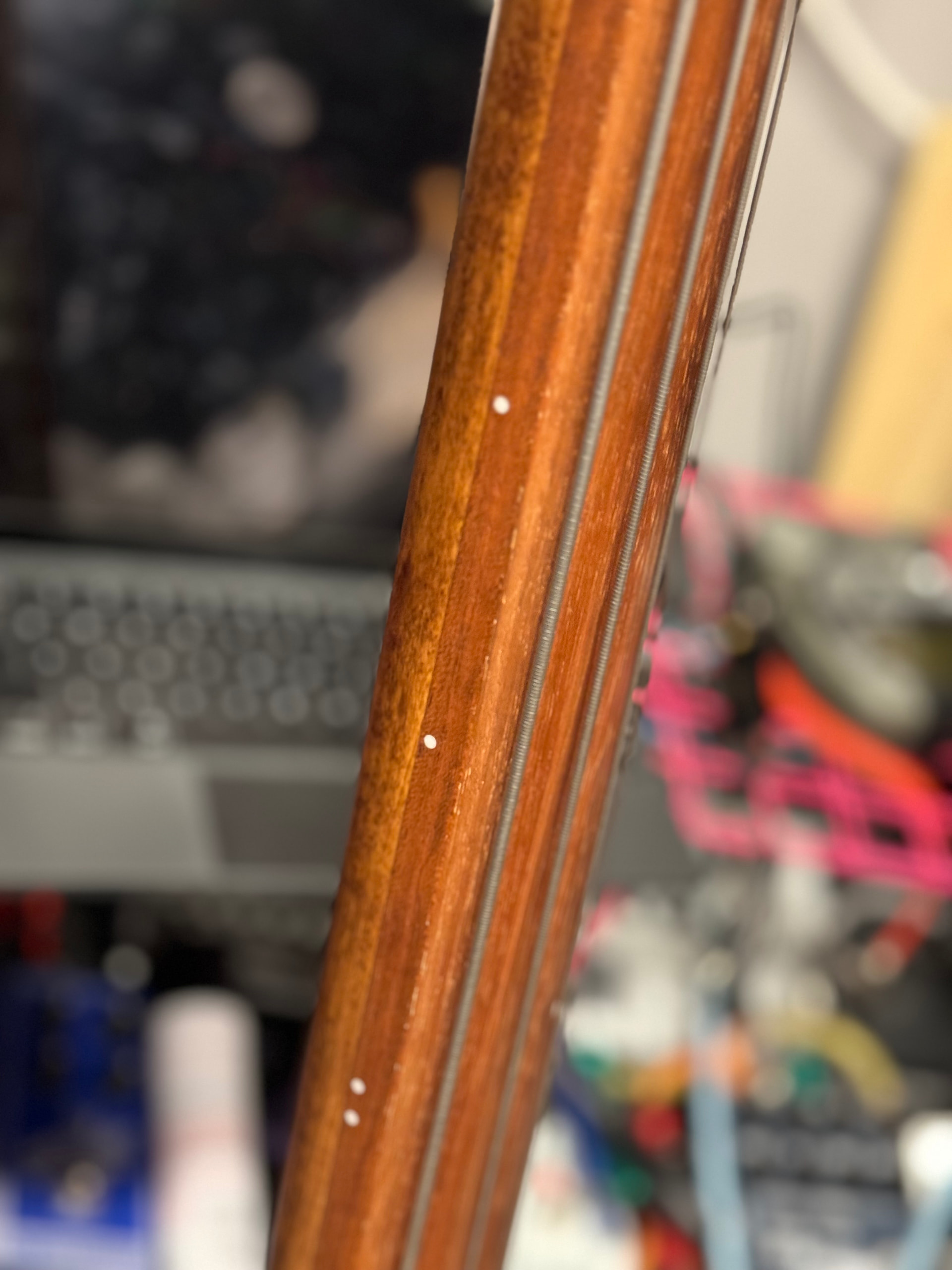
I had a revelation about compound radii somewhat recently. Not sure why I didn’t realize this before, sharing here so y’all don’t have to live with the same shame 
Take the typical non-compound radius fingerboard - 7.5", 9.5", 20", whatever. It’s a constant radius. And the strings form kind of a cylinder shape over them right?
Wrong!
The strings are closer together at the nut, and further apart at the bridge. They form a conical section, not a cylindrical one! (This was the aha moment - though I read about it, not something I thought of on my own)
And that’s exactly what a compound radius fretboard is - it’s basically shaped conically to match the shape of the strings perfectly. Not sure why this concept eluded me for so long, but there you have it.
5 Likes