I’ve been discouraged lately about my fretting hand. I don’t feel it’s coming along. I WANT to do some fretting hand drills, but I run out of time due to going through the course. I KNOW this is 100% natural, and I’m remembering the itty-bitty fretboard on my six-string guitar, but it still bothers me. I find myself trying to reach for frets instead of micro-shifting appropriately, and therefore, I don’t get a clean sound. Again, part of the process. So, today I have just been slowly running the Major scale and the 1-3-5 shape, focusing on micro-shifting and clean fretting. I know one day won’t make me a maestro, but I wanted to work on it. If I can, I’ll do a little bit on the course later, but for now, it’s scales and a shape.
1 Like

Practice Journal Entry – “Two Shapes and Three Roots”
In the course, we’ve been using a one-octave major scale shape that starts on either the E or A string. I wanted to see what would happen if I extended each version, including the E string below the A-string shape and the G string above the E-string shape, basically running the complete scale and ending back on the starting root.
My first thought was, “If I can shift one down a string, I should be able to reuse the same pattern for both.”
Well, not exactly. Once I laid out all the C major notes and drew two boxes, it became clear: the one-octave shapes are identical, but once you extend beyond that, they become two distinct shapes because of how the bass is tuned in fourths.
Then came the real breakthrough.
Looking at the full fretboard and thinking about Josh’s 1-3-5 pattern, I noticed there are three good spots to use that same shape:
- C on the 3rd fret,
- C on the 8th fret, and
- C on the 10th fret.
After doing a little research, I found that it’s actually common to move between these areas in a single song, not just for range, but for dynamics, tone, and expression. That made complete sense.
So here’s my new plan for practice:
- Run my basic scale in the lowest position.
- Shift to the next C root and play the same shape there.
- Move to the third position and repeat.
- Return to the start.
I’ll start slow and mechanical, then add a metronome, and finally bring in a drum track. This should help me strengthen my root awareness, build comfort shifting positions, and start thinking more horizontally across the neck.
I’m sure this is elementary for some players, but for me, this connected a few big ideas. It felt like I finally saw how the shapes, roots, and positions all work together.
For those of you who’ve been through this before, do you approach the same idea this way, or is there a smarter way to connect these shapes across positions? I’m trying to make sure I’m not missing something subtle here.
Yay! I’m officially halfway through the course! Earlier on, I thought I was halfway, but this time it’s for real. The lessons have been getting progressively more challenging, and that’s exciting. I’ve been taking my time — whenever a new topic comes up, I pause to dig deeper until I feel I’ve got a reasonable understanding of it. I know true mastery will take years, but I enjoy exploring a little further each time.
I’ve added “Pride and Joy” and “Green Onions” to my daily practice and have been resisting the urge to add every song from the lessons. As tempting as it is, I know progress would stall if I did that.
Most importantly, I’m trying to stay a thinking player, focusing on both my technique and the “why” behind what I’m playing.

2 Likes
EDIT: @howard noticed I have a wayward Ab in my graphic. Mistake! Please ignore that. I appreciate @howard finding it and taking the time to let me know.
A little graphic I made for myself. I’ll paste the text in the graphic. Please critique to correct any mistakes or to clarify. I’m still learning and connecting dots, and these graphics I include in my practice plan really help me.
A Minor (Aeolian Mode the 6th of C Major) The Major scale’s mode is Ionian. The relative minor of a Major scale is in the 6th degree (interval). In a C Major scale, the sixth degree is A, which forms a minor chord (Am). Both scales share the same notes: C D E F G A B.
If a guitarist is playing Am, we may choose to follow suit. If so, we can switch to the Am (Aeolian) scale. In the example here, on the left is the C Major scale. On the right is the A minor scale. Note: The A in the C major scale (6th degree) becomes the new root when we shift into A minor (Aeolian). Both scales use the same notes, only the tonal center changes. When I’m playing C major, reaching that A marks the natural doorway into its relative minor.
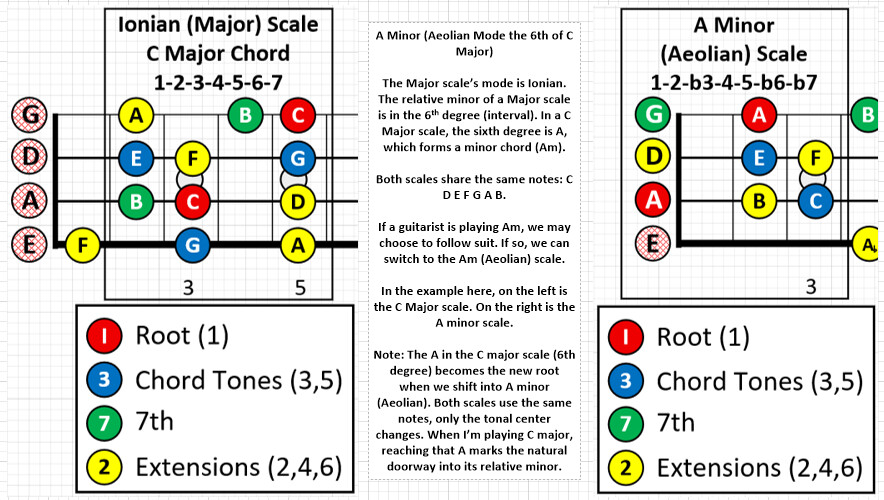
Why do you have an Ab in your Am scale? It’s not in Am.
1 Like
Good catch! I made this in Visio and left it in there by mistake. I will edit my original post and point that out. Thanks for letting me know!
1 Like
I finished Module 9 today. Lots in that module. I haven’t slowed down working on my bass, but I have slowed down on going through the modules. Each time I get a new topic, I dive into it a bit. I have a technical practice I do in the morning, and then work on some of the course in the evening. I have been going out of town quite a bit lately, so I can’t pick up my bass every evening. I would love to take my bass with me, but leaving it in the vehicle with the changing temperatures isn’t something I’m going to do.
I think I must be the last person in the world to hear “Feel Good Inc.” by Gorillaz. I pulled up the video when the lesson was done, and I enjoyed that. Over 1 billion views!
One of the things that I am doing away from my bass is learning the notes on the neck. I’m using a very nice quiz app located here: Fretboard Note Identification . I know that learning the notes in an app and putting it to use on the bass is different, but I’m trying to make use of some time. Below is a sketch of how I’m doing it. I may write a small article and make it a stand-alone post for anyone who may want to do the same.
In the app, I made it so that only the natural notes are quizzed. Then, I focused on the open strings and the dot frets, being 3, 5, and 7. FIRST, just the open and fret 3. As I could not get them wrong, I added fret 5, then 7. As that progressed, one at a time, I added in the other frets.
Here and there, I was able to pick up the bass and do the quiz with it in my hands. I’d start the quiz, and when it would light up a note, I would play it on the bass and name it.
Knowing the fretboard has levels to it, in my mind. If you can name the notes in an app, it doesn’t matter if you can’t translate that to the instrument itself. Because of that, I thought about levels of mastery.
| Level | Name / Focus | Core Skill Developed |
|---|---|---|
| Lvl 1 – Recognition (App) | Identify notes quickly in the trainer | Visual & cognitive recall of note positions |
| Lvl 2 – Physical Integration | Use the trainer while playing and naming notes on the bass | Connect the mental map to the physical geography |
| Lvl 3 – “Find All The ___” | Locate all instances of a chosen note across strings | Build spatial awareness and octave recognition |
| Lvl 4 – Applied Scales | Name notes as you play scales and exercises | Merge theory with technique and interval awareness |
| Lvl 5 – Musical Fluency | Name or recognize notes in real songs | Achieve automatic recall in a musical context |
Thoughts on all of this?
Done! I completed the basic course today.

2 Likes
Amp picked out to give to my wife to give back to me at Christmas. A picked up a Fender Rumble 100.
1 Like