Advice on pedals

Howdy.

I’m building a toy/goal list and need advice on things I should be looking for. I started off by asking google and I’m looking for feedback on its output. i.e. is it decent/good advice? is it bogus and I should focus on other types of pedals? etc.

The prompt: “guitar and bass pedals needed for the following sounds: Parliament Funkadelic, Hendrix, Soul, Ohio Players, Erykah Badu, D’angelo, Living Colour, Meshell Ndegeocello”. For bass AI suggested:

Essential Bass Pedals (Meshell Ndegeocello, D’Angelo, P-Funk) [1]

  • Envelope Filter: A crucial effect for funk bass, such as the MXR M82 Bass Envelope Filter or 3Leaf Audio Proton.

  • Octave: For that deep, synth-like bass sound often heard in Neo-Soul (D’Angelo) and by Meshell Ndegeocello, the 3Leaf Audio Octabvre or TC Electronic Sub ‘N’ Up is recommended.

  • Fuzz/Overdrive: To get the dirty, “synthy” funk sound, the Malekko Heavy Industry B:assmaster is a favorite for heavy bass tones.

  • Preamp/DI: An Aguilar Tone Hammer Preamp/Direct Box is excellent for shaping the “old school” or “modern” Neo-Soul tone, often used by Meshell Ndegeocello.

  • Compressor: An Origin Effects Cali76 is recommended for studio-quality control over dynamics in Neo-Soul tracks

1 Like

well, ai is never wrong it appears :grin:

but sure, that would cover everything on the list. maybe a synth pedal at some point, but not needed and also usually not cheap either. the source audio C4 also doubles as a pretty good envelope filter. and the MXR synth pedal has a fairly large learning curve (not the controls but actually getting your hands precise enough so that it sounds good, but man it sounds good). depending on what you want to spend you could also get 95% of all this with a good multi-fx pedal. and by good i don’t mean expensive, btw, there are some really nice reasonably priced ones out there. edit: i mean if it was me, i would start with something like a gp-5 from valeton which is one of the all time values in pedals. and if you decide later to go in a different direction easy to unload it.

4 Likes

Misses the obvious, first pedal in any chain needs to be a tuner, that also can act as a mute switch!

(I hate the look of headstock clip-on tuners :wink:)

5 Likes

@damion I’d start with an inexpensive multi effects unit that’s bass specific.

Then you can try different effects and find out what you like. I like Chorus, you might hate it.

Buy something with a built in drum machine and it’s practically free at that point.

5 Likes

The first pedal I bought is a BOSS TU-3. So AI missed it but I didn’t :slight_smile:

Tho my headstock tuner is still there, floating on headstocks.

2 Likes

I’m with @Barney on this. Go through your list and build a shopping list on like, sweetwater or thomann. Compare the total of those pedals, then go look at what a decent multi effect box costs. I’d be willing to bet that something nicer than that Ampero, even an Anagram is going to cost less. It’s also going to give you access to a lot more than just the stomp boxes that you’re looking at here.

2 Likes

The list also forgets to add a power supply, they range from $15 foa simple 9 volt adapter up to whatever you want to spend for clean power bricks with multiple output settings.

You’re also missing a board and case.

I went with individual pedals vs muli-effects. I did it because tech is hard for me.

If you decide to go the traditional pedalboard route, here is what I’ve learned.

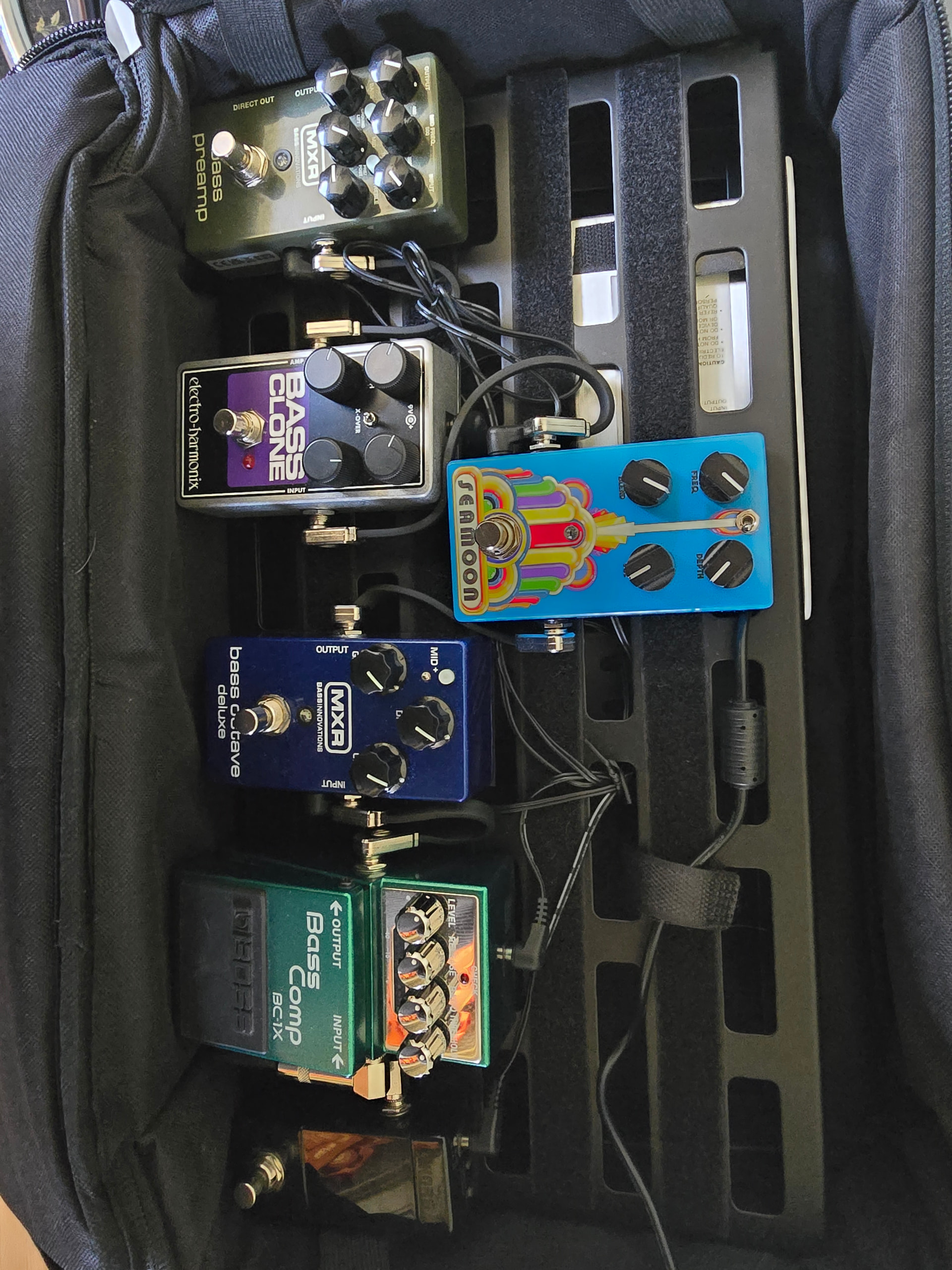
  • start by buying the right sized board 1st. If you think it’s big enough, get the next size up. I own a warwick rockboard. I do recommend it. It’s modular and you can add all sorts of features to it from power supplies to power amps and much more that you can add down the road as your needs progress. This in my opinion should be a buy once cry once proposition. If not you’ll end up buying 2-3 before you settle into the right 1.

  • Tuner pedal should be your 1st pedal. Lots of good options out there. $100 will get you a good one. I bought a korg pitch black mini. It’s accurate and it mutes. That’s all you really need. Since buying it, my needs changed and this pedal in particular does not have an always on passive mode. So ill be buying one with this feature soon.

  • Power supply. A simple 9volt adapter with the added pigtails will work short term. It’s not optimal because after you connect a couple of additional pedals, you will develop unwanted electrical noise into your signal. I went with a mxr power brick, and it serves its purpose. I’d buy again.

  • Compressor pedal would be my 1st effect. This will be the hardest to justifybut long term the one of the most essential. Its an alway on pedal. Cali76 is the standard by which all others are judged. At $400 plus, its a hard sell for hobbiest. I went with boss bass comp bc-1x for half the price.

  • Preamp pedal. Would be my next purchase and where you start to express your style and start to develop your “tone”. I went with mxr m81 bass preamp. I chose it because it was clean. It doesn’t overdrive the signal like others. I play in a country band, so it fills my needs. If your into other stuff where overdrive is needed, this one might not be for you. Make sure you connect with both 1/4” jack and xlr. It’s nice to not have to tote an amp to every rehearsal. This is also an always on pedal.

  • Now is the time to add the rest. On my board I have a chorus, octave, and a funk machine, which is kind of like an envelope filter but more. I have overdrive on my amp if I need it.

3 Likes

While it’s not my first pedal, I love my Cory Wong Wampler. Compressor it’s one and done last minute gig saver. It doubles as a DI as well. For clean preamps then the Providence Dual bass station is superb. 2 basses setup and ready to go the way you want at a click of the pedal.

2 Likes

Thanks all for the feedback so far.

I took @faydout ‘s advice and did a price comparison. For 5 of the recommended bass pedals, it’s about $1250. Assuming these pedals would only perform well on bass, I’d also be looking for some pedals on guitar as well. Plus a pedalboard and all the necessary bits to connect it all up and power it.

A line 6 Helix LT is $900 and should be able to cover both bass and guitar ( if I read things correctly).

For me the upsides of going with a helix lt (or similar) is one and done, tons of things to play with, and overall cheaper.

the downside is a single point of failure

the upside of individual pedals is I can use each new pedal as a milestone/goal. Learn a new song, get a new pedal type of thing. Doing it piece by piece gives me a chance to focus on that individual pedal to really learn it.

downside is different type of discipline in waiting, avoiding the impulse buy. And avoiding an endless pedal acquisition cycle to do yet another thing.

2 Likes

The Helix LT is what I use for bass and guitar. It does a very good job with bass, it’s spectacular with guitar. It’s got multiple versions of all of the effects that you listed at the top plus oodles more and would give you the discount on Helix native, which gives you access to all of those effects in your DAW.

2 Likes

Yeah the Helix line is the best you can buy until you get up to about $1500 and the Quad Cortex. Second would be Boss. Zoom is the best overall bargain but behind the other two in quality of effects.

2 Likes

I think the Darkglass Anagram deserves mention in this category at around $1300, and it is specifically designed for bass guitar, unlike the Helix or Quad. It has had a number of additions through software updates to what pedals are on it, since launch, and they’re building a marketplace for other developers to design and add additional effects.

To the original poster - I’ve had Zoom and NUX products in the low-price range, they were quite good for the price point. If you’re just starting with pedals, those are solid options. If you just want to dive in and spend some $$$, well, there’s a lot of great options. The only so-called “multi-pedal” I’d avoid is the Line 6 One - it has a ton of great pedals emulated, but can only run 1 at a time.

I think I did mention the Anagram further up, and I think they’re intriguing. I’ve considered it just for bass but I’d pay the extra hundred for a Quad Cortex mini way before the Anagram. It isn’t limited to bass for starters, which matters at that price point when you play more than just bass. An extra footswitch, has alot more options for effects, more available blocks for building a signal path, a more mature environment. The Nam integration is cool, but isn’t there a catch with it on the Anagram?

1 Like

I will preface what I’m going to say by acknowledging that ‘it’s your money’. However, here’s my journey…

When I started my bass journey, I initially bought a Zoom B1four. It was cheap and gives access to a fair number of effects. This meant that I could play around to get a sense of what worked for me, and what didn’t. From there, I started going down a separates route and bought a tuner, a compressor, a chorus, a phaser… I stated to look at some kind of fuzz / overdrive and then met someone who had a £1,500 Quad Cortex … wow, but equally, wow, £1,500!!!

Anyway, I started searching for a more reasonably priced multi-effects unit and happened on the Ampero One. For the money, about a 10th of the Quad Cortex, it was bl00dy amazing. I sold the separates and used the Ampero for probably 2 years.

I have now migrated to a BOSS ME-90B. Another reasonably priced multi-effects unit. Where it is different to the Ampero (Quad Cortex, Anagram, Line 6 units etc) is that it has physical knobs that enable you to tweak your sound. You can then save as user presets. At the time of purchase, I was also looking at the Anagram, but decided to a) save a chunk of money and b) focus on what I actually need in the band context, which is compression, overdrive, octave, phaser/wah and some chorus. I also wanted amp and cab sims for DI. The Boss unit does this all, and does it well. The other advantage of the unit is that it is simple, robust and absolutely gig-ready, and given the price-point, if someone spilt beer all over it, I’m not going to have to remortgage the house to replace it.

My overall reflection is that it’s very easy to get pulled into the buying boutique pedals space (a Cali76 compressor is +/- the same price as the ME-90B), or the £900 - £1,500 multi-effects space. The key question to ask is what do you actually need. For my use case, playing bass in an aspiring pub band, the ME-90B is perfect.

1 Like

Yep - and you could absolutely gig with a Zoom B6.

2 Likes

Yep. I’ve also seen videos on YouTube of people gigging with a Zoom B1four!

The reality is that, for the money, some of this kit is amazing! I still have my B1four, it’s my travel solution - its next trip overseas will be at the end of the month :smiling_face_with_sunglasses:

2 Likes

The B1four has to be one of the best values in music.

3 Likes

An alternative if you have a DI is to use software like Amplitube (it’s free for the basic version) which gives you access to a bunch of simulated pedals so you can see what you like.

^^^ This is my approach, I am entirely in the DAW for effects and EQ.

1 Like

Any effects you can recommend? I’m trying to expand my palette.