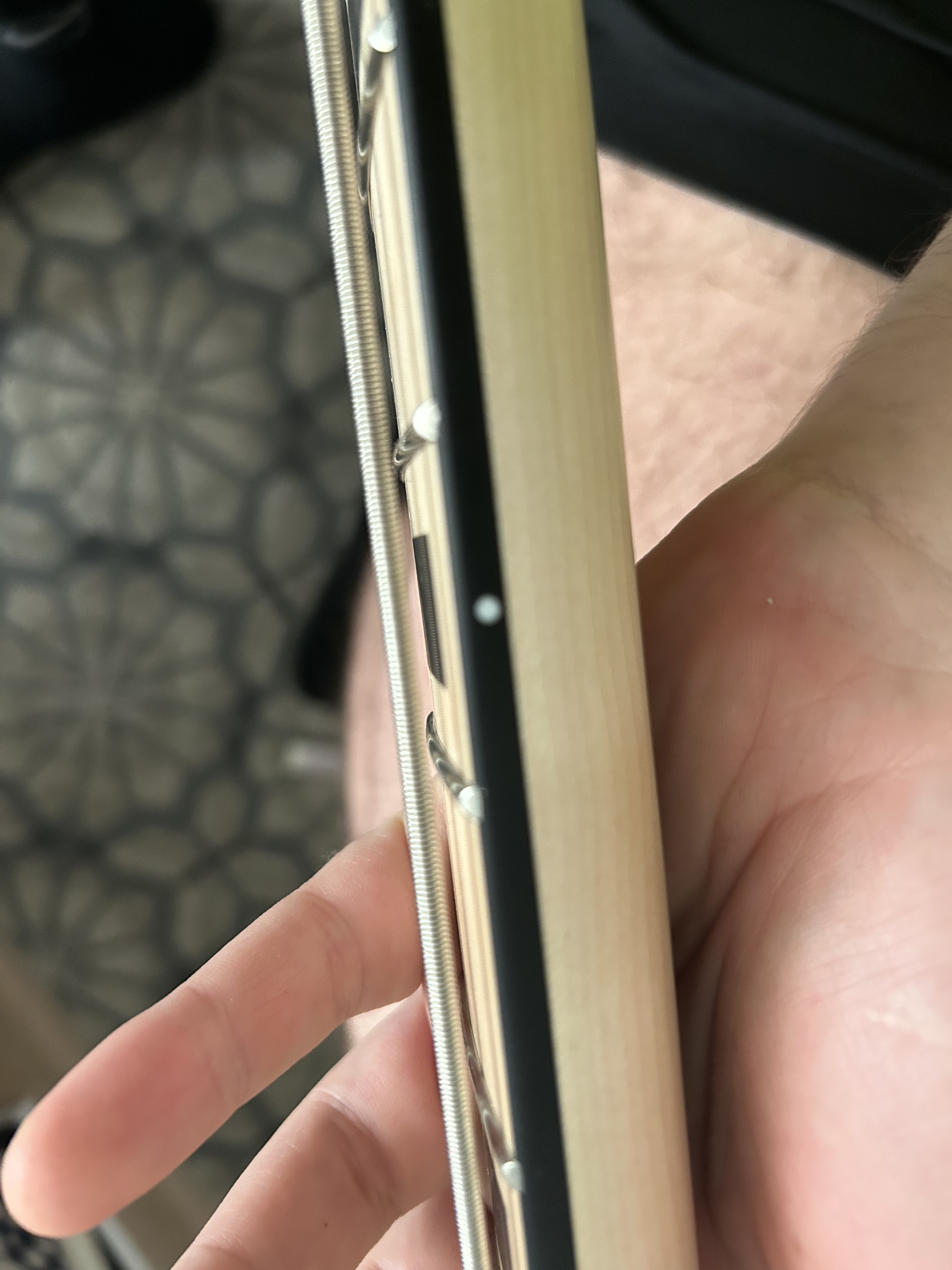
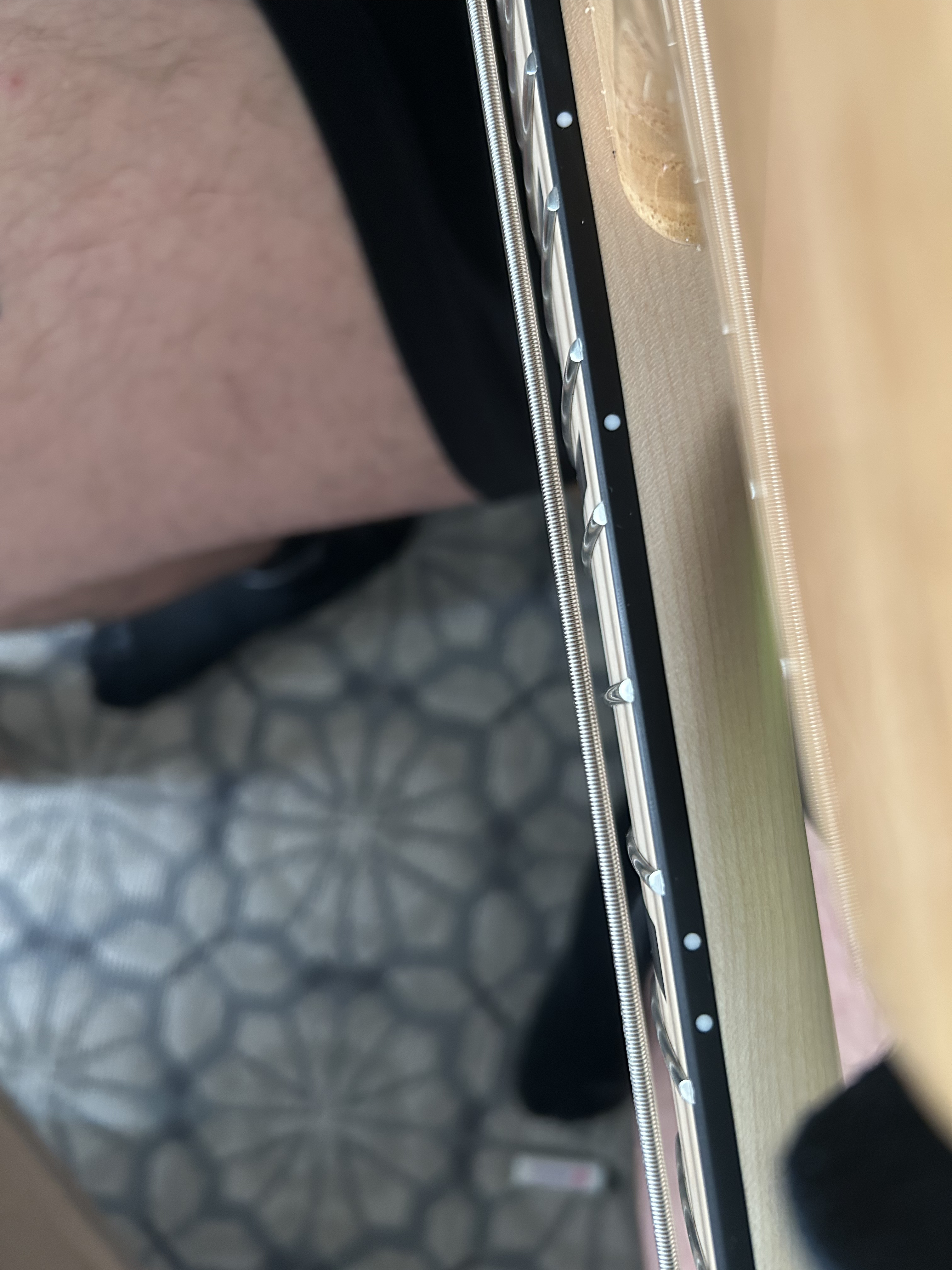
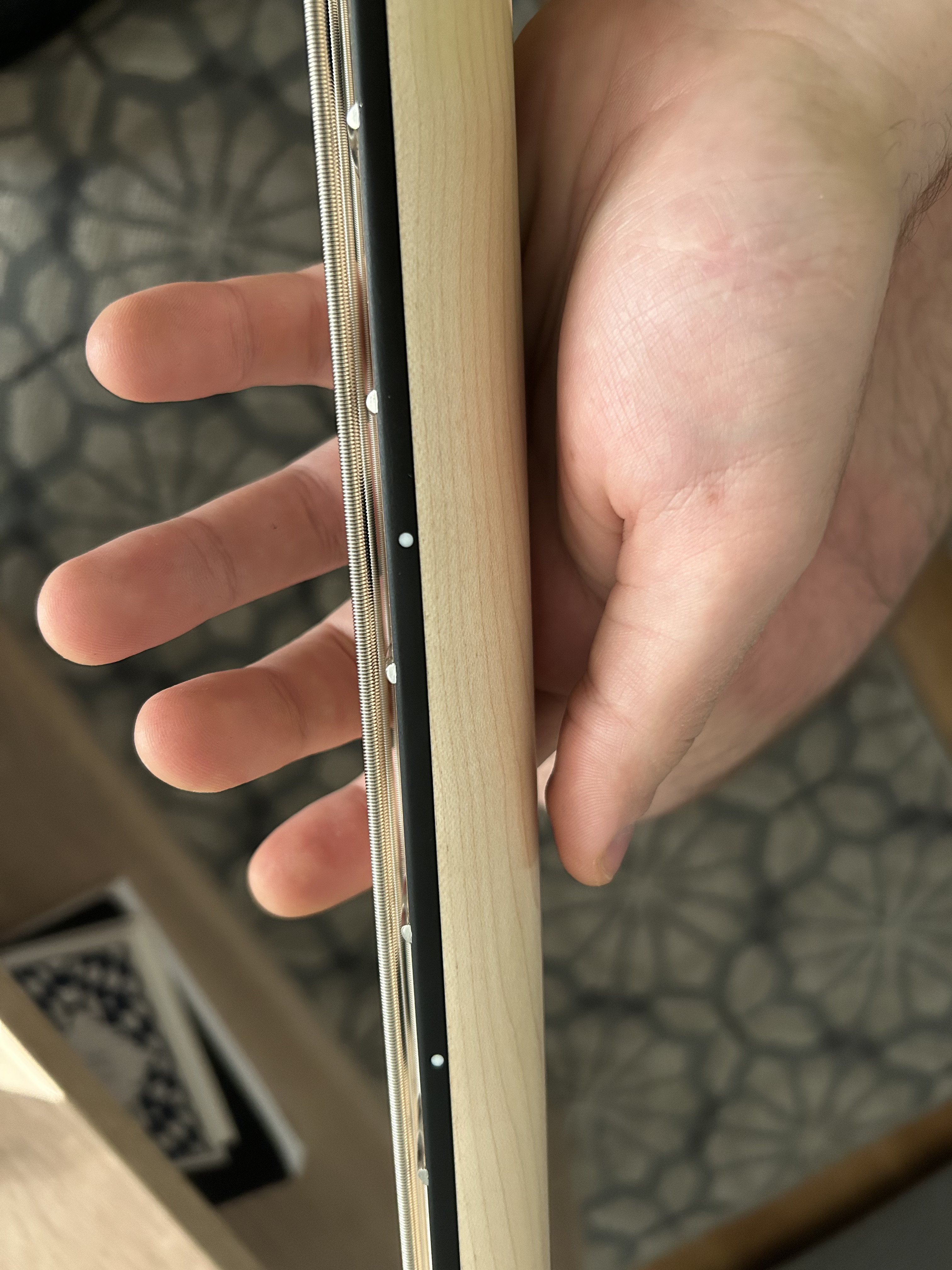
Josh noted in his first lectures that frets can’t be too high. When I remove my finger to early there is this ugly buzz. Reddit told me that it has to do a lot with technique and I should mute before I raise my finger, but I wanted to ask if my strings are too high based on your opinion. Here is a pic:
Not sure I fully understand what was/is said here…
String height (or “action”) often comes down to personal preference. Which, in turn, might be dictated by your playing style and the type of music you want to play.
If you tend to pluck lightly and want to be able to play fast lines and with little (physical) effort, then a low action might be preferable for you. If, on the other hand, you tend to “dig in” (think: Cliff Burton or Geddy Lee), then a slightly higher action is probably better.
Slapping and playing with a pick will also influence the “perfect” action for your playing style.
However, be aware that the type of strings also plays in - especially the string gauge(s).
Many players will use the following rationale to find their preferred action: as low as possible without getting any buzzing when playing as they usually play
That all said: when and how to press down and release a fretting finger is indeed a technique issue and can account for a lot of buzzing. This will get better with consistent practicing
TL;DR: It’s probably your fretting technique. Don’t worry too much. Just keep practicing and being aware of what you are doing. This will probably work out in time.
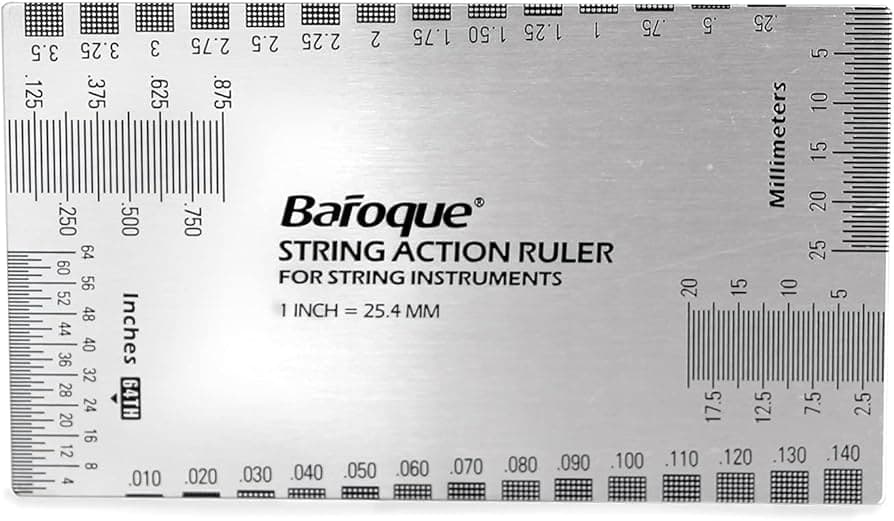
As noted, string height is really a preference. Your best bet is to get a String Action Gauge to accurately measure and set height. I find a dark card with white markings is easier to read. It’s hard to tell how high your action actually is with these pictures, but it doesn’t look obviously bad.
Lots of things could be causing this buzzing.
If it’s a setup issue, it’s more likely neck bow rather than action height.
Most likely culprit is something in your technique. Again, it could be a lot of things. No real way of knowing based on your short description. I’m assuming you’re very new to bass.
My gut reaction of the most likely culprit is: you could be fretting notes very low on the neck and compensating by fretting too hard. Then getting fret buzz when you start to relieve pressure. Best fix for that is to try to place your fingers as close to the fret as practical and use less force.
Ultimately, don’t worry too much. Keep playing. Have fun. This will probably work itself out in time as long as you keep playing and being aware of what you’re doing when you have this problem and when you don’t.
Just grab a string set up gauge, they’re cheap and it’s very straightforward to measure both your neck relief and action height yourself. I agree it’s probably your technique, however you can set your mind at ease with a $10 tool.
It could be so many things!
Best approach would be to set up the bass according to some nice specs and then you can eliminate string height / the bass side of the equation.
This video is pretty slick for learning how to do your own setups!
Such a tough question. Without actually seeing and evaluating your bass and you playing it we’re all just guessing here but my guess based on you being a beginner is that it mostly technique and that can only be cured with first assuring your technique is correct and playing more until it’s no longer a problem.
As you might guess from the responses and the video above action is pretty much a personal preference and it may even depend on the specific bass you play. But the action should still be within certain tolerances. As a beginner you may feel more comfortable with lower action that requires less effort on the part of your fretting hand but if it’s too low you may also experience more fret buzz. There’s a trade off.
If you’re unsure of how to do a full correct setup on your bass yourself it’s not a bad idea to take it to a tech and get the bass professionally set up for you and your specific needs. Once the truss rod is properly adjusted it only takes a few minutes to adjust the saddle heights and therefore the string heights. Have that adjusted and play it. If it feels too low raise it a bit. Too high? Lower it a bit. And again, there may be some trade offs between comfort and the fret buzz you’re experiencing.
You are the best judge of where it feels best to you. I would suggest you get it adjusted for that and if you’re still dealing with buzz then keep working on your technique. Eventually you’ll get better at fretting and it will disappear.
I just started bass myself but will say a full set up is a straight forward process with a few tools easily purchased from Amazon or your local shop. There are a ton a YT videos to walk you through the process. If you’re handy around the home and or vehicles it’ll be pretty simple. Plus you’ll gain the satisfaction and knowledge of being self sufficient.
You’re welcome. We are where we are in our own journeys due to those who’ve helped us to better understand our instruments, what constitutes a proper setup, and how to become better players.
Little things mean a lot and there’s a world of difference between an instrument that’s been properly setup for you or any one of us and one that’s not. It’s especially important for anyone just learning to play.
We understand just how much of a challenge that can be and how important it is to eliminate as many blocks to progress as possible. The bass itself should never be the reason for any struggles we may have.