Hi! Learning bass for a little over a month now. Really enjoying the course!
I’m trying to transcribe and practice a song I like, but I got confused when I tried to apply the chord progression analysis as a practice. The song is in E major. And in this particular period the bass plays E - F# - E - E - F# - B - E - E. I want to learn which exact chords these are so searched online for the guitar tabs. Most of them note the 2nd and 5th bar as Asus2/F#. Specifically the guitar plays F#, E, A, and B.
I looked into the slash chords notation, but still have questions about how a specific notation is picked, and what the slash chords mean for the entire music as well as for the bass player.
How does one pick Asus2/F#? IIUC the same notes can also be Esus4/F#, or F#m11 (or F#m7add11).
I learned that for inversion chords the root stays the same. For example E/G# is still an E chord. But if one writes Asus2/F#, the bass note F# is not a chord note in Asus2. Is this still an A chord?
Related to the above question, does the bass note change the function of the chord in progression analysis? Is this progression I - IV - I - I - IV - V - I - I, or should I take the F# and make it I - ii - I - I - ii - V - I - I?
In inversion or slash chords, does the bassline always anchor the bass note instead of the root?
In an inversion of a chord the lowest note isn’t the root of the non-inverted chord. So for example, a Cmaj (C) would be C-E-G, but a C/G is G-C-E. Typically, the bass would play the lowest note, so G in a C/G. But that is a very limited view of the role of the bass. If you take the view that the bass helps outline the chord, you could play C, E, or G, and frequently more than note per chord change, and would depend upon what other instruments were playing and also the melody.
A chord’s inversions also have a different feeling as well so while they are the “same” chord in that they contain the same notes, they really aren’t. @MSchneider is correct, the root note in C/G (the second inversion of C) is still C; however it’s no longer the lowest note in the chord, as the second inversion moves the fifth below the root.
Similarly, the first inversion of C is E-C-G. The root note is still C but the lowest note is now E.
Yes, these all make sense. But back to my original question, if the lowest note is also the same. For the notes F#-E-A-B, how does one determine if it’s Asus2/F# or F#m7add11 or Esus4/F#?
By the key the song is in and the likely progression
Also, usually (but not always) the simplest choice will be right most of the time.
Oh and also forgot to mention, simplest in this case can also mean in terms of guitar chords if you are looking at a song with guitars. Some guitar chords are just much easier than others and/or make more sense in the context of the song.
If it is piano chords it will be entirely based on theory and desired feeling.
I guess that also means in terms of chord progression and Nashville Number System, the lowest note determines the chord’s function? So in a C major key, C/G functions more like a V instead of I?
(just realized that I don’t know if the simple Nashville numbers only apply to simple triad chords, so not sure if the I-ii-I-I-ii-V-I-I stuff in my OP is correct in that context)
Actually the root note determines the function, with the various inversions providing a somewhat different feel. At least that’s how I have always thought of it.
An important concept for inversions is that the lowest note is no longer the root.
Ah okay I think this is coming together now (kind of?). So for my original question of F#-E-A-B:
Different chord notations come from picking different roots, and different roots change how the progression looks. So I should determine whether it’s Asus2/F# or F#m7add11 by looking at the context and whether I-IV-I-I-IV-V-I-I or I-ii-I-I-ii-V-I-I makes more sense.
I found the Asus2/F# from a guitar tab (that part of the song has only guitar and vocal) so maybe it’s just that Asus2/F# is easier or more common for guitars? (I don’t know how to play guitars)
(too much theory for today. Take away: can’t go wrong with the lowest bass note as a bass player going into a slash chord? )
Okay, spent some more time digging into this and listened to the separated stems.
The guitar voicing actually only plays F#, A, and B. The singer (lead melody) sings B, G#, and E. I guess it makes more sense to be IV-I and IV-V-I. So Amaj7sus2/F#? That almost covers the entire scale.
I would play the root instead, not the lowest note.
For the first inversion, the lowest note is the third. For the second inversion, the lowest note is the fifth. Those will usually work, but the root is guaranteed to work (and is the middle note in both cases.)
I like Asus2/F#, it reminds me of the background music in a computer game I played (Diablo II or one?).
If you play F# over Asus2, you can fret the notes very easily on a standard tuning guitar. You could also mute the low A-string with the index finger on the low F#, which might sound a bit darker.
Well, a slash chord requires that the bass play the note specified after the slash. Let the guitar or keyboard player worry about how they want to voice the chord mentioned before the slash.
There are so-called rootless chord voicings, which - as the name implies - don’t include the root - here, very often, the bass needs to play the root.
Naming chords is often not clear-cut, and there are different options (as you point out); typically, it’s a good idea to opt for the simplest description.
However, if a composer wrote a slash chord, we (as bass players) shouldn’t start to interpret this in different ways. Instead, we need to stick to the note written after the slash. Slash chords are not an accident (or wrongly named chords) - the composer often wants to emphasize a certain line in the bass underneath the chords (i.e., chromatic) or perhaps rather a pedaling note in the bass (underneath changing chords), like perhaps Cmin/F - G7/F - Bbmaj7/F
(Disclaimer: I did not read every comment in this thread)
(before the slash - that’s the root. After the slash is the fifth or the third, depending on the inversion).
Actually playing either is fine - the root if you want to anchor the chord, the inverted note if you want to emphasize the difference. As bass I would usually choose the root and be the bedrock, it will make the lead instruments sound good with the inversion.
Yes, slash chords can represent chord inversions; and very often that’s what they do - but they can be much more!
In my own example, the note behind the slash is the fourth, the minor seventh and the fifth, respectively.
My point was, that the composer or arranger had a specific intent when writing a slash chord, and we, as bass players, shouldn’t really second-guess this intent, but rather support the harmonic idea by playing the note behind the slash (and only that one).
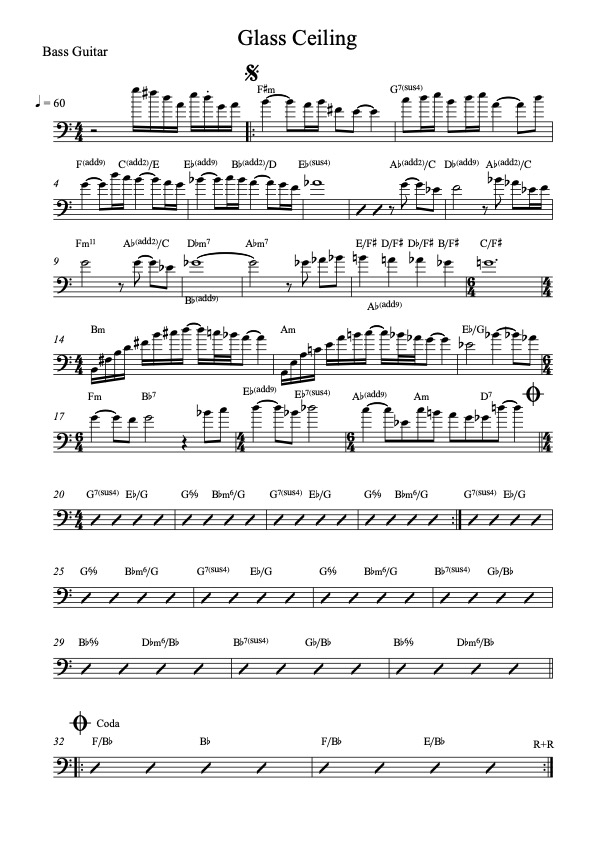
Here is a score, where many of the slash chords are indeed chord inversions; but not all of them. Especially interesting in this context is bar 12-13, where the melody moves downward, where the chords move downward, but where the composer wants the bass to keep pedaling on F#.


 )
) That almost covers the entire scale.