Hi all. Disclosure up front: I’m part of the small team behind Fretline, so this is our own project and I’m not neutral about it.
We built a free bass scale reference and I’d like honest feedback from people who actually practise scales on a bass, because I work on the site side and I’m not a bass player myself.
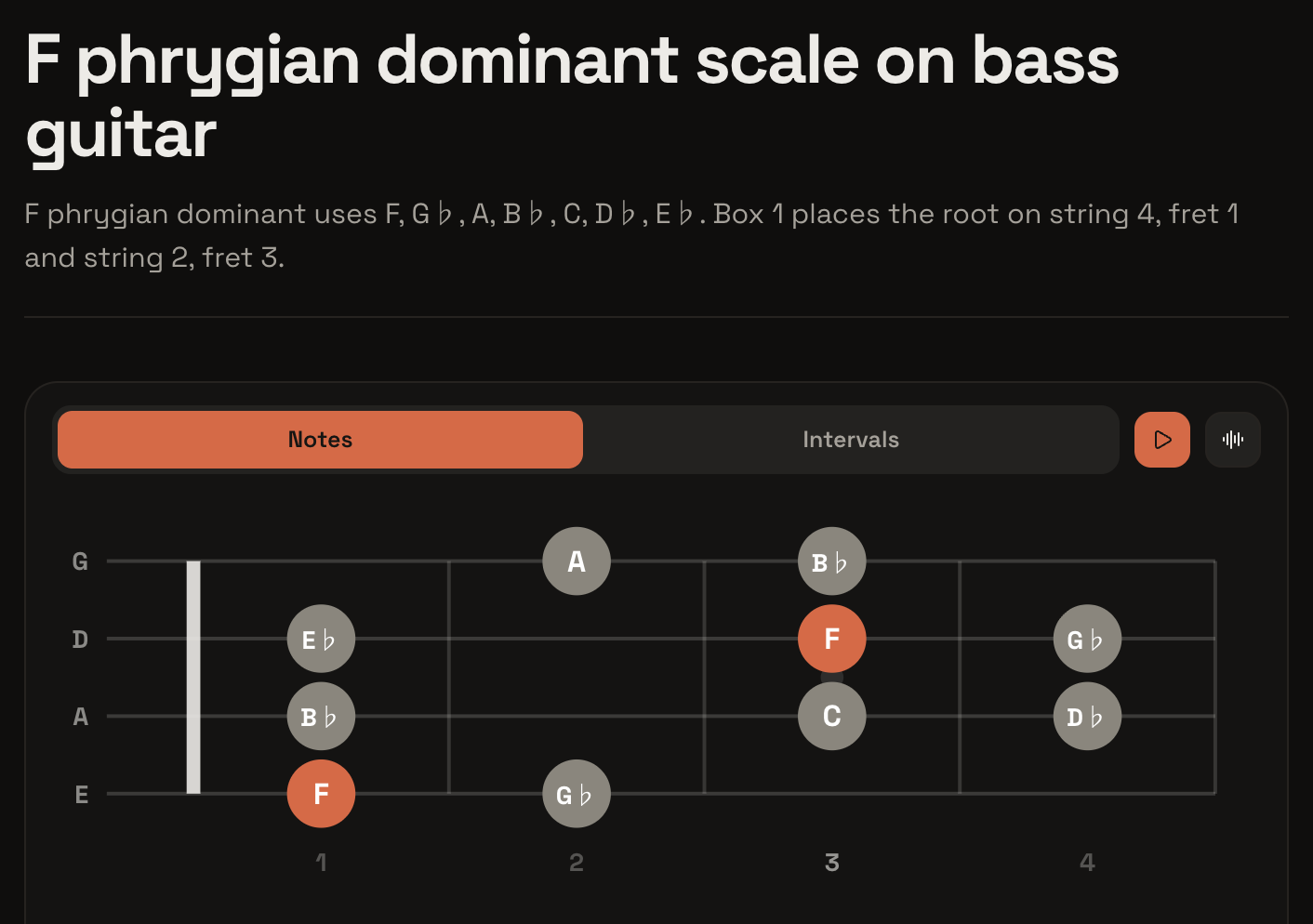
What’s there: 432 pages, every root, from the usual major / minor / pentatonic to less common ones like phrygian dominant, Hungarian major and neapolitan minor. Each page has the notes, the interval formula written as real degrees (1, ♭2, 3, 4, 5, ♭6, ♭7 and so on, with flats spelled as flats), 4 box positions on a 4-string neck with the root marked in each box, a fret-by-fret table per string, and you can hear it in the browser. No account needed.
Are 4-fret boxes how you actually learn a scale on bass, or would one-octave shapes starting from the root be more useful? I read the “Extending scale shapes” and “Scale guide app” threads here and they made me doubt our layout.
Is anything on the page confusing, or just plain wrong? We fix things quickly. A wrong ukulele voicing got reported last week and was fixed in two days.
Quite a useful tool man. I’'m now about to start practicing major scales.
But seems that i did not understood, how did you built the pattern. For me major scale has three-string pattern with fingerings “2-3, 1-2-4, 1-3-4” Like
@Alex_Hevari thanks, that’s a really useful question, because it shows where the page isn’t clear.
The boxes on Fretline aren’t fingerings. Each box is a fret window (box 2 = frets 3-5, box 3 = frets 5-8 and so on), and it shows every note of the scale that falls inside that window on all four strings. So it’s more of a map of where the notes are than a “play these fingers in this order” pattern.
The three-string shape you’re using starts on the root and goes root to octave, which is a different way of slicing the same notes. If you take C major and start your shape on C at the 8th fret of the E string, it runs from fret 7 to fret 10, so it overlaps two of our boxes (box 3 is frets 5-8, box 4 is frets 8-10) instead of matching one. That’s exactly why the page looks unfamiliar next to the shape you learned.
I’m not a bass player, so I won’t try to tell you which is the better way to practise: the fingering from the course is the one to follow. On our side the feedback is clear though: a root-to-octave shape with finger numbers is missing, and the boxes need a line explaining what they are. I’m passing that to the team today.
Thanks for providing this; looks very useful indeed.
I haven’t tested it in much detail yet, but three comments so far:
I think the 4-fret boxes are fine, but perhaps you could also offer different options for each scale (e.g., three notes per string etc.)
the scales to choose from at the top are a bit confusing; I think you might want to put them together into their respective families (as much as possible): e.g., dorian, mixolydian etc. belong to the major family; lydian augmented and the altered scale belong to the melodic minor family (but more important members of that family, such as lydian dominant, are missing); phrygian dominant belongs to the harmonic minor family; and so on
the intervals seem not to be working… I only see “9” for everything but the root
Thanks for your explanation - got it! Even more I can say - very usefull thing for me, because I’m using a Simandl technique for plucking hand and Franz Simandl himself divided the upright bass fretboard onto positions with three notes per string each. Transfering this scheme to elrctric bass would be like that
Half position = frets 1-3
Position I = frets 2-4
Position II = frets 3-5
Position III = frets 4-6
Position IV = frets 5-7
Position V = frets 6-8
Position VI = frets 7-9
Position VII = frets 8-10
Position VIII = frets 9-11
Position IX = frets 10-12
Position X = frets 11-13
Position XI = frets 12-14
So your boxes more or less coincide with this positioning scheme.
Thanks, it looks a useful guide, but I need to spend a bit more time with it. My initial though, was there is no defined run through a scale. But having looked a bit more and played a bit more, I think the more random pattern of notes would be more beneficial for learning the fretboard. I will run through a few of the boxes tonight as part of my practice routine tonight, it should give me a better feel for the tool.
I also only see 9 for the intervals, having them would be nice.
As I am in early stages of learning scale modes, I will defer comments on the layout at the top, for the scales. My preference would be in the actual order of the modes, then melodic minor etc. or as joergkutter has said, split them into relevant families,
Thanks everyone, this is exactly the kind of feedback I was hoping for. Going through it point by point:
@joergkutter and @Marce the “9 for every interval” thing is a bug, not a design choice. The interval view should show the degree of each note (b3, 5, b7 and so on). I’ve passed it to the team as the first thing to fix.
Grouping the scale list into families (major modes, melodic minor, harmonic minor, symmetric and so on) makes a lot of sense, and so does the missing lydian dominant. Both are on the list now. Three-notes-per-string as an extra view for each scale is noted too.
@Alex_Hevari that Simandl position table is really helpful context, thank you. Good to know the boxes line up with how you already think about the neck.
@fennario good catch on the open A. Open strings that belong to the scale should be marked, not skipped. Added to the list.
@PurplOtter 5 and 6 string support has been asked for before, so it’s clearly wanted. I can’t promise a date, but it’s written down with your name on it.
I’ll post back here when the interval bug is fixed so you can check it.
Ha, fair warning. Neapolitan is one of those names that sounds like dessert or a crime family, depending on the search engine’s mood. Thanks for reading all the way down to the exotic scales.