Yeah but before I get too yappy about this. I was born just as decimalization was introduced into Britain. So from 1971 onwards; 100 pennies to 1 pound or base 10. Simple.
Previously (my fathers generation) - Under this system, there were 12 pence in a shilling and 20 shillings, or 240 pence, in a pound. Plus an additional oddball that a Guinea was 21 shillings.
Nuts!
4 Likes
It’s just a numeric representation of natural language. December the First, Twenty Twentyone, 12.1.2021
There’s nothing illogical about it.
2 Likes
Yeah but it seems more logical to go day / month / year.
4 Likes
Yeah agree, or year/month/day. It just makes more sense as a written date.
3 Likes
In a numerical sense? Certainly.
3 Likes
Yes, important to remember that the SAE nonsense has England’s Imperial Units to blame for it. The US just persists it.
I still use both because I grew up with SAE units, but really wish otherwise.
1 Like
It is illogical. It won’t sort properly, you have to transpose the day and month, sort, and tranpose back to get anything in chronological order
2 Likes
I always thought it odd seeing that the US fought the British in a bloody and costly war. That they’d want to distance themselves from all the imperial stuff and go fully metric.
The metric system was nearly 100 years old at this point I think.
1 Like
The French were some of our strongest allies at the time too. Though I guess that was kind of a complex relationship.
1 Like
It’s really interesting how this works… In Dutch (translated literally), this date is “one December”, as it is in many other languages. The number 21, however, is pronounced “one-and-twenty” (again translated literally). Kinda illogical. Not as bad as French though, where the number 80 is pronounced “four-twenty”. There’s no word for the number 90 either, so 97 is “four-twenty-ten-seven”.
3 Likes
In Japanese, the words for numbers are straightforward; there’s a couple systems but they are mostly logical, unless you ae counting something; then it changes between them based on what you are counting.
But the words for dates are just straight up trolling. They almost make sense, except for the exceptions.
Like, “kyou” is “today.” And “nen” is “year”. So “kyonen” is obviously “this year”, right? Nope, kyonen is last year. This year is “kotoshi”.
3 Likes

3 Likes
Don’t the hundred enumerators also have some pitfalls in Japanese as well?
I seem to remember that 600 and 700 are strange.
1 Like
100’s aren’t so bad. 100 is “hyaku”, and so 200 is “nihyaku”, 400 is “yonhyaku”, etc. 300, 600 and 800 are little weird in that they replace the “h” sound with a hard stop consonant - sanbyaku, roppyaku, happyaku.
Weirder for foreigners is that like some other languages, Japanese counts in 10,000’s. ichiman, niman, sanman, etc for 10k, 20k, 30k. 1 million is hyakuman, “100 10,000’s”. This stops at 100 million, which is an “oku”. ichioku, nioku, etc.
3 Likes
Every language has its counting specificities.
In Polish 11 to 19 are considered “teens” and have the suffix “-naście” (as in jedenaście, dwanaście and so on). They have a word, kilkanaście, which literally means “severalteen” but signifies an unspecified number in the teens. A hundred is sto, therefore logically  200 is dwieście, 300 is trzysta, 400 is czterysta, but 500 and the higher multiples end in -set. Sam for the tens.
On the other hand, when I tried to explain to my Polish wife how to count in hundres, as in 2500, but that we don’t say twenty hundred or thirty hundred, I met with a blank stare and not a little disbelief.
I guess my point is that it’s all frickin’ customary.
4 Likes
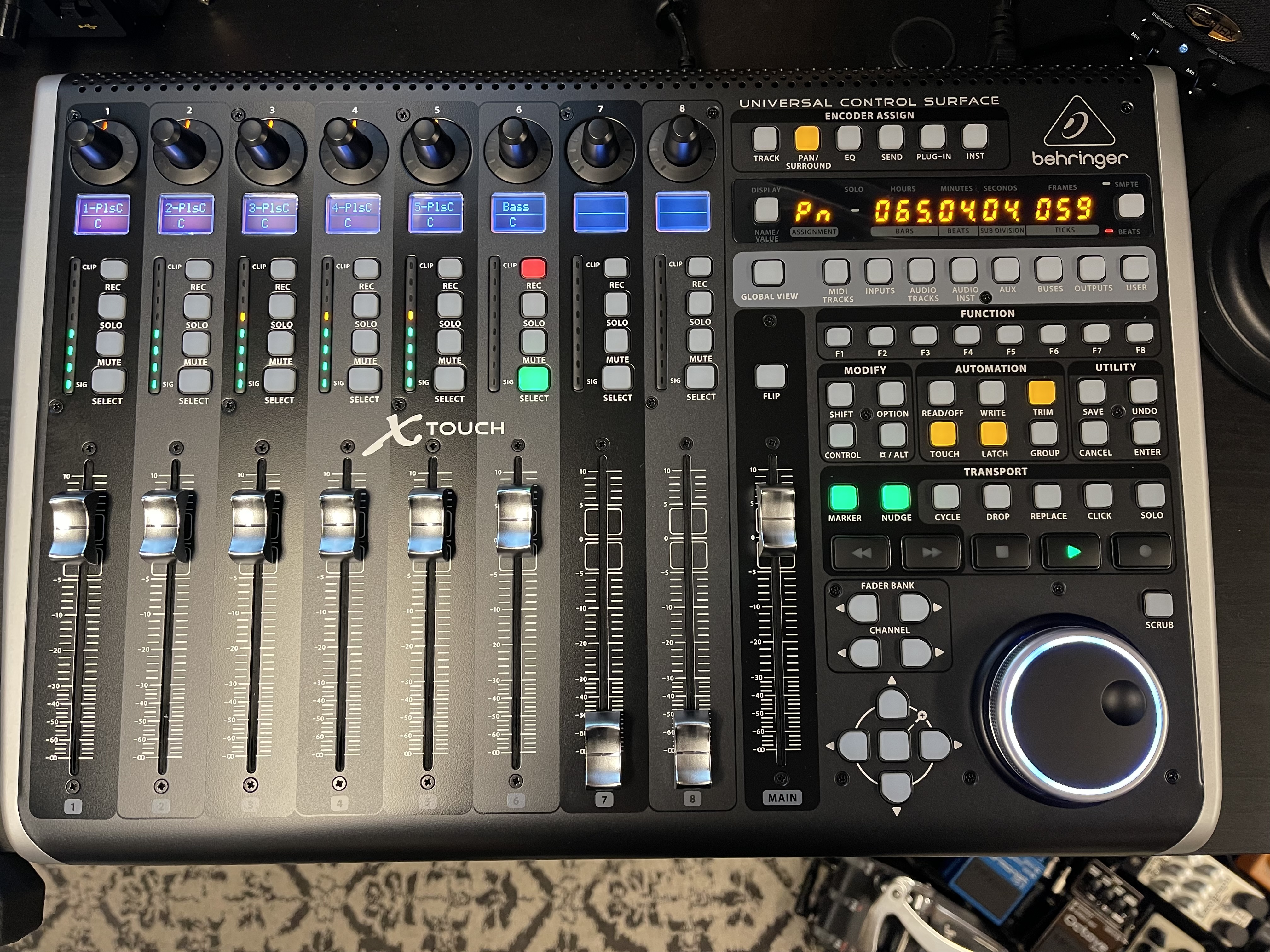
Ok, this thing is awesome!
I could watch the motorized faders move all day. I already love it more than the mouse.
Time to open a mini recording studio.
13 Likes
Latest toy acquisition, @John_E?
2 Likes
That looks frickin’ cool @John_E
2 Likes
Looks awesome. You’ll probably also love the scrubbing wheel and it’s nice that the thing has level meters on the device. Super cool.
2 Likes
For the $100 off at Sweetwater I couldn’t resist. I already love the scrubbing wheel @howard, there is no good way to do this in Abelton alone (at least that I know).
3 Likes