I just got a Katana 210. I’ve barely scratched the surface on what that amp can do, but I’m loving it so far. I haven’t really used the effects at all, just playing clean on it. I really like its tone better than my Rumble 100. I also got the footswitch and Bluetooth adapter. (BTW if you use Android, it’s a PITA to get the app to work with the amp, but it is possible. Let me know if you need help, because the people at Boss are no help at all.)
I just sold my Rumble to a guy in the area who I hope shows up on this forum some day. He’d fit right in. He’s fairly new to bass and already has quite a collection of bases and amps.
And yeah, Sweetwater is awesome. I’ve found their prices to be competitive/equal to places like Amazon and Guitar Center for the things I’ve been shopping for, and their service can’t be beat. They gave me another $20 off my order, even though it was all on sale already. Also they had a combo deal with the Katana 210 and a cover, but they were out of covers. So they agreed to give me the deal, but ship the amp out right away, and ship the cover when they got more in, and I didn’t have to pay shipping for the cover either. I think they’re the only place I’d buy a bass from due to their 55 point inspection. I think they do price matching too if you ask them.
The one nice thing about Amazon is it’s so easy to return stuff, as I just drop it off at Whole Foods (where I get groceries anyway) and I don’t have to pack it up or pay for shipping. Used to be Amazon was cheaper, but lately I’ve been finding things for the same price at Sweetwater and other places, so I think the online marketplace is getting more competitive, which is good for us.
So yeah, I highly recommend the Katana amps. The 110 is on par with the Rumble 100 as far as loudness, and I’m told the 210 is loud enough to play with a band as long as you’re not playing crazy loud.
The Katana 210 @ 160w RMS has 60% more wattage and 33% more cone area so it should present as being quite a bit louder than a Rumble 100. I’d a agree that it should be sufficient for gigs in small to medium size venues with a band playing at moderate volume. Congrats on the amp.
Not really, they may entertain the advertised price but not…say if GC give me a quote of 15% off, even in an email SweetWater would not match that, they’ll give me $50 off on a $2500 bass.
Actually I think it is the opposite. Class AB are more efficient (at about 80% power efficiency) than pure class A, which are only about 30-40% power-efficient. However they are still less efficient than Class D amps, which are around 90% efficient at the cost of some theoretical amount of fidelity, due to how they work. Given that prosumer level Class D amps likely switch at a much higher (10-100x) frequency than the audible range I would not worry about that at all, as artifacts would be so low in amplitude at that point that they are probably near the noise floor anyway.
@terb wpuld know a lot better than I would though, I only understand this in theory and do not own any.
I have built a 100W Class AB amp from scratch (not even in a kit) but it has been about 40 years
Howard nailed it. But I can also add that it’s an amps architecture (design) that will have more influence than anything the power source contributes and cost has a lot to do with this as well. An amp designed to meet a $500 price point will be different than one built to meet a $1000 price point.
This is why I posted previously that not all 500w amps are created equal or will produce equal volumes at comparable settings. It’s not as generic as we might believe it is. On top of that we can add speakers and speaker enclosures to the mix which is why I joked “my 100w is bigger than your 100w”. It very well could be.
yep! I should also have qualified my reply with “everything else being equal”, because one cost-easy way to widen the gap between otherwise equal amps is more expensive and sensitive speakers.
And the. there’s the amp design and components and lots of other things.
Love the 212 Neo cabs. I had an Epifani UL2 212 that I sold in the last year. Loved the sound but my days of moving bigger gear are over ergo my interest in the Genzler Bass Arrays and Magellan amps. My MG350 Combo with another BA 110 would weigh more than 10lbs less than that Epifani Cab itself and I can one hand both.
Gettin’ older ain’t no fun but at least Jeff Genzler realized this.
Amps are the one item where I will always say buy the best one you can afford and for a bass amp all the wattage you need. Top shelf speakers too. You’ll never regret it and you will hear a difference.
A $400 bass will sound great through a really good amp rig but a $2000 bass isn’t gonna sound anywhere near as good through a $400 amp rig. Buy used whenever you can. Performing bassists are always selling last years stuff for whatever just came on the market that’s even better.
About efficiency, Class A amps are more about 10-20% , Class AB less than 70% and Class D can be higher than 90%.
The thing with Class D is not really about fidelity but it behaves somewhat like it has slower transcients than Class AB, which means in other words that Class D amps have more power (at a given price and weight, because of the efficiency) but also less punch (slower transcients). It’s not necessarily a bad thing, and it could even be an advantage depending on the situation. But that’s the reason why I keep Class AB amps
Yeah. I am actually kind of in love with how Class D amps actually work. In a way they are sort of like voltage-controlled analog PWM synthesizers operating as power amps
So if their switching frequency is high enough - and AFAICT they nearly all are - the aliasing from the actually being discrete time systems should be negligible as the audio band is ay, way below their Nyquist frequency. At the same time you are right that they would behave differently (and slightly slower) on the attack half of a transient due to their quantization. (The difference to the decay should be meaningless I think.)
The aliasing is not a problem at all in my opinion, as the switching frequencies are very high. Just compare it to the 44 kHz sampling of an audio CD …
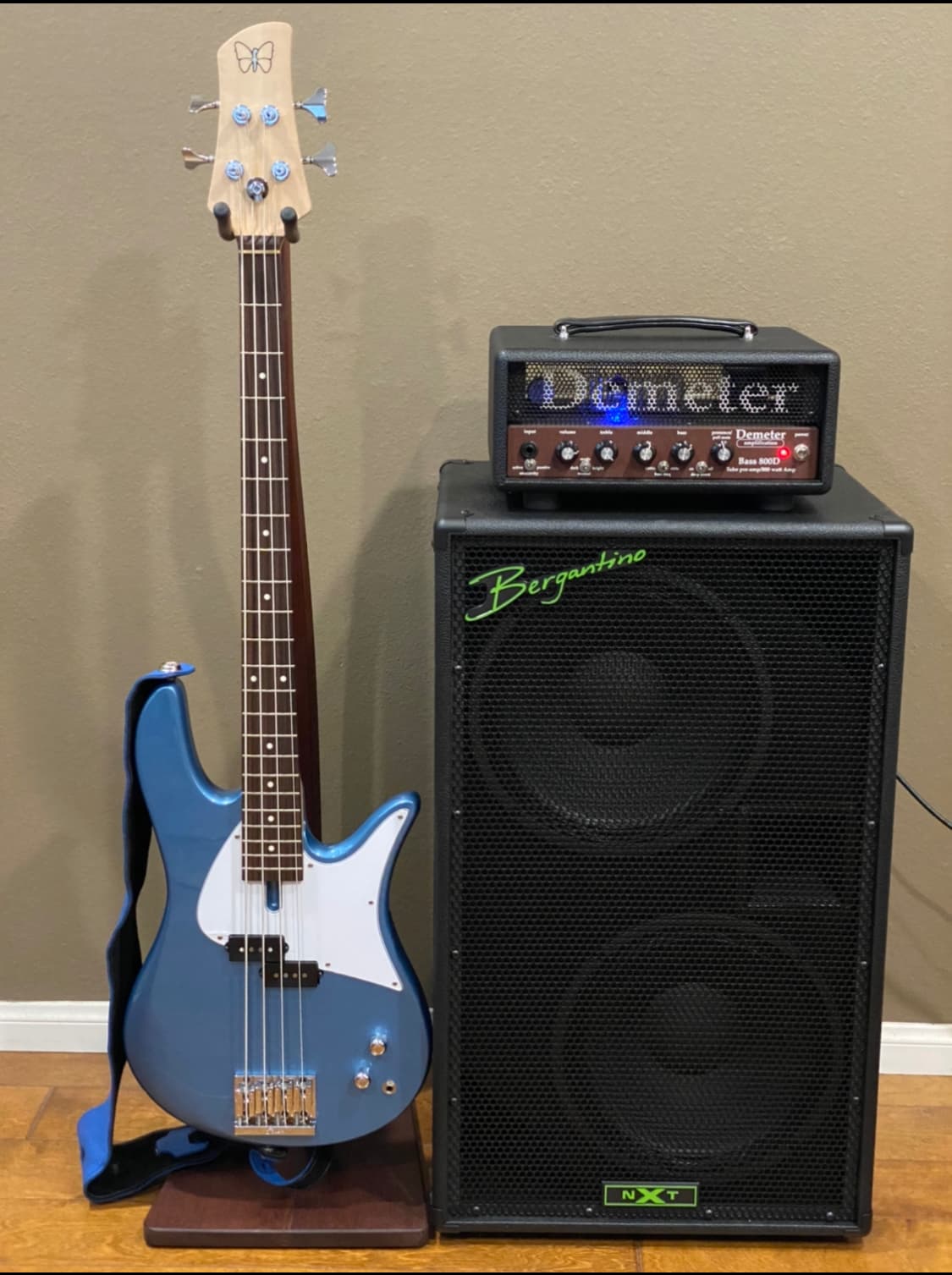
SERIOUSLY, @Al1885 you can pick it up anytime you want and hold on to it to try. I’d love for you to try them. I practice through my PJB BG-120. The Demeter has the Jensen Transformer upgrade.
Although I don’t notice it myself this is what some players will hear and describe as a bit of “sag” in their response similar to what some may hear from a tube amp. But it’s been awhile since I’ve played anything but Class D bass amps.
I would more say a (micro) “lag” rather than a “sag” ! the sag is a compression effect due to the power and/or rectifier tubes saturation and it sounds kinda “creamy”, it’s different in my opinion. At least it’s not what I was talking about.
Sag is just a word some have used for it. It’s not the same thing or caused by anything even vaguely similar it’s just what they relate it to like they’re comparing a SS amp to a tube rectified amp.
In a guitarist’s world it might better be thought of as “immediacy” vs the lack of it. I understand tube amp saturation and compression. It’s their word and description, not mine.
My guess based on how they work is that any effect on the attack would probably be a result of a one clock cycle pulse width delay on the initial transient and would surely be heard as a slight tonal difference, less “sharp” and more “smooth”, rather than an actual stutter if so.
At least that is what I would guess based on sampling theory- I could be wrong and it is something ekse.