It just popped into my head, if you only had a 4 string bass, would it at all be possible at all to cover pieces done with a 5 string bass, be that tuning transcribing or what ever.
The best i have is, find out what notes they play/scale and just tune your bass accordingly and hope they don’t use all 5 strings.
Addendum: I also dont know if this belonged in a specific category or not, so played it safe with general
I mean yeah, it’s super easy to play without the B string. It might not work well on some of the “dance” song with deep Notes but technically you are only missing 5 notes.
5 string basses only cover five notes that you cannot play on a 4-string with standard tuning. Their main advantage is opening up alternate fingering options and even then it works for some genres (like Jazz) but not so awesome for others (driving rock and punk is gonna get weak sauce limp noodled by the B string timbre on higher frets).
Tune a 4 string BEAD. This really would require new strings and maybe a bit of work on the nut / set-up
Drop tune a ‘standard’ set up. DADG is easily doable, with the low string not getting too floppy. Going much below D can get a bit m’eh though
If a low B to D# is called for in a song, just come up an octave when playing. I’ve done this plenty of times
Use an Octave pedal. I’ve found this works best if you then come up the fretboard to actually play. I did this on a cover of Billie Eylish’s Bad Guy. It worked well.
And a bonus approach:
Shift keys. We’re having a go at Blur’s Song 2 in the band. It’s in Fm, but requires the bass to drop to E♭. Come up to F#m and the low note becomes E. No drop tuning required.
C G D A strings could help if you can reach far enought to play with that tuning but you will keep your fingers mostly between frett 2 and 5 with them. Regular E A D G is way more relaxed but you reach way more notes with C G D A
Yes, being tuned in fifths like that also has some other cool effects too (any two strings form power chords at a given fret, etc) and some not so cool ones (some octaves are now tricky to fret). Alternate tunings are cool though.
Alternative, that tune is older than the E A D G tune.
I will say that it works way better on a short scale since you will have to reach between fret 1 and 6 preferably never but the regular 2 to 5 is not that bad
Well, yes in that fifths is the standard tuning for cellos (CGDA) and violins (GDAE)
For electric bass it’s an alternate tuning though as standard and most common is currently in fourths as EADG of course, probably followed next by drop D (one fifth and then fourths) and BEAD (fourths).

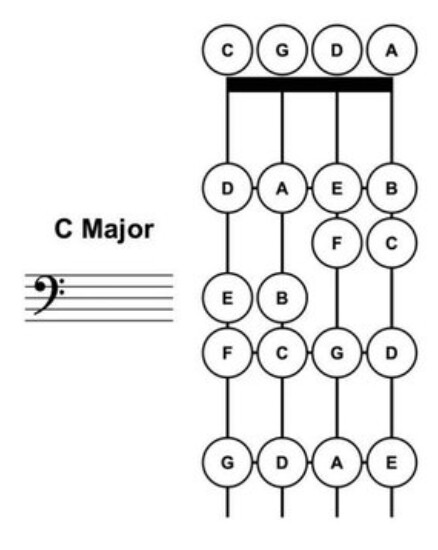
 Alternative, that tune is older than the E A D G tune.