I have been routing my signal as follows: instrument > (pedalboard sometimes) > looper > amp > mixer > monitors. The looper (a Boss RC-500) has two inputs and two outputs. For guitar this works fine, the amp is a pedalboard format Hughes & Kettner AmpMan Modern with a DI out with a cab sim and it all sounds good enough.
For my bass though I can’t get it to sound it to taste - the amp is a Darkglass Microtubes 200 and the DI output is the bass guitar signal before the preamp and without a cab sim and I can’t get it to sound good.
So I’m thinking of simplifying this by using a Line6 HX Stomp with both instruments connected - it has stereo in, stereo out and from what I understand you can treat these as separate, pan one signal entirely left and one entirely right and use 2 different presets (one with a bass signal chain and one for guitar). Not playing both at the same time of course since you can’t order extra arms at Thomann .
The reason I think HX Stomp is because I remember seeing setups like that with an acoustic and electric guitar.
How is the HX Stomp for bass, is it at all possible what I would like to do and does it make sense or am I overlooking an entirely more simple solution?
Part of the appeal is having one less device on my desk (it would replace the AmpMan and the Darkglass both). The downside is that I am trying to steer clear of apps and PCs and many multi-effects pedals need one or lean heavily on one at least.
So just to be clear, you would only ever be playing one or the other? I’m not sure why you would want to go through the trouble of trying to split things left/right, you could just plug whichever one you wanted in, and select the patch you wanted to go with it? This is very easy to do on the HX Stomp itself. HX Edit on the computer is really nice for editing patches, but you can also do all of that directly on the unit itself .
It sounds great with either guitar or bass.
Well, it looks like it should work. I put the main input as the source for the A side, and the Return for the B side. Gave them each a small signal chain with an amp and cab and a pedal, along with a reverb on A, then they merge, but A is split 100% left and B is 100% right.
The challenge is that you only have so much digital signal processing (DSP) power. If you split that up between two instruments, there’s only so many effects you can have in the signal chain.
But then again, if you’re not going to play them both at the same time, you don’t need to do this at all.
Thanks for the detailed reply and looking into this, appreciate it. I want to have both instruments connected at all times and manage the levels individually by having each on its own signal path (instrument to hx stomp l/r to looper a/b to mixer ch 1/2). The use case is have drums on the groovebox, play bass line and loop on track 1, tap footswitch, pick up guitar and loop on track 2, hit footswich, play a lead. Are the 6 blocks on your example the max it can do?
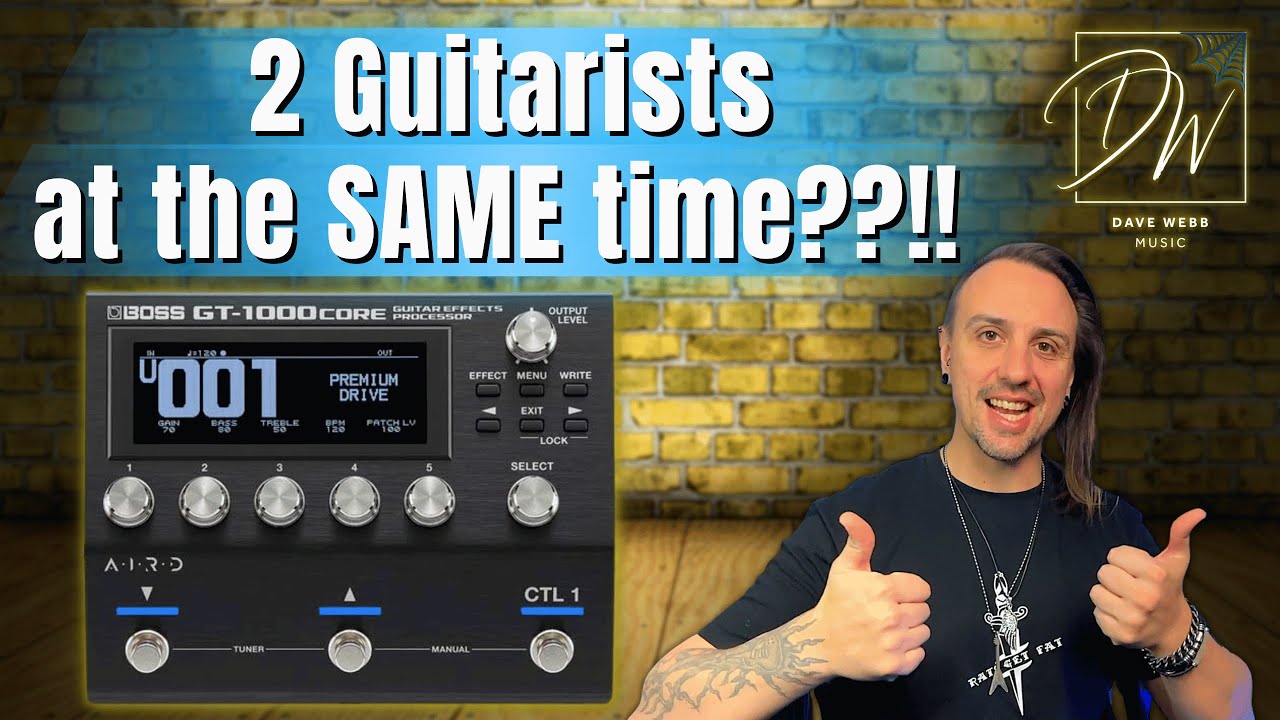
I can’t really find many pedals that have this kind of internal routing flexibility - the Boss GT-1000core seems like it might, still looking into it. Both the Boss and the Line6 are a bit older now but none of the newer pedals in a reasonable price range seem to have more than one input. I do have a Sonicake Portal ABY pedal lying around now that I think of it. Would be 2 footswitch presses (ABY and multieffects) but I could get away with something simpler (and less expensive) (maybe). less devices is always good though - needs less space, less cables and less power supplies.
Ah, ok, makes sense for looping. Do you have a standalone looper? The HX Stomp has one, but again it takes up one of the DSP blocks.
The HX Stomp has spots for 8 total blocks. Not every effect uses as much DSP processing power, though. If you use effects which require a lot of power, you might start seeing some of the available options are greyed out, meaning you don’t have enough DSP left to add them.
It is quite flexible with the routing for sure!
Given what you’ve described, I don’t think you need to put the guitar and bass in the same patch like I did. Especially if you have a standalone looper and it sounded like you had a mixer things would plug into, so you could just route the drums through that.
Instead, you could define a patch for bass, a patch for guitar, and a patch for lead. You could make the bass patch use a different input. But once you’ve recorded your bass loop, you don’t need to keep that patch active. You could switch over to the rhythm guitar patch with a footpress, then again for the lead patch.
In this mode, there are four patches that you can switch between with a single footpress:
Now you’ve got me curious. I have a drum pedal, looper pedal, mixer, and of course the stomp. Gonna try and hook something like this up and try it out, sounds fun!
That’s making it super complicated for not much result imho.
Like @fennario suggests a patch for guitar and toggle to the patch for bass. One button and you’re there. Easier to manage it in the computer as you can drag / drop and adjust levels and effects with a mouse.
Bit of a learning curve with Helix but really fantastic stuff and lots of good YT tutorials.
Or pick up a Helix Floor. They’ve come down in cost now that the Stadium’s are out. That would give you the DSP power and routing options to do what you’re looking to do without any compromises or workarounds.
I’ve got an LT, same DSP fewer inputs and I can run 2 completely separate signal chains and send them to the same output or split them to different outputs (2 different amps / amp or XLR to the board… etc.). It’ll let you do the same with inputs, so you could do guitar on input 1 to signal chain 1 and bass to input 2 to signal chain 2.
@fennario@Barney There can certainly be seperate patches for guitar and bass, as long as for any given patch I can tell it to only use input L or R and route the signal to output L or R only (whether as a setting or panning). I’m okay with using a computer to set it up once.
The appeal here is in the simplification, if I can get it working; since I could also just use a pedal or bass amp with DI out that isn’t pre-out and has a cabsim; but I have limited desk space and one Hx Stomp takes up less than one H&K AmpMan and a bass amp.
It’s absolutely fun, I’m working on a song by the XX which has drums, synth, guitar and bass. It’s super challenging for me getting everything working, not to mention actually playing it all, but it’s good fun and I find it super relaxing.
@faydout Thanks for the suggestion but the floor looks to be 3x the price of the Hx Stomp the LT is a bit more affordable but it looks to be overkill for what I need based on the input above?
Thanks, does look like it! I couldn’t find this in the manual of the device, likely there is a separate manual for this Tone Studio then. The HX Stomp seems to be better supported though, as well as slightly cheaper.
Barney, fair point. I’m playing only one instrument at a time. Going through the menus of the looper (not the most intuitive device this RC-500) the looper has 2 inputs (A & B), 2 outputs (A & B) and 2 tracks and its routing is entirely flexible - so there is no firm requirement to have the signal split in the HX Stomp.
If I use the ABY pedal I can keep both instruments connected to the HX Stomp or any other pedal that would work for both guitar and bass. Plug the output of that in the input of the looper, set both tracks to listen to the single input and route the output of track 1 to output A and track 2 to output B.
Switching between guitar and bass would then be switching ABY, changing preset on the pedal and changing tracks on the looper. The only advantage of the HX Stomp is then in eliminating the need for the ABY pedal since it has 2 inputs (edit: maybe ease of use as well, not sure).
Something like a ToneX pedal or even a ToneX could then work as well and works out quite a bit cheaper than the HX Stomp - 300 ish EUR for the pedal (or 150 for the ToneX one) plus the bass amp model pack which is another 50 EUR or so - so almost half the price of the HX Stomp.
 .
.
 less devices is always good though - needs less space, less cables and less power supplies.

 the LT is a bit more affordable but it looks to be overkill for what I need based on the input above?