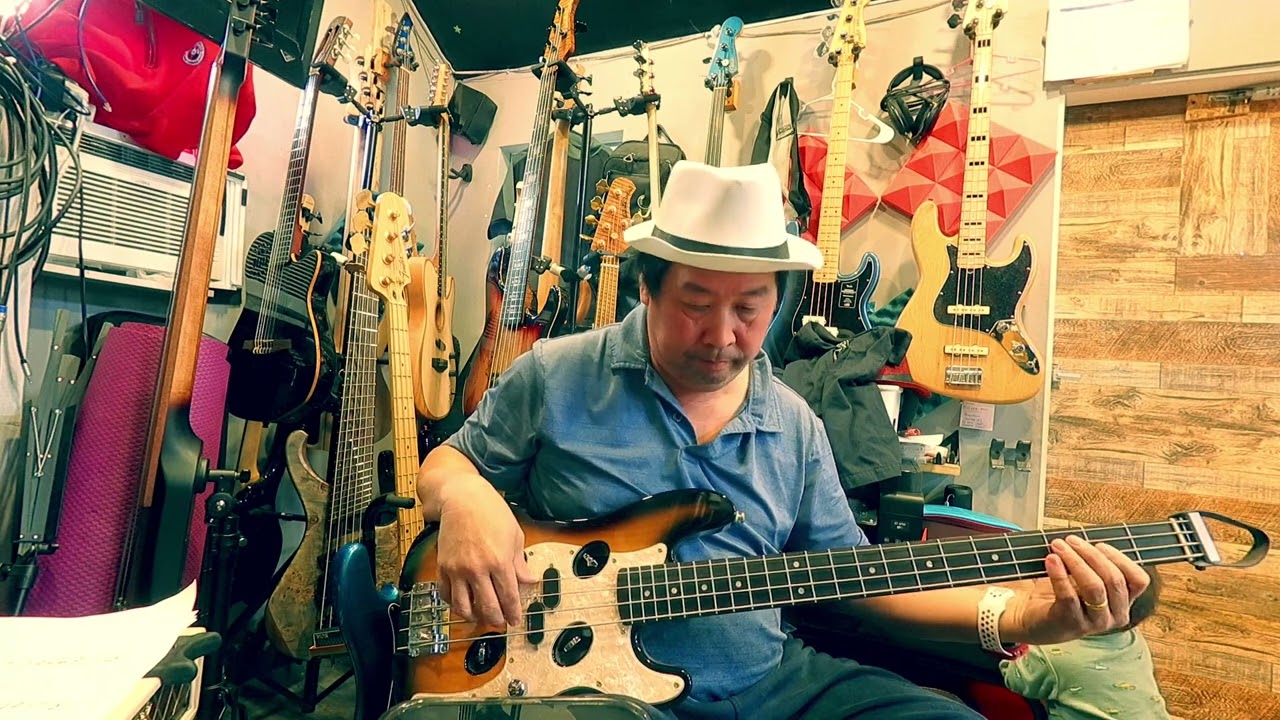
Hi all! First time posting. I tried to search for this specific topic but not seeing exactly what I’m looking for. I’m about halfway through b2b (module 8), and I have recently started noticing that I’m moving my thumb anchor basically every time I switch strings. I’m not sure if this is considered a “floating thumb” but I am still resting it on the pickup for playing E, and then on the next string up as I switch stings. I’ve been trying to force myself to not do that if playing a song that is say just on the E and A strings (like Josh is instructing). But as the fretting gets more challenging, I find that I am just naturally and subconsciously moving my thumb down. Partially because I get a better sound from the string I’m plucking, and partially because I miss strings (play the wrong string) way less this way.
My question is: Is this a bad habit? Should I slow down and force myself to be able to pluck across more than one string from where my thumb is? Ex: thumb on pickup and playing on E and A, instead of moving thumb down to E anytime I play on A.
I don’t feel like it’s too much of an issue. But it’s also not something you need to be doing.
I move my thumb down to the A string when I pluck the G string (and sometimes D but it depends on the song) which helps keep all the strings muted. But when you pluck the A string, you don’t really need to anchor on E as your plucking fingers will naturally mute the E string.
Unless it hurts your speed at string crossing it isn’t a massive problem, but I would say to try and work on not moving too much as it just isn’t necessary all of the time.
As an exercise, try playing open notes on the E string and then on the A string while keeping your thumb anchored on the pickup. Notice how the E notes will stop as you start playing A because your plucking fingers mute the E string.
i actually used to actively try to learn to play how you do, it sure makes muting a lot easier. i could never get to the point where i could do it consistently, i only anchor on the pickup and E string. it works for you and it has a lot of benefits.
Whatever feels comfortable is what Josh recommends in most cases. I usually just use my arm to hold the bass body against mine so I am free to anchor or not anchor when it suits what I am doing. It also makes any thumb pressure on my left hand feather lite.
Welcome aboard. The pros will be along with their answers.
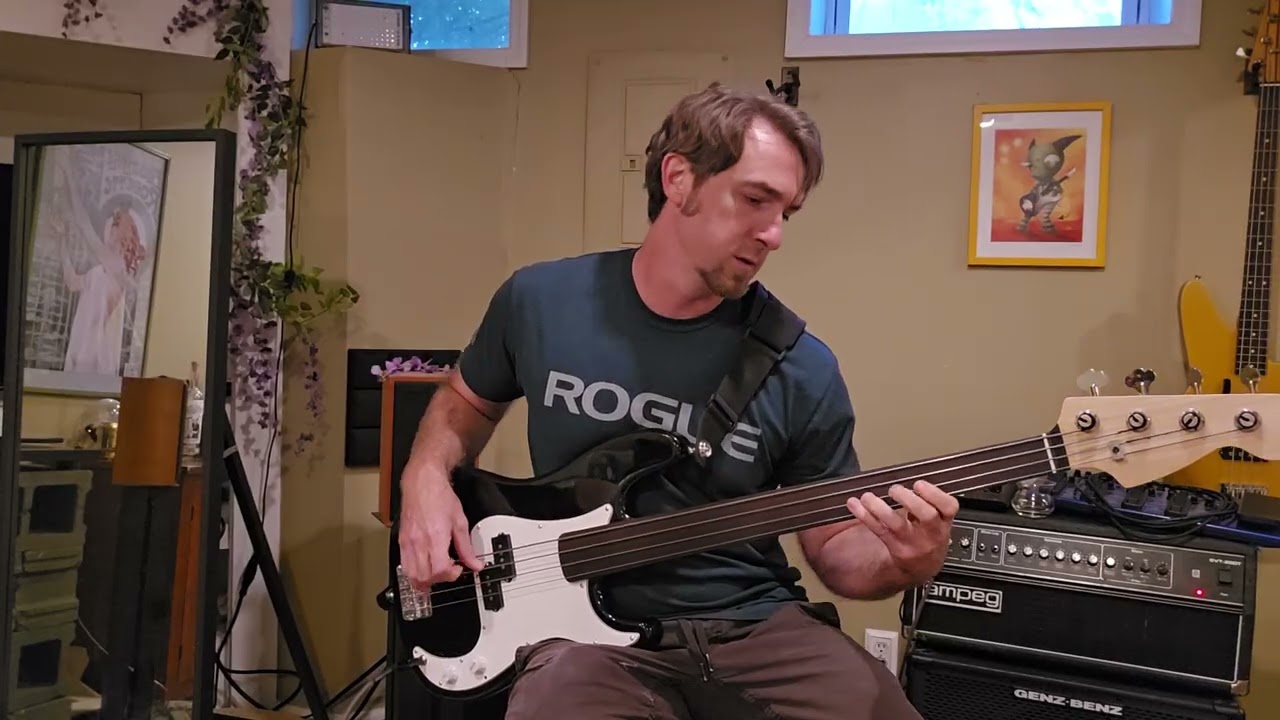
Your post got me wondering about how I do it, so I loaded up some of the lessons that you might have done recently from modules 7 and 8 and recorded myself playing them. I tried not to actively think about it when playing to see what came naturally.
On All Star, it just felt natural to anchor on the E when I plucked the A string. It’s a fairly slow riff, so it’s easy to move your thumb without messing up timing.
On the major triad one, I stayed on E the whole time. You could move your thumb up to the A string but why bother?
Then on Midnight Hour I noticed I also move my thumb to play the last 2 notes of the bar. I tried for a couple of bars to keep my thumb on the pickup but it just felt more comfortable to move it up.
I guess it kinda doesn’t matter unless it really messes with your timing. But I’d advise if you’re going through the course for the first time to try and stick with what Josh does, as everything on the course is done for a reason. Try watching some of the workouts and see where he puts his thumb.
Your technique looks fine to me. Your hand is staying in a natural, relatively relaxed position. You’re pulling through and muting.
In the second bit, you are reaching across strings when it makes more sense to do that.
Practicing both techniques is the right decision.
The only adjustment I would make is to rest your wrist farther over the body of the bass, so your hand is further away and you can pull more parallel to the string and body of the bass. You are not pushing into the body, but you’re having to pull with your fingers at an angle to the string. If you moved your hand out, you could keep your fingers more perpendicular to the string.
Other than that, you could relax more and use less effort - but that will come with time and familiarity.
You can compare your technique to how I play here:
Very similar to what you are doing.
You can see me resting my hand further from the bass.
I also (this is more advanced) rest the side of my thumb on the E string, instead of pressing into it as a true anchor point. This lets me slide between the Pickup, E, and A strings more easily. (So, in that triad exercise, I could slide my thumb up to the A without having to switch my anchor points.)
I would not be worried about it at the point you are at. It took me well after I completed the course to develop that technique.
Just be aware of this technique, but don’t worry about practicing it yet.
@colleen.miller2219 I hope you are not under the impression that your thumb needs to be “anchored” in one place.
Not only you plugging hand needs to be moving vertically but horizontally as well to generate specific accents and articulation.
That’s my ultimate goal, to be able to move around all the time. Why does the fretting hand gets to have all of the articulating fun. All of the significant tone shifts are from plugging hands.
Nah I know I definitely want to be moving my thumb down to say play D and/or G strings. But I just mean that I’ll be doing a lesson that is only only E and A, and Josh advises to leave thumb on pickup for both. Because as others pointed out, and I do understand that it is not necessary to move down to thumb on E to play A because pulling across into E mutes it. So I get why I don’t NEED to move down. I just do so naturally and subconsciously. And I’m worried that I’m limiting myself by not really being able to play two strings away if my thumb is up higher.
Well, I expand my skills by switching fingers on both hands plugging with middle and ring, playing palm muted style muted and non muted, same goes on the fretting hands no thumb support, mostly due to injuries some
times. It’s not uncommon for my to get cuts on the favorite fingers so relying heavily on the remaining fingers is very common, .
I even try to model after my hero who plays inverted and upside down, it’s definitely a humbling experience, but now I have enough confidence to pick up a left hand bass and play.
When I started I was quite religious about it and always anchored on pickup for E, E for A and A for G and D. I don’t really think about it too much now and I find if I’m playing a line that hops back and forth between A and D then I just stay on anchored on the E. Equally if hoping back and forth between E and A then I stay anchored on the pickup. Another line I was playing recently was almost entirely played on the A and D with very occasional E. For that I don’t even bother anchoring for plucking the E string I just hover and then anchor back on E for the next note.
I don’t really think about it now; I just do what feels easiest for the piece. It’s much the same for alternate plucking. I mostly do it without thinking but sometimes I just have to do a sequence of notes in a particular order, say leading with the middle, and that might mean plucking twice on the middle to get into the right order.
Don’t worry about it. You are not limiting yourself or building any bad habits by moving your anchor point.
You have a finite amount of brain power to focus on different techniques while playing. This is not the thing you should be spending that brain power on.
Josh is probably suggesting people don’t move it, because for most people that suggestion means they won’t worry as much about it.
You aren’t one of those people. Do what is more natural for you here.
(But do shift your arm farther forward over the bass. You’ve got the body of the bass right up next to your wrist, and your palm is almost on the body. You can see that both @Al1885 and I, are resting the middle of our forearms on the bass, with our hands away from the body.)
Thanks for this thread! I will be through Module 6 this afternoon and this is the only sticking point for me so far. I like to be anchored a string above or on the pickup for the E string. I don’t pluck as evenly nor as cleanly from two strings away. It’s nice to read that this won’t necessarily be a limitation down the road. I’m still gonna play around with it to get better at it, but it won’t hold me up getting through lessons.



 .
.