Scales and Key Signatures (B2B Module 07)

Ok, so, I’m going through the full Beginner to Badass course again. I’m paying much more attention this time and not skipping over the theory parts (which I kinda did on my first run-through). I just finished module 07 and I am starting module 08.

In module 07, @JoshFossgreen goes through the C major scale, the shape, and how it’s made up of all naturals. He then goes through the G major scale, explaining how it has one sharp (F#), and at some point, he explains the key signature for the G major scale, showing how it has a sharp on F right after the bass clef, so that we know all F’s should be played as an F# (unless it’s marked as an F natural).

Later in the module, we play around with the A major and E major scales, but only what frets are played with the major scale shape are covered. Unless I’ve missed it, or it’s yet to come, there’s no discussion of the sharps and key signatures for those major scales. So, I want to try to puzzle this out from the knowledge rattling around in my head:

In the A major scale, there’s a C#, an F#, and a G#. So that means the key signature would have sharps on C, F, and G right after the bass clef.

In the E major scale, there’s an F#, a G#, a C#, and a D#. So that means the key signature would have sharps on F, G, C, and D right after the bass clef.

Is that correct? Am I understanding the relationship there?

Is there any specific order that the sharps would be shown in the key signature? Or is it just… in the order they show up in the scale (so, for the E major scale, the sharps would show on F, G, C, and D in that order as I’m reading the key signature)?

Thanks in advance!
It’s best to learn sharps in order of appearance in each major key.

Major key on top row.

G…D…..A…..E…..B
F#, C#, G#, D#, A#

This order is not random: note that each subsequent sharp is the fifth of the one preceding it.

Also, each sharp is the Major 7 of each key.

2 Likes

Here’s a good resource for learning how sharps appear in various key signatures.

3 Likes

A common mnemonic device for this is: “Father Charles Goes Down And Ends Battle” with the order reversed for flats. However, if you’ve learned which letters go to which line or space you’ll be able to see that the placement of the sharps/flats matches this. You can see this in action on this site (click the left/right arrows at the bottom to advance).

To expand slightly further on what MikeC was saying earlier these relationships are most commonly discussed as the circle of fifths. While I wouldn’t recommend diving into that super hard as a beginner, I’ve found it pretty handy to keep a copy to help identify keys when I was starting out. Josh does a quick analysis on the rest of the pieces in the course so you’ll have plenty of opportunities to practice as you progress.

Thanks, @MikeC and @lvl4goblin.

Before I can dive into that stuff though, am I correct on the first question I asked?

Yes. The sharps will be indicated in the key signature, on the appropriate staff line, in order

Yes, but note that the correct order in which the sharps will appear in the key signature will be F# C# G# D#.

2 Likes

Ok, so, to summarize… at least with major key signatures… all the sharps in the key will be shown in the key signature, and they will always appear in the key signature in F/C/D/A/E/B order.

My next question: why is the order that they show up in the key signature important? If I look at the key signature and see that it is sharping C, G, F, and D, wouldn’t that be enough to tell me that it’s an E major scale? Or is the order just so that there’s consistency and I can then memorize the key signatures kinda by rote, without having to figure out what actual notes are sharped?

I don’t really have answer to your question, but if I had to guess it would just be the convenience of having a standard for representing western music. A lot of notation ties into theory and understanding the intent of the composer. If someone starts breaking the rules others will question why.

If I saw a key signature that had G#, but not F# my first instinct would be to curse out whoever was responsible for engraving (if not the composer). My next course of action would be to figure out what the actual key is and the significance of G#. What if it’s A minor and that’s a raised 7th that got notated weirdly? What if the piece was part of comedic play in which the music was intentionally “wrong”?

At the end of the day the order doesn’t matter, but myself (and probably most other musicians) take comfort in knowing that 1 sharp = G Major or E minor. It’s simple, it’s easy, it makes easy to jump into performances on short notice.

Are there other reasons for the order? Possibly. Sounds like a topic for an Adam Neely Q&A.


Musical notation reflects hundreds of years of the development of music in the western world. Over time it changed to make things easier, to be consistent to different groups of people, or because some weirdos got into petty fight over their preferences in various publications. If learning about that sort of thing sounds funny to you I highly recommend checking out this video from Tentacrul:

Spelling and syntax matter in any language.

Knowing the progression of the Circle of Fifths (and of Fourths) is essential if you want to know how Western music works.

2 Likes

Well, it tells you that it’s in the key of E, but yes. As you become more familiar, if you look and see 4 sharps, you’ll know what they are and know the key.

This. If you study theory and play from notes long enought, at a certain point you won’t need to look at what the sharps are, you just see 2 sharps and know they will be F# and C#.

And while we’re at it, the order of flats is the mirror image of the sharps…
Sharp order: F-C-G-D-A-E-B
Flat order: B-E-A-D-G-C-F

3 Likes

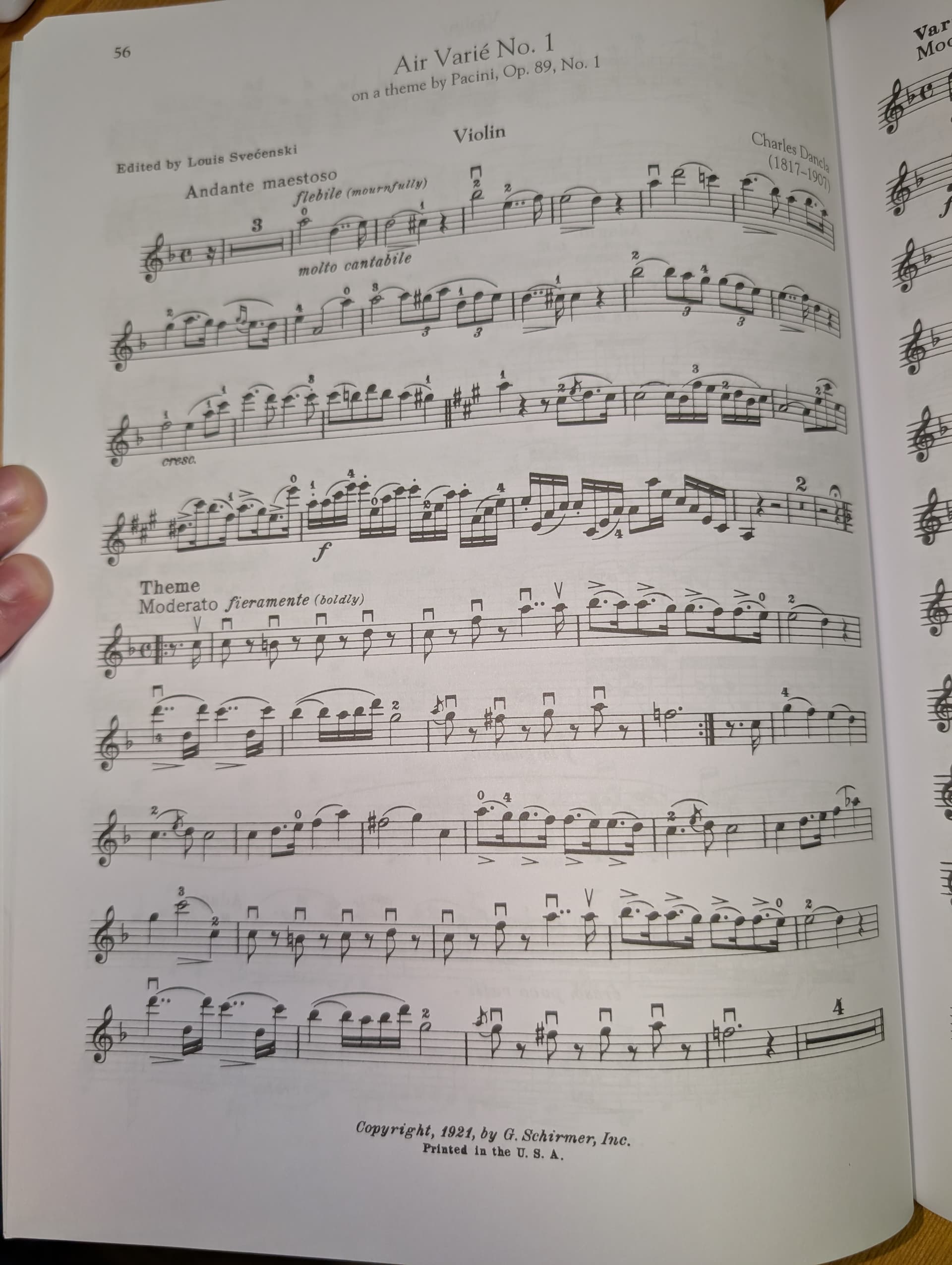
Classical music pretty frequently changes key signatures during a song, so readability matters.

ETA:

For example it’s nice to just look at the shape and know you’re going to a major or f# minor. In this particular case there’s a decent amount going on with a position shift and the dotted eighth with a grace note so it’s a pretty good example. It doesn’t matter as much for monophonic instruments but a glance at a chord would tell you major or minor as will.

1 Like

This ^^^.

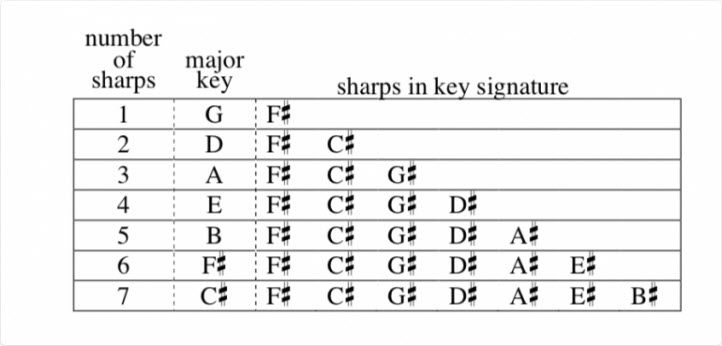
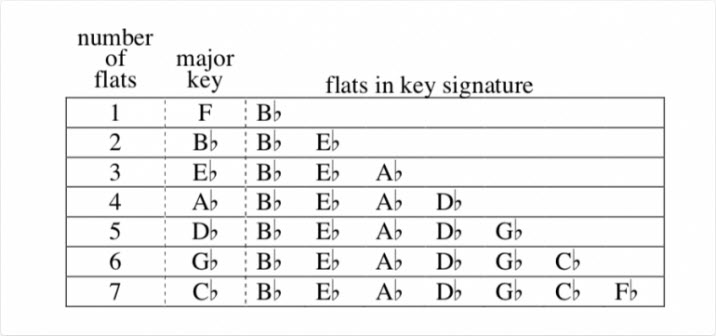
If anyone is interested, I cut out the sharps and flats tables in the article that @MikeC linked to above.

2 Likes

What helped me was that all the letters stay in order:

A B C D E F G

You might start somewhere different, e.g. for G major:

G A B C D E F# |G

But all the letters show up in order.

If you use the circle of fifths, all you have to do is

  1. go up a fifth each time (e.g. from C to G, G to D, …)
  2. keep the previous sharp and
  3. sharpen the new 7th

So, for D major to A major:

D E F# G A B C# → A B C# D E F# G#

Finally, on the fretboard it all looks the same - so learn the scale to the 7th and then reposition and repeat the pattern across or along the strings.

:slight_smile:

1 Like

Totally. I would even say that the Fourths direction is even more important (for chord progressions).

Even just grokking why they are the same circle and the implicit relation there is a prime first step. Understand that fundamental relation and you have started down the right path.

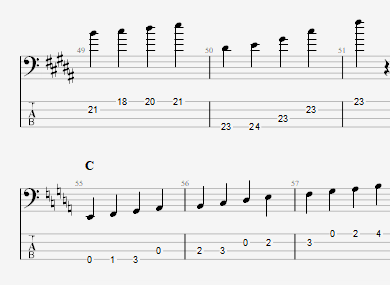
One of the fun ones I came across recently was a switch to C Major. Because that’s all naturals the key signature is basically nothing which is fine if that is the opening key signature but if it’s switching from something else to C Major it has to indicate it with a key signature of all naturals.

Note it doesn’t have to show all 7 naturals but just the ones that are different from the previous signature (B).

2 Likes

Wow. So much information. But it looks like my initial questions have been answered, which is what I was hoping for.

Yes, I am.

Yes, there is, and while it ties in with the circle of fifths and all kinds of other theory, the main reason (that I care about, at this point in my journey) is for ease of recognition.

Thanks all!

1 Like

This I also only got during the B2B course. Before, I was staring at the Circle of Fifth thinking wtf*** does this mean?? :joy: Now that I know the connections, everything became much more clear to me.