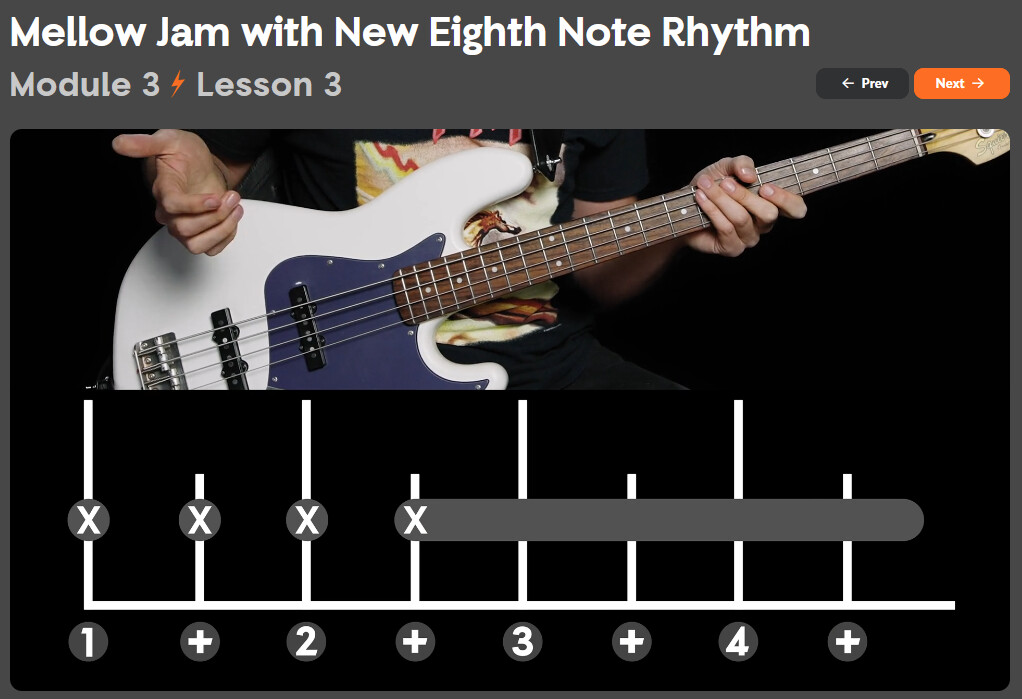
Hi all a bit of a newbie here. Module 3 Lesson 3, I assume I should be silencing between notes? Thanks in advance.
1 Like
Edit: For this lesson, don’t worry about it. There are tiny things that I would probably do going back through the course with more experience, but not anything that YOU should be worries about yet.
…
You should eventually be working on controlling your note length. Both how you start, and how you end notes.
That may or may not mean “silencing” between notes.
You are also a beginner. You should be focusing on a limited number of concepts and techniques at a time that you are able to give full attention to. Rather than trying to improve EVERYTHING all at once.
It is entirely possible that you have more important things for YOU to focus on than muting between notes right now. If so, don’t stress.
You might be at a point where controlling note length is a valuable skill for you to put focus into.
I can’t tell you which.
3 Likes
If I get this right, the notes are played for their full length. You can find the notes/tab in the course extras:
Here are the notes for module 3, lesson 3:
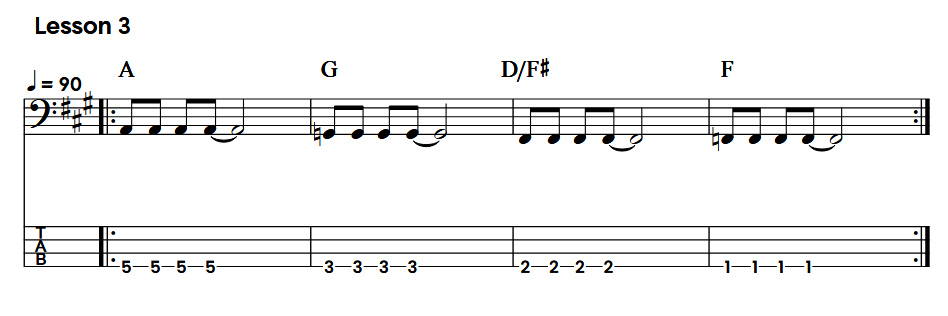
There seems to be no muting in between. Just play the notes for the whole duration.
2 Likes
Thank you both for your responses. Josh did talk a little about muting between notes earlier in the course.
So if I were a professional bassist I would play those first three notes without touching (silencing) the strings in between? For the fourth long note I would definitely want to silence after correct?
2 Likes
As you’re playing all the notes on the same string, there would be no need to mute the longer notes.
You would need to mute if you were changing to another string, if there is a notation indicating a pause or for example if the notes were to be played staccato, indicated by a point over the note.
2 Likes
Eh. Not what you should be worrying about now.
I would probably put a touch of separation between that sustained note and the downbeat, but not a full staccato or “silence” the string. Something more subtle than I could convey in text.
This is not what you should be focusing on right now.
(Edit: As an analogy - if I were playing this on a piano, I’d hold down the sustain pedal throughout each measure, but I would lift off the sustain pedal to end the last note of the measure before striking the again for the downbeat. If that does not make sense, then you should not worry about it.)
1 Like
@BeerBaron and @Krescht pretty much have you covered.
Note length is what you want to learn to control… not so much the “silence” in between”. Changing/varying note lengths can make the difference between dull and funky.
In the example here, there is no more specific information on note length, so they should be played to their full length. Ending the previous note then happens as you pluck the string again for the next note (and that holds true for the fourth note as well).
But, what I would suggest: try out different note lengths - see how you can control shorter notes (and still stay in the groove). Try to alternate between one short, one to its full length, or the other way round, and try different combination. Learning and mastering this will become very handy as you progress in the course and your playing.
In time, you will apply your “musical understanding” to decide what a given context requires in terms of note lengths (unless it’s specified in the sheet music, of course  )
)
4 Likes
If you want to practice controlling note length, go learn to play “Papa Was a Rolling Stone”.
3 Likes
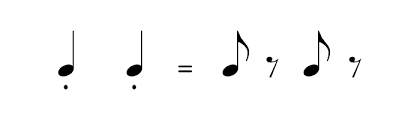
As mentioned above, if you’re changing strings, then you’d want to silence the note once you switch to another note (again, if it’s on another string). If you’re supposed to explicitly silence the note, it will be called out as either a staccato note, or there will be an explicit rest notated in the bar. A rest is a “note” of silence and can be of any duration that a note can be (example whole note rest, half note rest, quarter note rest, etc). The image below shows two staccato quarter notes, which is the same as an eighth note, followed by an eighth note rest, then repeated. As mentioned above, don’t worry about this for now, this comes later on.
In the image pasted from the module in question you’ve got 4 eighth notes with the final eighth note tied to a half note…which means you hold the last note for the remainder of the bar.
2 Likes
Thank you all for the responses! This is a great community and I’m having a blast with the course!
3 Likes