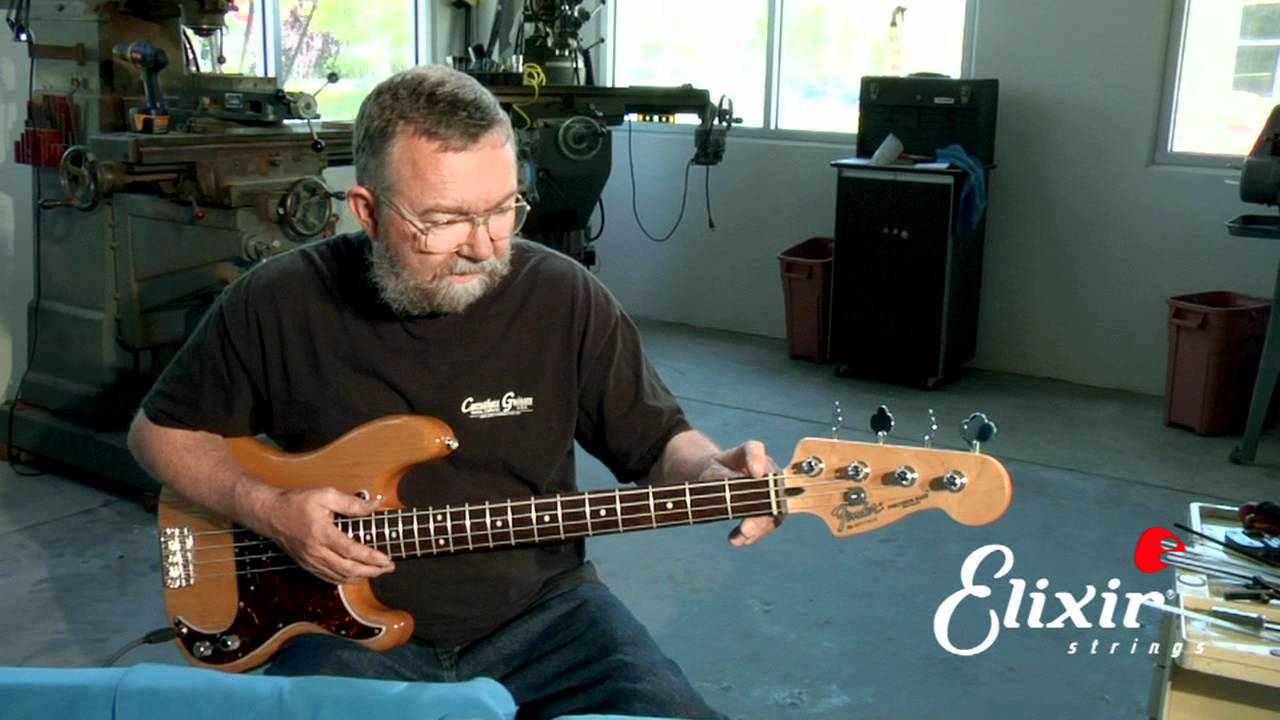
ok here goes . I got my new Squire Jazz Bass and, following Josh’s advice and your tube video, regarding the neck relief. I couldn’t get the business card under without forcing the E string up a bit. This is using the holding down of fret one and thirteen and putting the business card at fret seven. I have loosened the rod 3 quarter turns and it still moves the string slightly when using this method. Now, the silly newbie bit: do I need to loosen it again so the business card can freely move under the string without resistance?
I have a new set of strings of higher quality coming next week to ill wait and do a set up with better strings. I’m used to a high action, as that was on the second-hand bass I had.
Once you have the process down, you’ll make little adjustments as the weather changes. It’s no big deal anymore - it took me a little bit to get to that point though.
Fantastic information in his videos. My only issue with them is I think he overcomplicates it a bit. For example, I don’t think buying feeler gauges for neck relief is a good idea - the bounce/feel method works fine, leads to excellent results (and frankly probably better than picking an arbitrary spec), and is very fast.
I think videos like Josh or Marcelo’s make better “how to” setup videos, especially for beginners. Then videos like Carruthers’ are good for reference if there’s something tricky or weird.
In general when I make adjustments I don’t do lowest or any kind of -est on any bass. I’d give a mil or 2 so I don’t have to keep adjusting. Low setup is pretty terrible to play in general. I usually go for low-ish,
The nut height should be checked by fretting the bridge side of the second fret and looking at the gap above the first fret according to the vast majority of info I have read and seen. If using his method, the neck ahould be dead straight. Anything else throws off the reading with the feeler gauge. I am not saying to avoid his way but I think it is too short of a lesson. And for any bridge saddle adjustment raising the action be sure to loosen the string. Lowering the action would not require loosening the string.
There are better videos on Stew-Mac’s channel and Music Nomad. Doing things right the first time is always the best result even if it takes longer. Double/triple check before moving on. Good luck.
I have made a few bone nuts and like the results aside from the smell. Tusq is nice as well. I would not advise making new nuts unless it is on a junk project that won’t matter if you make mistakes.
correct. There should be a very small gap, well under half a millimeter.
This doesn’t matter much if at all for nut height. It’s also literally the difference you are trying to measure for neck relief, so not sure where this came from.
Also, don’t file the nut grooves to lower nut height. In almost all cases, the entire nut will be too high, not just one string. So, just pop the nut off (very easy) and sand the bottom by placing a piece of sandpaper flat on a table and sanding the bottom of the nut on it. This will uniformly reduce the height; do a little at a time and check. Works like a charm and always gives good results.
And if you ever do need to file the nut, ffs don’t spend $70 on luthier files you will use once in your life; the cheapo $5 diamond files you can buy on amazon work just fine.
Also, feeler gauges are useful like maybe one time and then you can just do it by feel via the bounce method and get better results because you’ll start to know what you actually prefer, not just what the baseline spec is.
I only meant if using a feeler gauge like the guy in the video does. And he totally missed on the G string height. The feeler gauge is angled and you can see the gap under it.
And sanding the base of the nut is kind of misleading. Some follow the radius of the fretboard. Most are flat but beware.