I’ve been trying practice diatonic substitutions. For the major scale it’s quite straight forward, but when I try to do this with minor, then things get pretty complicated. My question is, is there a general set of substitutions that could work. I understand that doing this would leave out a lot of potential possibilities, and this would not incorporate the reasons for or differences between the 3 minor scales, but I’m trying to simplify things so I can get 1 diatonic substitution over each chord and then I can start practicing over them.
Hey Todd, could you explain a bit more what you mean by “diatonic substitution”? What do you want to substitute? A chord, one chord, all chords?? Or something else?
As you write, there are several minor scales (natural, harmonic, melodic, …) and they all have their own modes with the corresponding chords. Often, there is more than one choice of chord over the various scale degrees.
This is even true for the major scale: e.g., you could have an Fmaj7 over the fourth degree of the C major scale, but it could also be a Fmaj7#11. Often, suspended chords (sus) will work nicely as well.
Thanks @joergkutter, what I mean is to swap a chord in the scale with another chord in the scale. So, (in simple terms) in C major D-7 can be swapped with F^7, G7 can be swapped with B-7(b5).
@joergkutter in your second paragraph you highlight the problem perfectly, and I’m aware that there are many choices. I’m trying to boil this down to ‘a good choice’, one that will work in most circumstances. I’m trying to come to grips with this stuff in a small digestible way.
I wasn’t even aware of the multiple substitutions on a major scale, I was hoping it was more simple than doing this on a minor scale.
Ah, OK! Yes, well, technically, I guess, you can do these swaps, but you should be aware that these chords have “functions”, which is why they all have names such as “dominant”, “subdominant”, “mediant”, “tonic”, etc. The I chord is the tonic, which always signifies “home”; the V chord is the “dominant” chord, which strongly wants to resolve to the I chord (very often). It’s all about “tension” and “resolution”, and while chord sequences don’t always take the direct route, they almost always will be resolved in the end, i.e., return to the tonic.
This is not a law of nature, just what pleases our (conditioned) ears. You can do whatever you want, but it is probably a good idea to do something intentionally rather than by chance. And it might be the reasons why your swaps might not sound as pleasing as they could…
So, again, trying to understand better: is it that you have a given (diatonic) chord progression, let’s say I - vi - V - I and you want to swap out some of these to maybe get to this: I - vii - IV - iii ??
It would be a given chord progression. Let’s use as an example a ii-V-I in C major. This would be Dm7-G7-Cmaj7. Adding diatonic substitutions I could have IVmaj7-Bm7(b5)-Em7.
I wouldn’t know how to do this in a minor context such as A minor.
Well, in A minor, it’s the same chords really, just starting from the A:
Amin7 - Bø7 - Cmaj7 - Dmin7 - Emin7 - Fmaj7 - G7
So, if you want a iiø-v-i, it would be Bø7-Emin7-Amin7 (and in your approach, you could swap with any of the above chords). Note, though, that this movement is not as strong as in the major case…
Also: this is for A natural minor (A æolian), which is, of course, the C major scale from the 6th degree (and all the corresponding chords). It’s a whole different story when you are considering harmonic minor or melodic minor scales.
By the way, a common chord substitution (albeit no longer diatonic) that is popular in jazz, is to replace the V chord with the bII chord; in your example, instead of the G7, there would be a Db7. This is called the tritone substitution because G-Db is a tritone (a flat fifth interval). This is nice because then the root movement (for the bass) is a nice chromatic D-Db-C (instead of D-G-C).
Hey there @c.t.matsumoto !
As you already saw here, @joergkutter had some great points and helpful ideas.
I have questions to ask before I can give an accurate response.
What style/genre of music are you applying this to?
Chord substitutions in pop are not something bassists are allowed to do, as everything is composed and very purposeful in how our harmony builds each chord.
It is something that can be interpreted in soloing, in some ways, but it’s still a stretch.
If you’re talking about general theory or composition, then it’s a lot of deeper theory ideas, and @joergkutter touches on some of that.
But it doesn’t show up as functional bass playing for rock/pop/funk/etc.
If you’re talking about jazz, this is something that comes up a lot, but if you’re not listening to jazz or playing jazz, (particularly improvising walking lines) it would just be theory stuff without application.
Let me know if there’s a specific style/genre/application that you see this working with.
My first instinct is to not work on substitutions so much, but work on playing chord inversions.
Meaning, rather than trying to substitute a new harmony for a C major chord (in a song in C major) work on playing a bass part (or a chord-tone arpeggio) from:
The root: C-E-G
The third (first inversion): E-G-C or E-C-G
The fifth (second inversion): G-C-E or G-E-C
This way you’re working with new sounds without changing the fundamental harmony, and you’re working your bass and theory chops to be able to tackle any diatonic chord from 3 different harmonic places.
Let me know if any of that is helpful and holler with questions if you have ‘em.
This would be a jazz context. I’ve been taking lessons and those are for jazz. The lessons cover a standard and each standard has 2 parts, an ‘improv’ like part and a walking bass line part. I’m quite familiar with inversions so I started to look into different areas. I’d started to look at this more closely because the song I’m working on now is a ii-7-V7-I in C. The way my teach composed it was by preceding each chord of the progression by playing the 3rd of the chord. So for Dm7 I precede this an Fmaj7, then Bm7(b5) to G7, and Em7 to Cmaj7. These work very well as most of the cord tones are shared except (I believe) the 9th is included. I found this very interesting and I thought aren’t these diatonic substitutions? Then I thought how would this work in minor. After looking things got really complicated fast as @joergkutter verified.
Yeah, a lot of the substitutions in jazz, and a lot of the chords that move things around in jazz are diatonic… just, a lot of key-changing very quickly.
When you’re playing from the 3rd of the chord and then the root, are you improvising melodically, or is that for the walking bass line?
Melodically, that’s a great way to find colorful melody notes.
Bass line, it reharmonizes everything and is a much bigg deal functionally and in how people hear the song.
It would work in minor in the same way (but yeah, minor has some trickier chords, and the alteration of the minor v to a major/dominant V7 is unique).
So, if you were in the minor, and were playing a ii-7(b5), V7, i-7 in the key of A minor (relative minor to C major) your root position chords (ideal for walking bass) would be:
Bmin7(b5)
E7
Amin7
If you were thinking of substituting up a 3rd (like you did in the example above) you could go for Dmin7 (to the Bmin7(b5)), G#dim (to the E7 chord), and Cmaj7 (to the Amin7).
The tricky spot is with that E7 chord since it’s the one that is altered and not a truly diatonic chord.
I love this stuff, and I’d be happy to keep going with ideas here if you have more questions!
The lesson I’m working on take the melodic approach.
Again I really like the 3rd of the chord preceding it’s root. It’s kind of like a rule of thumb (80% right most of the time). What I was looking for was a way to ‘stabilize’ or simplify the minor scale, but I don’t think that is possible. Instead I could ‘stabilize’ a minor 2-5-1. If I could get a standard minor 2-5-1 that doesn’t change then I could start exploring the 3rd chord to root chord idea.
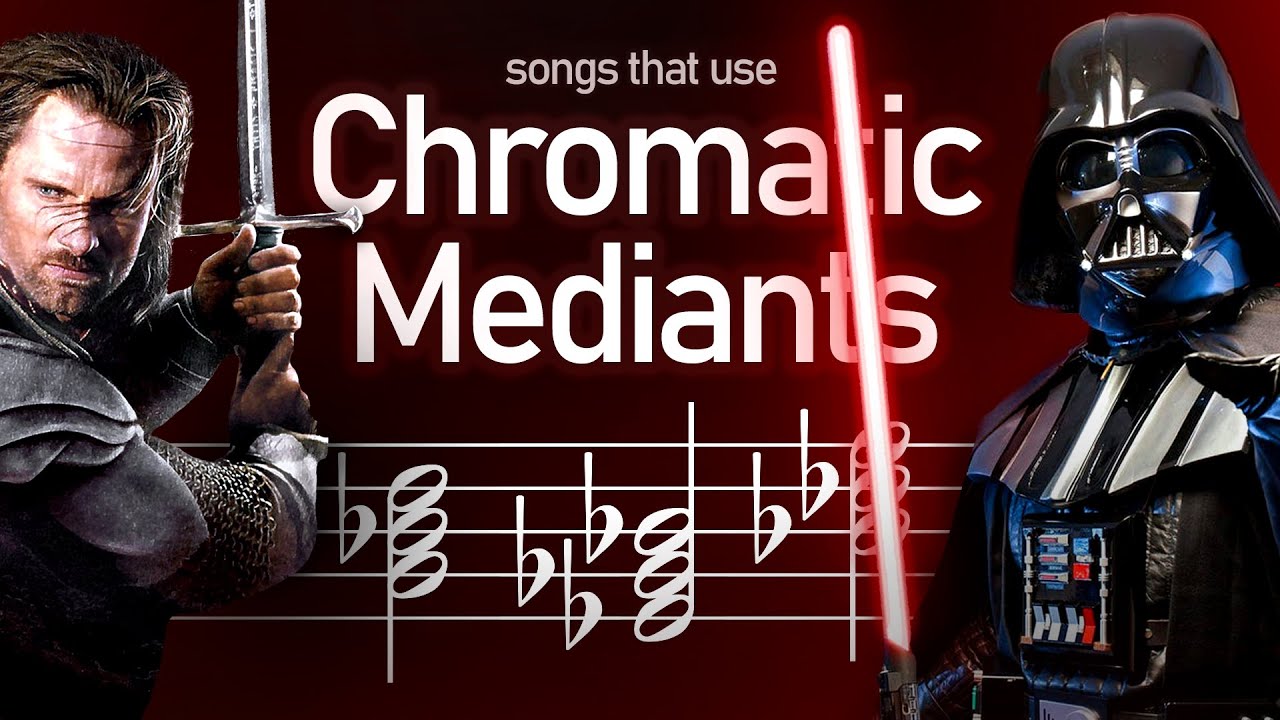
I totally dig chord movements in thirds, but they can be even more beautiful when you consider non-diatonic/chromatic chords there. They are called “chromatic mediants” and have often a very cinematic flavor.
As you can see, there is not bottom there in the hole that is “harmony/chordal theory”
Well thanks @joergkutter , now I’d also like to get that under my fingers too! Usually when I learn about things like that I try to ‘simplify’ it into a basic principle. Something that can be used in most cases. That way my brain/playing can keep pace with what is happening. For example for secondary dominants I tried to limit it to the 5th below the root note, so that the positions will always be the same. I know this leaves out a lot, but it keeps it manageable. And that is something that gets away from me (and I suspect many people) with jazz, is you can quickly get into information overload while still not being able to use what you are learning.

 :
: