Hi all, just went through the first lesson with string crossing last night (I think it’s in M3 somewhere) where the riff is from Sweet Home Alabama, and you cross from A to E and back. I’m having a heck of a time with it! I’m getting all kinds of noise from E when playing on the A, and just general “that ain’t right” sounds from what feels like all over the place. I’m anchoring on the pickup - should I move anchor to E when playing the A? That seems like a lot of moving, or maybe it’s just me not watching. I’m having a hard time between watching the fretting hand and trying to watch my plucking hand. Maybe this will improve with more play time? I’ll probably try to run back through the playalongs in my next practice session. Did anyone else get tripped up here?
Either anchor on E, or as you are plucking, pull through and rest the finger that just plucked on the E to mute it.
You can also use your ring or pinky finger on your plucking hand to mute the E string. You have options!
 This! As BassJase said, if you are plucking across, your plucking finger will touch the E string after plucking A, and the E string will be muted.
I was in this exact same place when I started. Strings ringing and trying to figure out how to mute them, and I was frustrated. The good news is that this will become easier with time, and soon you will be muting without even noticing.
Throughout the course, Josh speaks again about muting techniques, so as you progress through the modules there will be more tips and reminders.
The easiest muting is when playing adjacent strings, like A and E, because the E string ringing is also a reminder to improve your plucking. When you pull across the A, the finger will touch the E at the end of the movement. For now you can work with that.
The ring finger and pinky can also be used to mute strings, by placing them on the string you want to mute, like BassJase said. Josh tells more about that in the following modules.
In the beginning I was told an useful advice: don’t worry too much about that, because there is too much to learn in the beginning. But as you go on, you will learn all this, and it will become easier, and soon second nature.
Hey there!
I watched the lesson video and Josh rests on the pickup, but he mutes the E-string with his fingers, like the others said.
Try to go slow and just watch your plucking hand first, then add the left hand muting.
Exercise one - Muting with the plucking finger
- Watch the right hand only for the time (Josh does that too, briefly at 3:07)
- Rest on pickup
- Pluck A string once and leave the finger on the E string
- Pluck A string again and switch the finger that rests on the E string
Exercise two - Mute with the left hand
- Rest the left hand on the strings so that you only get a muffled sound, no overtones, no notes
- Raise the fingers slightly
- Pluck the A string once
- Lower the left hand fingers back on all strings, like above: no overtones, notes or rattling
- Repeat slowly
Exercise Three - Combining the strings
- Rest on the pickup, mute with the left hand, too
- Like in Ex.2 raise the left hand fingers while you pluck the A string
- While plucking, rest each plucking finger on the E-string, like in Ex.1
- Optional: mute with the left hand, inbetween plucking with index/middle fingers. At first, this might be too much to coordinate - and not necessary.
- Switch to the E-string, still resting on the pickup
- Mute all strings with your left hand
- Pluck the E-string
- Optional: just like Ex.2, rest your plucking fingers on the pad of your thumb/pickup after each pluck
- Mute with all strings with your left hand
- You made it!

By the way, string crossing is one of the most overlooked drills. People often move on too quickly, including me.  Then they come back when muting becomes important, or when they learn slap.
You got this!
Cheers,
Antonio
Thanks everyone! I’m going to run back through the exercise and get some practice in with what you guys have mentioned before I do that.
Ran back through the playalongs and did much better with muting on the E string with my ring finger on my plucking hand. I also played around with moving my anchor from the pickup to the E…both were effective.
In general, how long did it take you to get comfortable with string crossing? I started my lessons in mid-April and took a good week and a half of due to the flu.
It’s still kicking my rear end a bit. Josh put out a couple of videos and I’m going to try the one with 5 levels of difficulty.
It adds challenge to a bassline. If the bassline is slow or simple it’s fine. If you are already challenged by the bassline then the string crossing makes it extra hard.
Developing any physical skill takes time, especially when it comes to fine (and fast) motor control. You should be thinking in terms of months, not days or weeks.
For any new technique that moves your fingers in a way you haven’t been moving them, the first week or two will be spent getting your brain to figure out how your fingers should even move. It will take focus and may even be mentally exhausting. The next few weeks after that should start feeling more instinctual, and you should be making fewer big mistakes. After a couple of months you should be able to do it without thinking about it, though it will probably take even more months to feel like second nature.
And keep in mind that “string crossing” isn’t a single skill, it’s a set of them. For example, a root-third-fifth pattern is a different type of string crossing than disco octaves. It’s a completely different shape and motion with your plucking hand. The more of these skills you’ve learned, the more quickly you’ll pick up new ones, but they will all start out feeling awkward at first.
Anyway, the point is to keep at it, and in July you’ll be playing across all your strings and wondering why you thought it was so hard.
A couple of weeks and it seemed to get better. I’m still not great at it. I do better going up than down for some reason (E > A vs A > E).
This is exactly what I needed to read. I crushed the first 3 modules. Modules 4 and 5 have been kicking my butt the last few days. I’m getting through the slow workout, but struggling on everything else. I want the immediate gratification of success. It’s been a humbling week. I’m glad it’s happening though. This will build resilience. I’m looking forward to going back in a week or so to see my improvement.
We all do! But personally, I think the delayed gratification is one of the best things about learning bass (or any instrument really). It helps get our brains off of the dopamine loop by reminding us there is value in slowly chipping away at a task, bit by bit, to gradually reveal something greater. It’s a different kind of satisfaction, and I like it better than the quick rush.
I’ll stop before I find myself turning into Calvin’s dad. 
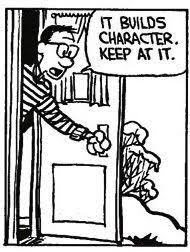
Well said. I couldn’t agree with you more.