I started playing bass 3 weeks ago and since I know habits are hard to get rid of, I want to go for the right plucking hand position at the beginning.
Option 1: Josh’s Approach
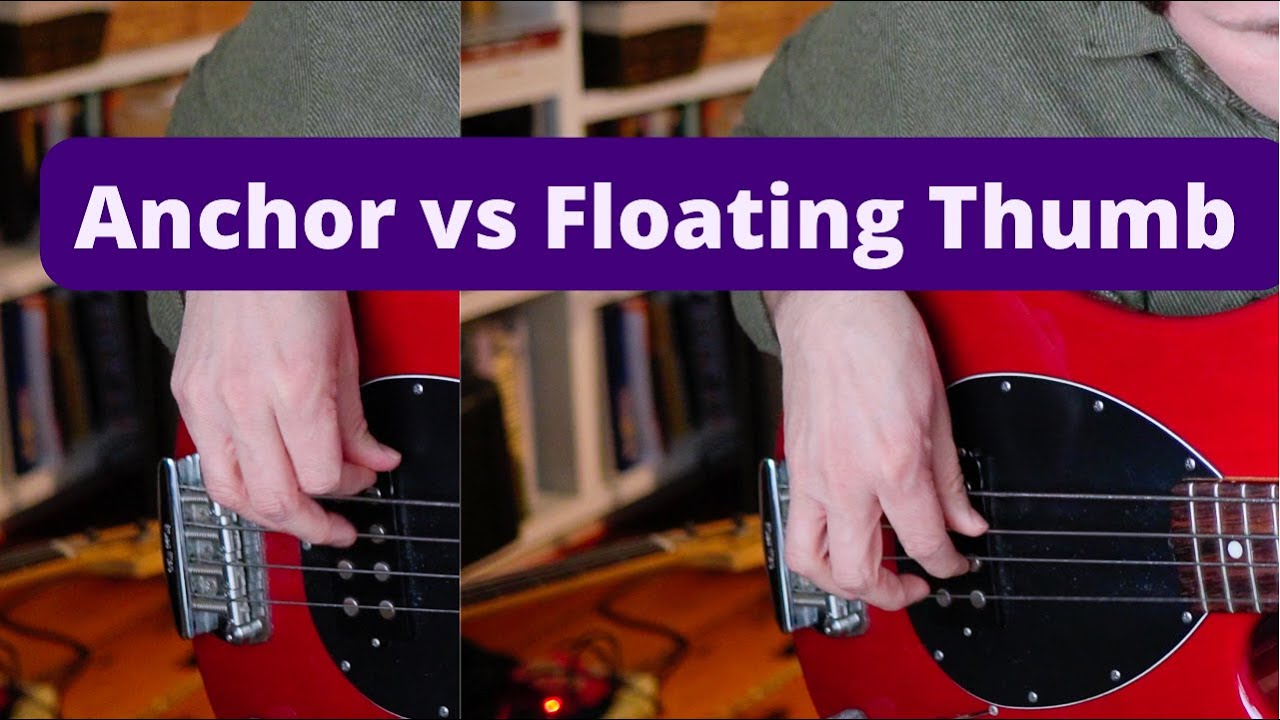
The thumb rests on the pickup when playing the E and A strings and moves to the A string, muting the A and E strings, when playing the D and G.
Option 2: Study Bass’ approach
The thumb rests on the E string all the time and only moves a few millimeters above the E string when this string is played. When the A and D strings are played, the thumb doesn’t move and index/middle are muting them. When the G string is played, the ring finger is muting the A string.
—
The StudyBass’s approach is harder for me, but I feel like it’ll be much easier once it becomes natural, because I won’t have to move my thumb as much.
I don’t know which one to choose honestly. I am a bit lost but I have to make a decision and stick with it.
Any advices / feedbacks ? Have you try the StudyBass’s technique?
As with everything on bass, there is rarely one correct way to do something. My advice would almost always be: do what feels most comfortable for you.
At your stage, I honestly wouldn’t overthink it too much, as you’ll likely use both approaches (and others too) in the future to fit what you are playing at the time.
I would say if you’re working through Josh’s course then you should do your best to follow the way he teaches it, as he does this for a reason and certain techniques will build on ones that came before.
I remember when I was figuring this out myself. Option 1 seemed so difficult at the time because I had to consciously think about moving the thumb. After enough practice, that goes away and it just becomes automatic. While I agree wholeheartedly with @THRILLHO here in that you should do what feels comfortable, at the beginning it’s ok to expect it not to feel quite natural yet.
My $0.02 - I think option 1 is better for you in the long run and is worth putting the time in to master, but option 2 is also perfectly acceptable.
Do what works for you without thinking about it and you have your answer. FYI - you may find yourself doing both here and there. Remember, once muscle memory kicks in you stop thinking about this and it just happens.
I agree with John_E, see what works for you. Choose one and do it for a week, then re-evaluate.
There’s the floating thumb technique, too. It’s a lot of fun and very versatile - but at first maybe too overwhelming and inconsistent.
The Study Bass version is new to me. I’d be concerned that the plucking hand gets locked in one spot for too long. I like the movement of the movable anchor technique (Bassbuzz), it’s relaxing for my hand.
I used to be quite rigid about my thumb rest: pickup for E, E for A and A for D and G. However I now find I vary it according to the piece. Often I still play as above if the line moves around a lot. However, many bass lines focus on the A and D and don’t use the G and hardly use the E. For these I just stay on the E just lifting free for the occasional E string note. So now I guess I just use what works and is comfortable.
I come from playing fingerstyle guitar, where the thumb plays bass as the rest of the plucking fingers play the melody (and chords, as required).
“Anchoring” any finger, let alone the always-thumping thumb, felt totally foreign and restrictive to me when I took B2B. So I started floating my thumb as I play.
Rather than resting my thumb on the E string, which requires a decent reach to pluck the D and G strings, I move my whole plucking hand across the strings so each pluck is played with the same, consistent technique, from string to string. As I shift my hand from plucking the E to play higher strings, I mute lower strings with the side of my thumb.
Might seem weird, but it works comfortably for me.
Doesn’t seem weird at all, as we’ve discussed this is what I’m using these days as well. It just wasn’t one of the options he mentioned trying to choose between
Now where’s @Al1885 when we need him? Somebody needs to suggest the Gary Willis technique! (Which does seem weird, but also makes a lot of sense!)
I didn’t miss the point of the OP’s original post. I offered another perspective. Freely offered and equally welcomed to ignore.
Regarding Gary Willis, his is the exact true floating thumb technique I described, and use.
As per Google:
Yes, Gary Willis is widely credited with inventing or popularizing the “true” floating thumb technique for the electric bass. Unlike traditional anchoring techniques where the thumb stays fixed on a pickup or a single string, Willis’s approach uses the thumb as a mobile muting device that rests against the side of multiple unplayed strings to keep them silent.
yeah! I taught this to Gary years ago before I was born, he’s mastered it. So proud of him.
If you just started everything is hard so might as well go with the best method.
In general fixing your thumb anywhere is just bad. You are losing dynamic and ability to generate note articulations. You want to keep your plugging relatively even but not dead even, little accents goes a long way. Different plugging positions also promote different tone if your thumb is fix on the screw tab of the P bass you have no chance.


 yeah! I taught this to Gary years ago before I was born, he’s mastered it. So proud of him.