Im struggling to comprehend.
The opening few bars on ‘sultans of swing’ has us playing D to C on the A string, then jumping to A on the E string.
Being a newbie, its sooooo much easier to play the A note on the open A string.
So why do the tabs have me making the almost impossible switch of back and forth between the A&E strings, when all i need to do is lift a single finger a few times ?
Tabs are a suggestion, play whatever makes it easier for you
5 Likes
When possible I try to avoid open strings, only because our singer tends to change things often and asks the guitarists to move capo’s up the neck to make thing easier for her to sing. As a result, it really throws me because I’m not at the stage yet where I can translate what they’re playing. So i rely on patterns played higher up the neck to get me through and by playing all fretted notes it makes my life way easier.
2 Likes
I prefer the fretted A, D, G because I like the tone better and it’s easier to mute.
5 Likes
I play open strings all the time. Muting is doable with practice. They also sound just fine in a bass line.
I would play the A on the E string in that pattern. Makes total sense to me. Not a jump. Your hand stays on the same position and just shifts down a string. This is a super common pattern that you see EVERYWHERE, and that you should get a lot of practice playing.
Like… that 1 - 5 - 7 shape is one of the most common I see/use.
It’s not so much the shift, if it were a single shift, i could handle it, but its a constant back and forth from C to A on different strings that i can’t perform.
…yet.
If you prefer the open string, use that. But going back the root and 5th below on adjacent strings happens a lot, and is good to practice. You won’t always be able to make use of the open string.
2 Likes
5th fret of the A string is about as close as you can get to 5th fret of the E string. I wouldn’t call it a shift since you can play all three notes without really moving your hand at all. Pinky on 5th fret A, index on 3rd fret A, ring on 5th fret E.
I see this song tabbed using open strings (Songsterr) so play it however you feel is easier
Well i had another look at it today.
And playing open A to fretted C back and forth is so much easier than playing a fretted A for me.
Then do it that way
3 Likes
I do it both ways as the mood suits me. Learn it both ways and don’t fret too much about it!
3 Likes
I see what you did there 
2 Likes
Perhaps a fretless bass would help! 
As a beginner who is not in a band playing these songs for money I look it it this way. I’m playing songs less for the song itself and more for whatever technique I’m trying to practice and master. String crossing between fretted notes is an important thing to master.
The two riffs I make sure to work on every day now are Billie Jean because it is a series of eighth notes with your fretting hand in a relatively static position, this is difficult for me because my fingers get confused and tied into knots.
And then every day I play the opening to Sweet Child of Mine because it has a couple of shifts because it is played between the ninth and 16th frets. Right now my shifts are slow and not as accurate as they should be, sometimes I miss the fret I am shifting to.
Sometimes there are easier way to play things. People better than me often say the easier way doesn’t sound as good, often I can’t tell the difference at this point. I tend to take their word for it because worse case scenario is I’m practicing a skill that I know I need.
2 Likes
I just took a quick look at that one (it’s one I keep thinking of covering) and I actually find it easier to play using the E string:
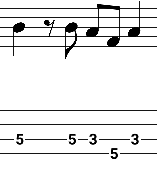
The reason I find it easier is that I play the two Ds fretting the 5th fret A and then the 3rd fret and then rake my plucking finger to the E string on the 5th fret and back to the 3rd A again. I find that rake makes it easier especially if you start plucking with the first finger and the rake will then be first finger down to the E string ready for the middle finger to go back to the A, and you’ve already lifted the ring finger (in my case) from the 5th A (to fret the 3rd) so it’s ready to fret the 5th E. Hope that makes sense. (I’m doing all the fretting in this bar with my first and third (ring) fingers).
Looking on further into the song there’s a fair bit of string crossing you’re going to have to do anyway so might as well get used to it! But as others have said do what works for you; I often change the tab to suit my fretting and plucking preference.
5 Likes
Same here. To me, this is easier, more comfortable, and sounds better.
Using the open string is easier as a beginner when you’re paying attention to the attack of how you PLUCK a note. Crossing strings is easier as an intermediate where you’re paying attention to how you RELEASE a note. Also makes rhythm easier.
It’s also easier to play that second C. If you play the A on an open string, you need to completely remove your fingers from the A string. If you play on the E string, you keep your index finger on the C, and have less work when you play it again. Your index finger is already in position to fret it.
This shape made by the Root, minor 7 below it, and 5th below it is the most common one I have seen in western popular music. Playing root notes is 1/2 of your job. This shape is 1/3.
2 Likes
and that is both A. how you would play it outside of the lesson, and B. probably why you’re being told to play it this way in a learning situation, its more challenging.
1 Like