Not sure how to approach memorizing songs. For now just practicing over and over and trying to figure the parts but I’m afraid that even one day or two without practicing makes me forget a lot.
1 Like
Most rock songs are broken down in to sections (verse, chorus, verse, etc.), try picking the song apart and learning the sections until you’ve got those down, then put them together. There might be some variations in the chorus or whatever but if you get the main body of it down, you’ll be 95% of the way there. Also, for difficult sections, try slowing them down to 50% and working up to playing cleanly at 100%.
4 Likes
The system that works best for me is to approach Bottom Up, rather than Top Down.
Top Down is brute force memorizing all the notes one after the other in order. This takes a lot of energy, and if you slip up, things tend to fall apart.
Bottom Up means you start with the basics of the broad structure first and gradually fill in more and more detail as you progress. Find the key. Find the root notes of the major chord changes. Then figure out basic melodic motifs. Then figure out where things are fills, improvisations, or embellishments. Start with the verses or A section (these tend to be simplest), then Chorus or B, then Bridge.
With this system, if things get to be to be overwhelming or time goes by without practicing, you tend to revert to a simpler version of the song rather than everything falling apart. It also takes off a LOT of pressure because you quickly recognize what lines or patterns are actually integral to play precisely and what lines are just the improvisation that the artist happened to play on that take (it’s a LOT).
7 Likes
Thanks 
My irl teacher wants me to really stick to the fingering pattern instead of sometimes using a pinky instead of ringfinger. How can I make my spread between index finger and ringfinger a bit larger so I dont have to shift my hand so much?
[/quote]
You can’t. (Unless you’re a child whose hands are still growing.)
You will have to shift your hand to span fretting gaps. This is a completely proper technique.
What is the context for this direction? Are you working on playing scales and the instructor is directing you to practice 1-finger-per-fret technique? So your instructor wants to you play a whole step with index and ring finger, then half step with pinky? If so, it’s good to practice fretting those notes with those fingers, but you will (probably) need to shift your hand off the lower frets as you do.
If this is something else weird and your instructor is hung up on ALWAYS using finger-per-fret and never using Simandl. That’s not necessarily a “wrong” way to play, but there are other ways that are more efficient.
It’s entirely possible that this instructor is the wrong fit for you. (I dropped one that kept insisting I use finger-per-fret when it made no sense.)
Josh has a great video about this:
1 Like
There’s nothing wrong with micro shifting! It’s a very common technique so don’t worry if you have to shift.
Personally I would encourage the use of the pinky - for the first year or so I was playing I couldn’t make the stretch from the 1st to 4th frets without putting a lot of strain on my fretting hand. I’ve been playing for around 4 years now and I can easily make that reach.
3 Likes
Awesome video ! Thnx!
Me too! It is overwhelming. I think I need to train myself to tie in with the drummer or click. It will get better with practice. When I practice with Songster I usually turn off backing music. I could turn it back on when I have good handle on the tune. It may help me to play with the “noise”
1 Like
Does anyone have any tips on how to comfortably play the higher frets closer to the pick ups? My hand gets all contorted and my pinky barely reaches G string when my hand is in position with thumb behind neck. I need to elevate the bass to change my approach to reach some frets.
Hold your hand how it is natural and comfortable. If you have to hang your pinky in the air, there’s nothing wrong with that.
If you have to adjust, bring the bass in line with your hand position rather than trying to bring your hand in line with the bass. This likely means holding the bass up higher on your chest, angling the neck up higher, and possibly even shifting the body of the bass over towards your fretting hand.
Standing up might also make it easier.
Here is Chris Squire of Yes demonstrating:
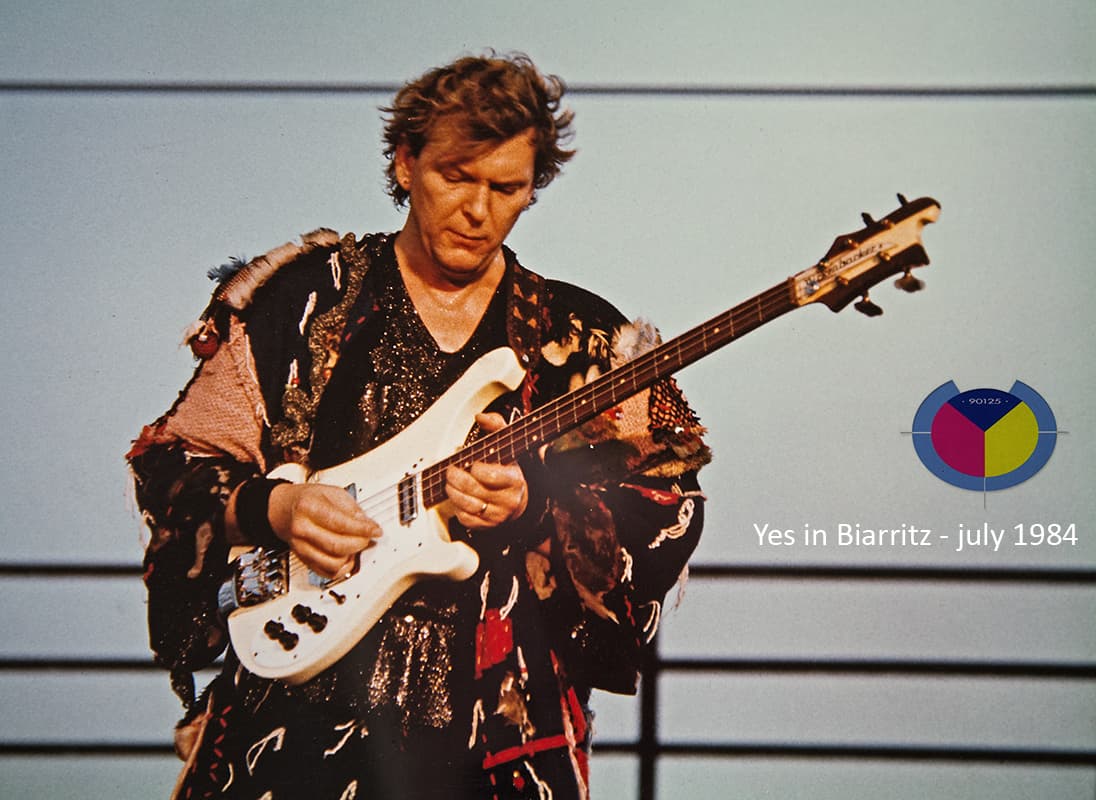
Bass in his normal position. Pinky in the air.
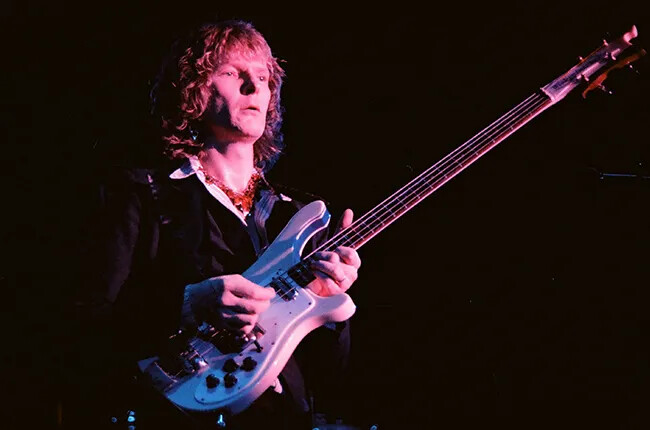
Pinky on the fret - bass held with the upper horn up by his shoulder.
2 Likes
You need to be comfortable enough with what you are playing that it does not require 100% of your focus. Then sort of “pin” the different lines of information you’re processing into different things that your brain processes separately.
You can probably multitask enough that you can ride a bike, hold a conversation with someone, and reach down and take a drink of water while listening. You can multitask enough to split your attention at least that much.
I can’t tell you what things will work for YOU to associate and split your attention similarly with regards to playing music.
For ME. The things I think about and do are:
- Hearing tonal parts as part of chords instead of individual separate notes.
- Hear parts as in conversation with, not isolated.
- Taking different instrument parts and physicalizing them in different parts of my body.
For the first- practicing singing harmonies helps.
For the second - listen actively to jazz. It is constant back and forth playing ideas off of each other. Funk is also great for this. (But funk and jazz are close relatives.)
For the last… I’m a dancer, so that is something I’ve practiced a lot. Picking an instrument, associating it with a part of my body (feet/legs, head, chest/shoulders, arms/hands) and moving in a way that represents what the sound feels like.
The simpler version I’d suggest to start this: pick a song and walk or jog to the tempo of it. Now your feet are probably keeping time with drums. Keep moving and start bobbing and swaying your hand to something else. Then start waving your hands and fingers to other instruments.
For me - I usually associate my feet with drums; my chest and core with the bass; head with something like rhythm guitar, and hands with melodic or lyrical instruments.
1 Like
module 11 lesson 3, papas got a brand new bag. its the first one im properly struggling with so far and i have to keep pausing the video with the tab on screen to keep practicing slowly. then when i think ive got it i play the vid again and i still havent 
i’ll get there…
1 Like
Right there with you! I still can’t do the fills in the context of the actual song, but practicing slowly I can. I have moved on, however, and will practice it in between lessons.
2 Likes
This is the way. ^^^
3 Likes
I have printed off the tabs on several lessons and tried to get it under my fingers before returning to the videos. My problem was not so much playing it as just remembering the where to put my fingers next. Once it’s played at any speed at all I can’t keep up with the video. Add in trying to pluck with the right finger and muting, it’s a lot to keep up with all at the same time.
This is true. But multi-tasking a particular activity is something we all do every day, without giving it a second thought. A prime example is driving a car.
When we all were just learning to drive, we had to learn a slew of laws, best practices safety precautions and physical techniques. It was a lot, particularly for a newbie.
But we now (hopefully) know and perform the act of driving as second nature.
It’s the same with bass. There is basic music theory, note locations on the fretboard, and physical fretting/plucking/picking techniques to learn and apply — just to play a riff, line or song.
It is a lot. But it all comes together — given patience, time and slow, mindful practice.
Isolate any particular aspect of playing that seems tricky for you. It could be muting, string jumping, fretting/plucking coordination, timing, etc. isolate a riff or a single measure in a line or song, and slow it down to a crawl — to the point you can play it cleanly. When you can, that’s a win, regardless of how slow you go.
Just slow down and enjoy the journey. You got this.
2 Likes
Thanks @BeerBaron
Thanks, Mike, and I agree. My post may not have been very clear. As a reply to sadexpunk, I was just saying printing off the tabs might make it easier to learn the riff before returning to play along with the video. I can be long winded and talk in circles.
2 Likes
The simple answer is practice it enough your body knows where to place your fingers without thought. You shouldn’t have to think where your fingers go next. Do it slow, and speed up when it’s automatic.
1 Like