so i guess this is coming up with patterns from the 1-3-5-7 of a chord rather than just 1-3-5 yes? but would a guitarist ever call out ‘this ones in Fmaj7’ or whatever? i thought itd just be a simple major or minor chord.
thank you. but that final major third is just the normal 7th in a major chord no? so in C is a B? so why is the chord Cmaj7 and not just C major?
and similarly, the C7 (C dominant 7). the final minor third just makes it the usual 7th note for a minor chord (Bb?) so why is this called C7 or C dominant 7? what stops it from being just the C minor chord?
Well, I am only at 12/13 in the first module. Like I said, I have watched them several times before it started to click (barely). Once it does you can see how understanding the theory helps you to come up with baselines. It shows how and what go together to make musical sense. The patterns you’re looking for are all these various chord sequences. I’ve started looking closer at the songs I’ve learned from say, Songsterr, and put them into these triads/intervals and it starts to make sense.
I’m doing module 1 right now and Mark goes over all of this. I’m just intentionally going way slower than I feel like I should to catch everything. I watched the lesson on intervals every day for a week as I was noodling away at them all around the fretboard, even though I thought that I got it after the 2nd day. I’m doing the same thing with the triad lesson currently.
@faydout Agree completely. This course goes much deeper than B2B and needs more time to absorb. B2B gets you playing, GT will give you the understanding of what you’re playing and how it all fits together.
Ah, well - one is the key of a song (“this one is in F major”), while the other is concerning chords. It is often up to the guitar player or keyboard player to use the standard triad chord or a seventh chord. Adding more notes than the standard triad makes for more color, more variation, more interesting harmonic choices.
Again, the semantic distinction is between a scale (C major scale) and a specific chord (made from notes of that scale). The Cmaj7 chord contains the 7th, whereas the Cmaj chord does not.
That’s where these different combinations come in. In order to be a minor chord, the first triad needs to be a minor third. That said, the Cmin7 chord has indeed the minor 7 on top (Bb).
So, maybe we need to briefly look at more of these 7th chords.
Cmaj7 - C E G B
C7 - C E G Bb
Cmin7 - C Eb G Bb
Cmin7b5 - C Eb Gb Bb (also called C half diminished seventh or Cø7)
Cmin maj7 - C Eb G B (not so often encountered)
You could construct more of these…
Anyway, confusion often comes from “sloppy” use of terms (all musicians do it).
Nothing really to add here but I’m happy that that I brought this up the other night. This turned into a whole thing and I’m learning a ton. Some of it is still over my head. Thank you @joergkutter (since I’ve already thanked Howard and Mike).
To be clear, the Groove Trsiner course is not intended to teach theory, per se. It primarily presents a methodical progression of short lines (brief etudes, actually) for students to work through in order to gain technique and timing practice. While the lines are constructed harmonically correctly, Mark doesn’t dive deep into how they are constructed. Rather than a theory course, GT is a practical playing course that provides bass lines to practice.
Creative Bassist is intended to prepare the student to create original bass lines, fills and, eventually, solos. It is a methodical curriculum that requires students to write simple riffs and lines pretty much from the start. Mark provides instruction and context, but the responsibility to come up with lesson lines is on the student, without handholding. In short, creating lines is up to the individual player.
Lastly, the Chord Tones Essentials course is a massive deep dive into intervals, chord construction (major/minor), triads, seventh chords, chord inversions, and much, much more. It’s a music college-level course with tons of reference material and potentially years-worth of study. That said, Mark starts off with simple core concepts, assuming the student is brand new to the subject matter. The course is not intended to be fun or simple. It definitely requires work and dedication, as does anything worth doing well.
I picked up the Music Theory course to do next. I’m kind of wishing that I’d gone with Chord Tones tbh. I’m really enjoying this whole chord construction part of GT, and it’s making a lot of things that I thought were just random and “sounds good” fit into place. Even almost 2 years into playing. I’ve already noticed over the past couple of weeks that I’m looking at tabs on Songster and telling myself… Oh, thats a major 3rd into a perfect fifth… kind of stuff and it’s making it easier to memorize. For instance, I’m working on one of the songs that I’ve wanted to play since before I bought my first bass (The New by Interpol), that’s been too hard. I’ve done check ins every few months and it hasn’t been there. I tried it out last week and got the opening riff down in a half hour.
Mark’s music theory course is designed specifically for bass, and it’s really good. It goes into every aspect of theory. There is a lot of complementary material between it and Chord Tones. For anyone interested in a holistic approach to music theory, it is excellent.
Mark created this course many years after Chord Tones, based on what he’d learned from his TB teaching experience and student feedback. If you choose to study it, I think you’ll get tons of benefits and not be disappointed.
I’m still working on finger issues. I just found this video on the Spider Walk exercise. I do a bunch of the “bunch” and “seesaw” that this guy talks about.
I’m really struggling with pinky rolls right now; the joint collapses backwards unless I keep it perfectly arched….can’t do that when I’m rolling, and I can’t supplement with my ring finger at speed. I’m starting to worry that I won’t be able to make it behave because it’s getting worse with practice and not better (I’ve seen an orthopedist for this hand before, it’s hypermobile, thinking of getting a brace for it and seeing if it helps)
I am finding musicians open to playing with me. Problem is they’re above my skill level and I’m working to set a realistic goal on the level of skill I need to feel like I’m not wasting their time (kind of a what level belt do I need to practically spar with a black belt).
In the other hand I have two friends that write and produce their own music with Pro Tools. It’s another way to go to explore your creativity.
I’ll probably start with the latter.
How was the BecomeABassist course. Any other recos.
Sounds like a great way to get better. I’ll just repeat what I have seen written here; playing in a band and especially with those better/more experienced than yourself is the best way to improve.
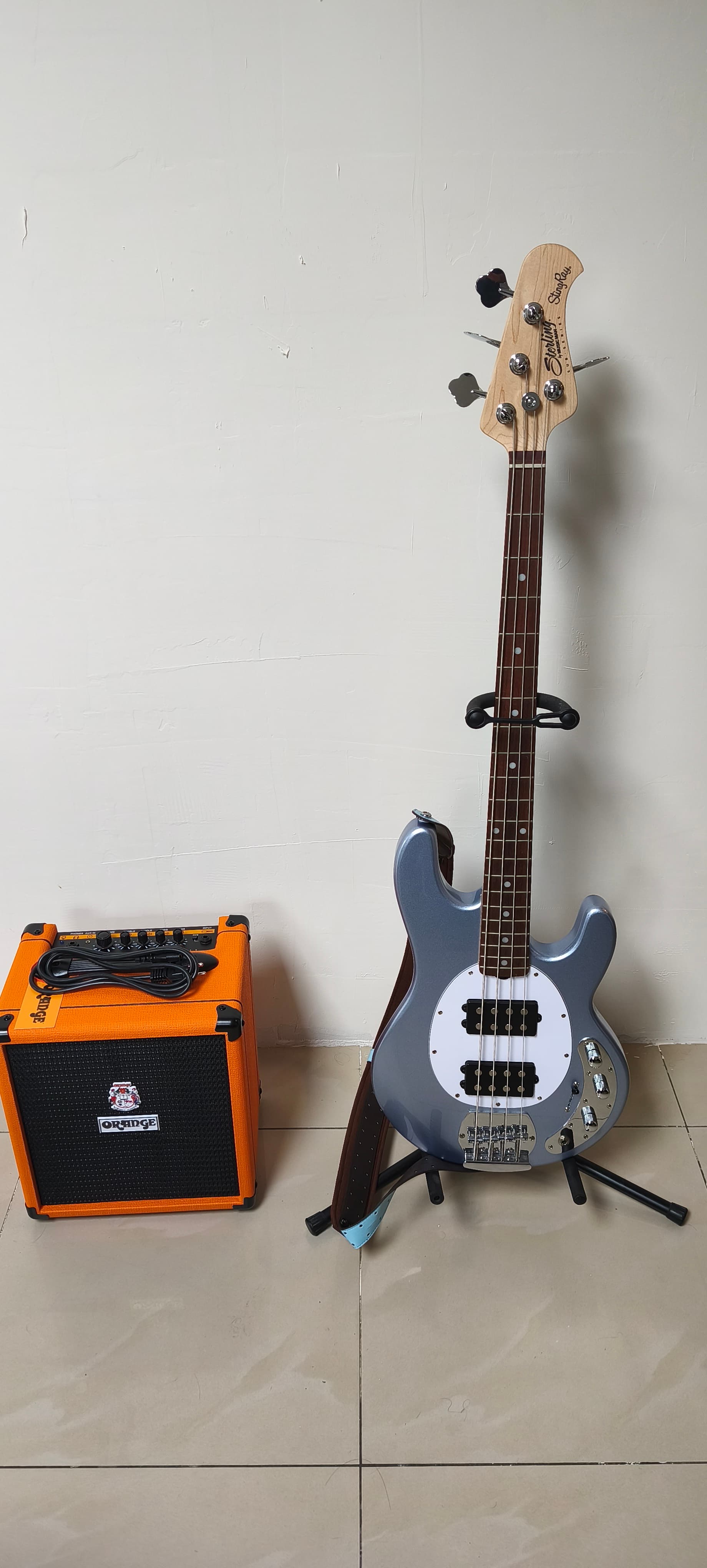
Hello, new here. I’ve started my journey a couple of weeks ago and currently at module 4. I As just wondering, recently I’ve wanted to try slapping even if I know it’s not yet the time, it was really more fooling around. Thing is that, I also watched the 7 step to slap video and I got an issue. When I try to slap it actually makes a sound but at the same time the cord strikes the last frets and it makes unpleasant noise. I tried relaxing but I don’t know if I hit the cord too hard or if something is wrong. I got a sterling stingray sub 4HH if it can help
How was the BecomeABassist course. Any other recos.
@geoff it was decent value for money. and tbh it didnt seem to be any lower standard (to me anyway) than the talkingbass ‘groove trainer’ course which is more expensive yet so far hasnt given me anything more than the BAB course did, (although i still have some of the later GT ‘grooves’ to go through.
im still toying with the idea of asking for a refund on the GT course and plumping for the Creative Bassist course instead which i think would be more suited to someone finishing this B2B course, although that seems to go against popular opinion, so i maybe ought to give it more time.
I haven’t taken it so I can’t speak to it, but I would maybe send an email to Mark and tell him your concerns. Maybe he can help you work out if this course will work for you. He’s on this forum from time to time and I’m sure he’d address your concerns.
Not so much the muting itself per-se, but more the right/left hand coordination when playing staccato notes. It feels like both my hands are coordinating to the beat, so I end up playing a ghost note instead of playing the note and then muting it shortly after. I need to find some way of coordinating my left hand separately to my right …
I also need to figure out the best way of muting open strings when crossing to another string.