that’s a perfect sum up of the general go-to rules, yeah.
don’t be too shy @joergkutter , you know how it works now and you’re totally legit when you say such things 
that’s a perfect sum up of the general go-to rules, yeah.
don’t be too shy @joergkutter , you know how it works now and you’re totally legit when you say such things
Agree, all I would add are maybe some examples (i.e. stuff you might want before the preamp so it gets overdriven too if you overdrive the preamp). Like the good example with Modulation effects being last and post-preamp there, especially reverb.

As long as it does everything you need, absolutely. I like having a dedicated tuner pedal, so I’d add that. Some people add a dedicated preamp/DI pedal to get an XLR out (the HX Stomp has a balanced 1/4" TRS out which is just a simple adapter cable to XLR, but it’s one more loose thing to keep track of so people don’t always like it).
The built-in effects don’t always do everything exactly the way you want them so there’s still legitimate reasons to use dedicated pedals for some effects, especially if you really like the way a specific pedal sounds. I’ve found after playing with a couple of multi-FX capable amps that the “generic” (from NuX) or single-branded (from a Boss Katana amp, which replicates Boss pedals specifically) effects aren’t always what I want, so my preference is to pick and choose pedals from a bunch of different brands which are all the best (to my ear, that I’ve found so far) at what they do for the sound that I want - right now that’s seven different brands out of the eight pedals I have on my board. I haven’t tried the HX so I can’t say if it tries and, if so, how successfully it replicates different versions of the same effect, but it’s something to be aware of when considering multi-fx vs a rainbow board.
If you can be happy with the multi-FX unit’s effects, you’re saving yourself a bunch of money, space, and effort by not needing to try all sorts of different pedals and carry big boards to gigs.
Not a thing. We, regularly, raise threads from the dead.
This is it. @joergkutter has it right.
Very well stated, joergkutter!
Thank you all for the vote of confidence!
I have learned from the best 
(After all, I started this thread more than 5 years ago because I was (mostly) clueless!!)
Anyone have experience with the Boss GX100? Curious if anyone who has tried that and an HX Stomp would rate the two. I saw Boss just released the GX10 which is just a sized down 100
a quick DAI setup question. this is just theoretical, I’m not actually doing this. if you wanted to go signal out of your interface live to front of house, what is the easiest or best way? I think you can go TRS out of the interface into the FOH board, but I also think the preferred method is xlr out. so interface out into a DI box then xlr to FOH?
Many have balanced line outs, so just a TRS->XLR cable would work.
ahh so simple
Sooooo… I got an idea in my head (never a good thing), and I can’t get it out without executing it.
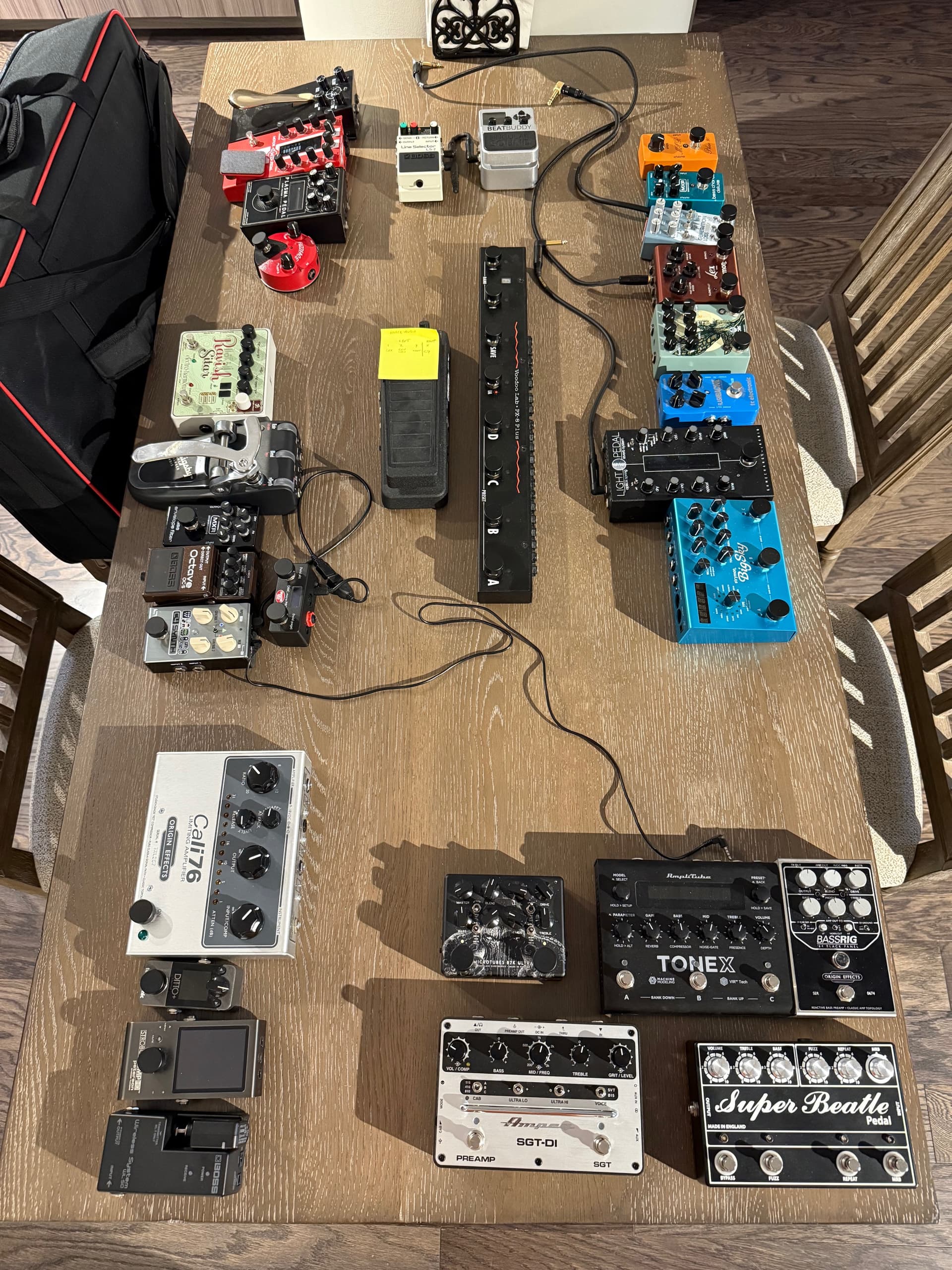
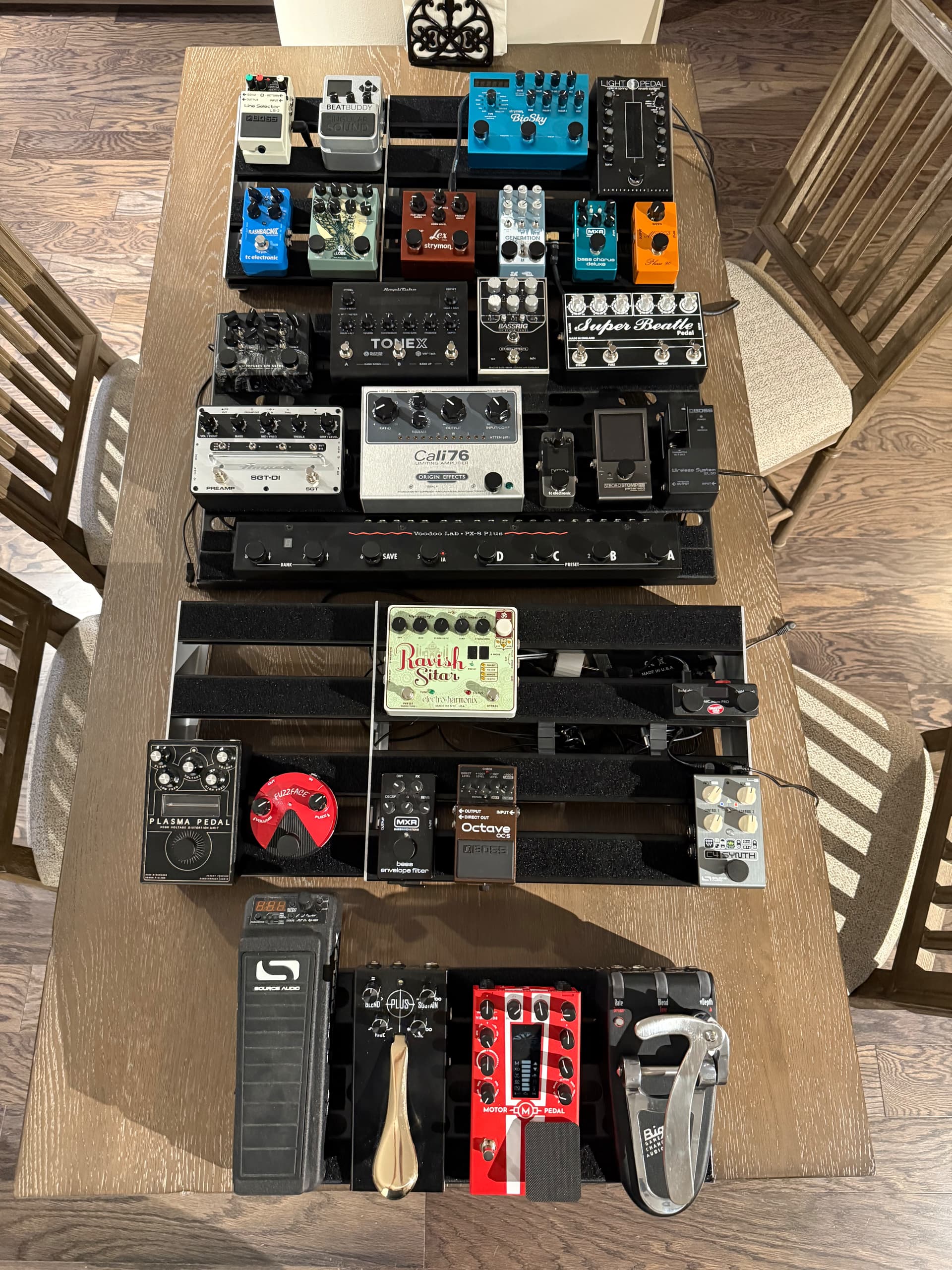
I have a LOT of pedals, and I really despise the ‘bend down to the floor to adjust scenario’. This has been bugging me for a long time. Therefore I have been looking at multiple ways to make a 3-D-ish/vertical-ish pedalboard. And so the project begins… (disclaimer, I know this project is completely rediculous, and I own that, and I like organizing stuff).
After a lot of searching, I settled on a Standtastic multi-tiered keyboard stand, which has custom width and heights settings.
I have ripped my 3 pedalboards apart, added back in a couple pedals that were in a drawer, and spent some very interesting quality time with the nice chatgpt lady figuring out order, adding in various bits and making decisions vs. the options for certain pedals she gave me, really cutting down on good old human thinking and time wasting, lol.
After quite a lot of back and forth, I have decided on the following order…
Bass → WL-50 Wireless → Strobostomp HD Tuner → TC Ditto+ (front looper) → Cali 76 Compressor →
PX-8 Loop 1: Tracking/Synth Section:
PX-8 Loop 2: Dirt/Chaos Section:
PX-8 Loop 3: Modulation/Ambient Section:
PX-8 Loops 4–8 (Pre-amps, one active at a time):
Loop 4: Super Beatle
Loop 5: Ampeg SGT-DI
Loop 6: Origin Bass Rig Black Panel
Loop 7: Amplitube Tonex
Loop 8: Darkglass B7K
PX-8 Main Output → LS-2 Line Selector + Beat Buddy → Amp Input
Off-Board Controllers (positioned to the side):
Source Audio Reflex Expression Controller – controls C4, Strymon Lex, Gamechanger Light, Generation Loss MKII parameters.
Disaster Area DMC.micro PRO – selects presets on Source Audio C4.
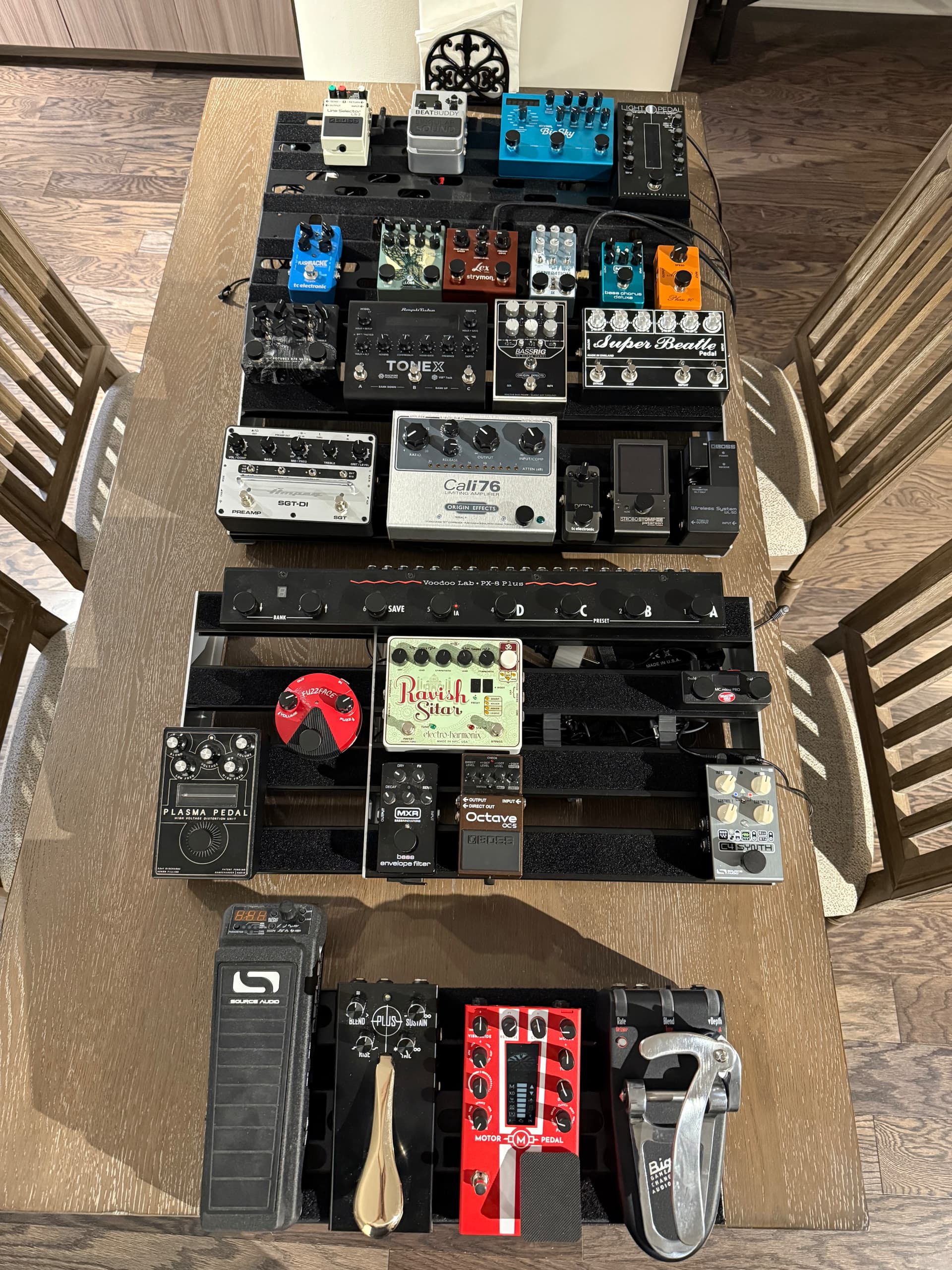
The PX-8 allows me to section off the various effects areas to keep the chain short when effects in a section are not needed, and secction off each individual preamp, since I only use one at a time, to ensure I don’t double up and go gain crazy by accident. The Reflex, Motor, Bigsby and Plus pedals need to go on the floor, so a small board will still exist down there, as they are ‘foot forward’ pedals.
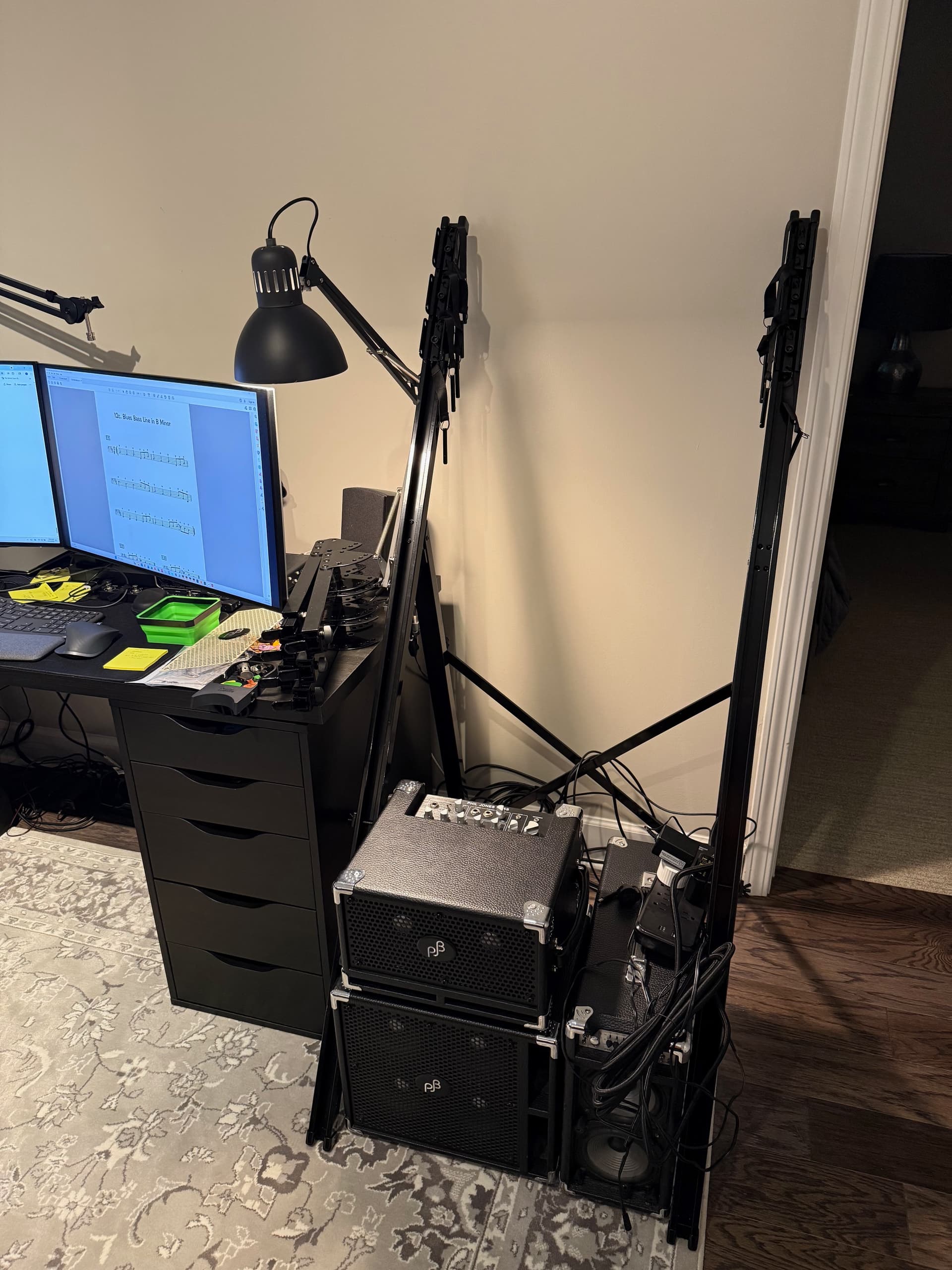
In my work apartment, I have my PJB rig, and a PJB briefcase amp which I have not spent a lot of time playing with. Going to try the upright through the briefcase and leave the bigger rig for electric bass, guitar and sax (ya, that’s a fun thing too).
In case you are curious, or a big nerd, or have nothing else to do right now, below is the rationale for the chain (again, thanks chatgpt lady! - FYI - i was kinda close in my original setup to this, but made tweaks based on her reco’s in a couple areas, and had a few questions to get options on, the whole process took about 30 minutes of planning). Now all i have to do it assemble it 
WL-50 Wireless – sends a clean wireless signal to the board.
Strobostomp HD Tuner – tunes before any effects.
TC Ditto+ (front looper) – records clean bass phrases before compression or other effects.
Cali 76 Compressor – controls dynamics early, optimizing pitch-tracking and synth effects.
C4 → Vocorder → OC-5 → Bass Envelope → Bigsby → Ravish Sitar
C4: Main synth/pitch effect.
Vocorder: Tracks clean/compressed bass, adds vocal/synth textures. Must come before octave/envelope for accurate tracking.
OC-5 & Bass Envelope: Post-vocorder processing for octave and filter effects.
Bigsby: Vibrato/tremolo.
Ravish Sitar: Harmonic coloring.
Reflex expression can manipulate C4, Vocorder, and other downstream parameters.
DMC.micro PRO selects C4 presets remotely.
Rationale: Tracking-sensitive effects are early. Vocorder placed before octaves/fuzz ensures accurate pitch tracking and preserves expressiveness with Reflex control.
Phase 90 → Chorus → Generation Loss → Lex → Lore → Flashback → Light → BigSky
Reflex expression controls Generation Loss, Lex, Light parameters.
Rationale: Modulation and time-based effects come after dirt for clarity. Expression pedal allows dynamic parameter morphing live.
Front looper records clean bass.
Tracking/synth section → C4 and Vocorder for pitch/synth textures; presets selected via DMC.micro PRO; parameters controlled with Reflex.
Dirt/chaos section → distortion, fuzz, sustain textures.
Modulation/ambient section → expression-controlled morphable effects after distortion.
Pre-amps → selected pre-amp colors entire signal.
LS-2 + Beat Buddy → optional drum machine mixed in before amp.
And yes, I still know I am rediculous.
Now, to figure out in which order these all go vertically… which ones are most likely to require knob fiddling… 
indeed - which is why i am now on break from this mess to let it stew in my brain hole for a while.
The longer I play the less pedals I bring to gigs. Tuner, compressor and dirt. I still use my EQ but it’s more of a preamp at this point and the eq side I subtract rather than boost my tone. My main bass Stirling ray is just too hot for boosting any of the signal.
Now for goofing around with basses, guitars and synths I play with all sorts of wacky pedals but I found jeeping that stuff on my gig board just meant weight and additional potential loss if it got stolen.
Some loopers let you run stereo in and out, which is awesome for modulation/ambient stuff or something like BeatBuddy.
Loopers are crazy flexible and make pedalboards way more configurable. You see builds like this a lot on guitar forums. I’ve still got an RJM looper somewhere that I snagged for a steal 
Good luck building this monstrosity  I loved using Ernie Ball cables in my looper setup, and depending on the pedal, I’d mix straight and right-angle plugs.
It depends entirely on whether I’m playing bass or guitar nowadays for me.
My bass signal chain has gotten significantly more simple. On bass, it’s tuner, eq (mostly as a clean boost), I’m working a tube preamp in atm which sounds so incredible when the tubes start to break up but i keep the tone neutral otherwise, then into my helix lt for the comp / svt amp and cab / then I’ve got a few choruses set up that i can cycle through / and a fairly simple hall reverb.
The guitar side is where I’m letting myself go crazy with the helix. I’m playing with a patch now running 3 delays, 2 reverbs, 2 drives, and 2 different cabs (one of my post-rock / shoegaze / dream pop patches). That mini board that I run with it has another verb / delay on it with my favorite reverb pedal that I haven’t been able to reproduce in the helix.
Test fit #2 - allows for reuse of many shorter cables off the PX-8… this may be the winner, going to let it stew a bit…
Or…now hear me out.
Sell the lot. Keep the Cali76 compressor, BassRig and Beat Buddy.
Then work on your timing