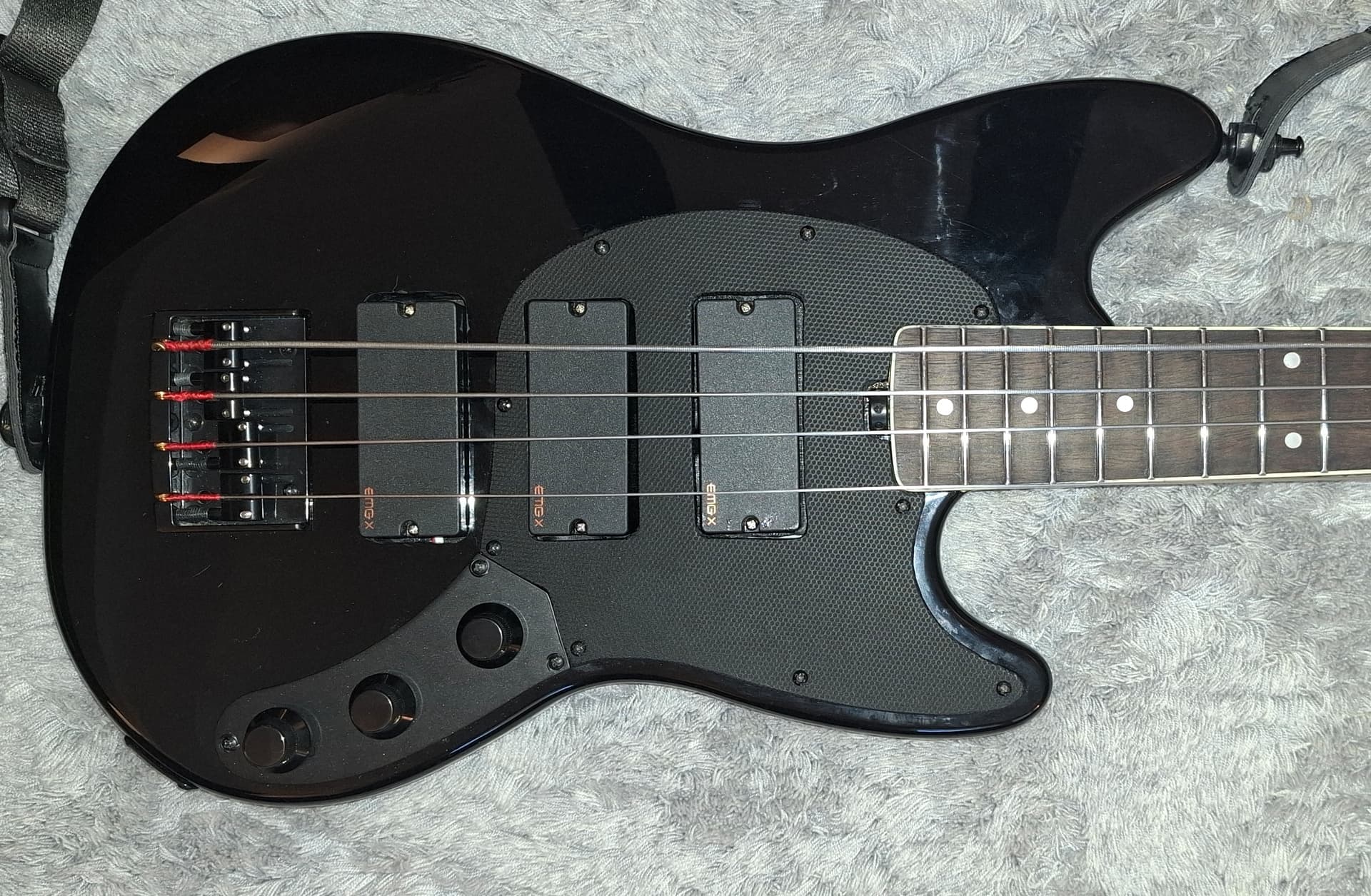
Unless you only have one pickup then I don’t know what you do lol.
I’m finding more and more I prefer to play near the bridge just in terms of how it sounds and it’s more comfortable to hold the bass that way, and it feels better to pluck there. But every video I see people are plucking closer to the neck.
Sometimes I meet a friend of mine - who is a great bass player - in the park and we talk for hours about basses & technique, while he is noodling around (on a bass :-))
Last time he explained different plucking positions to me and cause I have three humbuckers on my park bass I can use them as a thumbrest for neck/middle/bridge positions.
He said: “It’s all about amplitude…”
My findings (and this confirms what he said):
plucking on the neck pickup gives you a very deep tone, but it can be fuzzy. You can approach a double bass tone here, dependingon strings and bass.
plucking on the bridge pickup gives you a very “defined” tone, but it is not as deep. I find it too thin. Maybe good for jazz?
plucking on the middle pickup is a good compromise. This is the P position on other basses. It’s defined and still deep.
A good bass player seems to change plucking positions depending on the tone he wants within a song.
I did not notice that until last time in the park, but now I can’t unsee it.
My bass playing friend changes hand position not only while fretting but also while plucking - all the time.
It makes me dizzy, and as soon as I try it myself it gets very slap-sticky. Like falling over a banana with your fingers
Just don’t confuse “pickup position” with “plucking position”!
I know, a lot of people rest the thumb on the pickup (cover) and thus define their plucking position, but those two things are not the same and shouldn’t be confused!
For me personally, it’s the song I’m playing. When playing with the band, (classic and southern rock) it’s between the bridge and pickup area 95%of the time. When I play at church it’s more around the bridge area and often I may play 3-4 inches up on the fretboard, again, depending on the song, if the music is coming way down and softening up, I’ll slide up on the fretboard and make a soft pull on the string if the music is building I’ll make my way back down and pluck a little harder. I usually take a passive bass to church as well, Band mostly active, sometimes a switchable. This is just what has worked for me over the years.
I was thinking more like near the neck versus near the bridge, with the pickups on mine anyway just being like handy points of reference. Is that what you mean, or close? Although now I know the middle is a thing too. I’m not sure that my ears are good enough to tell the difference between such incremental positions.
What I meant was: don’t assume these two terms can be interchangeably used. These two concepts are only linked because some people use the pickup (cover) to rest their thumbs and then, basically, pickup position = plucking position.
Otherwise: pickup position is a design choice by the luthier; plucking position is a musical/stylistic choice by the player
OK, I am on thin ice here (not a physicist or an engineer): when you pluck a string, you excite it (you make it vibrate). Depending on where you pluck, you might need more or less effort and you excite fundamentals and overtones in various ratios.
Once the string IS excited and vibrates, the pickups register this and turn that into a signal. Depending on where the pickups are, they register some excitation modes better than others, resulting in a different “sound”.
So, there are two degrees of freedom and they are (in a physical sense) not dependent on each other.
Ah … after that complicated explanation that I did not understand , I get the reason for your remark
When experimenting with plucking positions I also experimented with switching pickups on or off (= setting volume to zero) and - to make stuff even more complicated: switching between dual and single coil.
Playing a single neck/middle/bridge pickup (and neglecting plucking position) is kind of similar but different (same same but different).
I find the neck PU “deeper” but less precise … and the bridge PU thinner and “sharper”.
My current strategy is to set individual volume and mode (single/dual) coil to get a general tone I like (I don’t have a tone pot).
And then I play a song with different plucking positions, depending on what that part should sound like.
At least in theory, as I have not mastered the art of that at all.
I need to change positions consciously and when I do that I loose all control over fretting, plucking and (almost) bladder
But applying different plucking positions is definetely something I want to learn properly…
Yes, there is definitely the same trend, meaning as you get closer to the bridge, it sounds “thinner” (more mid-focused), whether you have a PU closer to the bridge or whether you pluck closer to the bridge.
As Jaco talks about in the video, another reason to pluck closer to the bridge is that the strings are tauter there, and thus it becomes easier to play fast or to pluck chords.
Regardless of pickups or configurations playing at or near the neck heel would produce warm and deep tone with good sustain.
Playing near the bridge would produce brighter and more sparkling tone though with less sustain.
Pickup at neck heel will produce warm muddy tone and pickup at the bridge will produce chimney brighter tone, put a saddle pickup on the bridge will make an acoustic bass tone.
When you play you may want to move around up and down the neck for tone dynamic, then combined the pickup location to the plugging location add a sprinkle of finger plugging angle dynamic and you get a 3D of tone articulations.
I generally tend to pluck kind-of over/kind-of not over the back of the neck pickup, on both my J/J and P/J basses. On my Kiesel, which has a more aggressive tone, I tend to pluck more towards the front of the neck pickup, to bring in a bit more warmth.