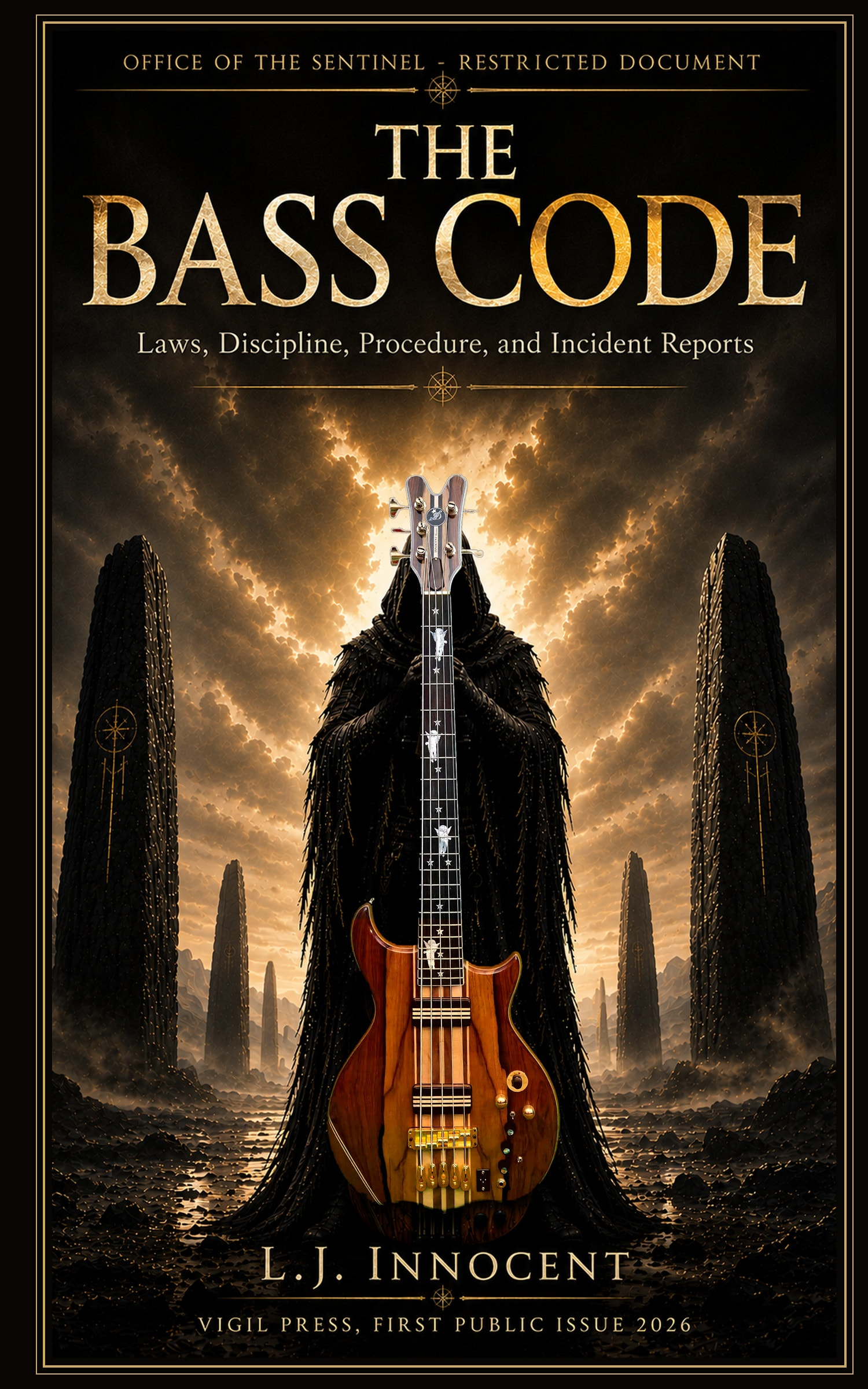
I wrote “The Bass Code” — 55 sacred laws of bass conduct. Which are you guilty of?
Hi all — Jason from the BassBuzz team kindly pointed me your way, so hello.
I’m the author of a new book called The Bass Code. It’s a deadpan comedy written as the ancient sacred doctrine of correct bassist conduct: 55 articles of law, plus eight formal “incident reports” from a fictional institution called the Office of the Sentinel, documenting bassists who broke them. It’s all played completely straight — the comedy comes from how gravely it’s delivered.
Here’s one of the findings, so you can see what you’re dealing with:
OSR-052 — Rehearsal unit 7, Walsall The bassist was asked to turn down. He understood this as a challenge.
The request was made politely. It was made again, less politely. It was made by hand gesture, and finally by a second musician crossing the room toward the amplifier on foot. At no stage did the bassist turn down. He has explained that the tone “only works” at that volume — that beneath a certain threshold the instrument “loses something.”
The something it loses is the capacity of the other four people in the room to remain inside it.
I’ve attached another finding as a PDF too, so you can see how the Office files these.
So I have to ask this particular crowd: which Article are you most guilty of? Confess below and I’ll file the incident properly.
The book’s out 14 July — but honestly I mostly wanted to share it with people who’d get it. Cheers for having me.
Genuinely, thank you — that means a lot, and I hope it earns the pre-order.
The Office, however, is obliged to note the following:
Subject voluntarily took the bait. This is recorded not as a lapse but as the correct response to a lawful summons. Pre-ordering the doctrine before being compelled to is the rarest form of good conduct on file. The subject’s standing is provisionally excellent. The Office will be watching — approvingly, for once.
A long, long time ago, when I was deep into “substances” and played under the influence of those substances (psilocybin and weed), I would occasionally play a song that was different from what the other 3 guys in the band were playing.
Ha — full marks for honesty. The Office has seen worse, though it’s currently struggling to remember when.
Finding: the subject, by his own testimony, performed a song other than the one the rest of the band were playing. The Office notes this does not constitute a mistake within the arrangement, but the spontaneous creation of a second, competing arrangement — performed at the same time, in the same room, without the consent of the other three.
Mitigating circumstances were submitted. The Office has reviewed them. The substances are not recognised as a defence, but they are recognised as an explanation, and the file has been marked accordingly: “knew not what he played, but played it with conviction.”
The matter is closed. The other three have been contacted. They also do not remember.
That means a lot — thank you. Comments like this are exactly why I wrote the thing. I hope it lives up to the pre-order; I reckon you’ll have fun with it.
Ha- thats a fair cop on the replies. The office types faster than i do, but the book itself is mine, AI in the mix but thats noted openly. ive been having way tooooo much fun! anyway, Lee, behind the curtain. Nice to meet you.
Yes, you are funny and I would love to read it. Will be a bit before I can buy one tho, my situation has me in a position where I am not yet in the money as they say.
Ha — that’s exactly right, and painfully so. It’s always the three-note one that gets you.
The Office has reviewed this testimony and finds no breach — only instruction. The submission is upheld: the easy song is the dangerous song, precisely because it is not feared. The bassist relaxes. The bassist is punished.
The observation has been entered into the permanent record and will be treated as doctrine. The contributor is credited. This is rare.