I have gone through the lessons on diatonic chord progression several times trying to understand the criteria for naming a chord major, minor, or diminished. When Josh names them it seems arbitrary. Sometimes when selecting the 1st, 3rd, and 5th notes in a chord it’s called major. Other times, it’s called minor. And then there is the rare diminished. Can someone explain the criteria for naming a chord either major, minor, or diminished?
1 Like
The notes in the chord. A major triad is a root note, a note a major third interval up from it, and a perfect fifth up from the root (or a minor third interval up from the third). A minor triad is a root note, a minor third, and a perfect fifth.
A minor third interval is three half-steps (i.e. frets). A major third interval is four. A perfect fifth is seven.
A diminished chord with no other qualifier replaces the perfect fifth with a diminished fifth (six half steps from the root.
2 Likes
You basically keep adding flats until you’re out of notes 
Triads:
major> minor (b3)>diminished (b3,b5)
7ths:
major>dominant (b7)>minor (b3,b7)>half diminished AKA m7b5 (b3,b5,b7), diminished (b3,b5,bb7)
There must be a simpler explanation than that 
1 Like
All normal diatonic chords are built by stacking major and minor thirds.
Major triad: root + major third + minor third
Minor triad: root + minor third + major third
Diminished triad: root + minor third + minor third
3 Likes
I think you’re confused because you’re trying to deal with the overlap of two music theory concepts: the naming of chords (specifically triads) and diatonic chord progressions.
@howard covered the naming of triads, although he left one out.
Augmented Triad: Root + Major 3rd + Major 3rd (or sharp 5th aka minor 6th)
As you go up the scale diatonically, the triads you build shift between these four types. However, the order they are in depends on the mode of the root key - if it’s major, minor, etc.
Let’s just look at the 2nd triad in C Major vs. C Minor.
In C Major, the 2nd is D. If you form a basic triad off of that using diatonic notes, that will be a Minor Chord: D (root), F (minor third), A (major 3rd above that).
But if you are in C minor, the second note is still D, but the triad you form will be D (root), F (minor third), and then Ab (another minor third). That is a Diminished triad.
So in those examples, both are the 2nd diatonic chord in the progression, but they’re different types of chords. One Minor, and the second Diminished.
Does that make sense?
BTW - thank you for asking this question. This was something that had bugged me that I didn’t fully understand until now. Figuring it out untangled this concept for me.
1 Like
Yep. Another thing that is really important to grasp (and why) is that the pattern the diatonic chords change in is always the same - the starting key (or mode of that key) simply changes where in the pattern you start.
This is all much easier to learn on a piano because it is immediately obvious why this is so.
2 Likes
Thank you for your reply. However, nothing that has been said makes sense because of confusing terminology. I understand the concept of a triad for each of the notes in a scale. In the C major scale, the triads are C major, D minor, E minor, F major, G major, A minor, and B diminished; each triad consisting of alternate notes i.e. C-E-G or D-F-A. But none of the explanations clearly or simply explain why the D rooted triad is a minor while the F rooted triad is a major, and so forth. It seems when I play these triads I can guess (quite accurately) if its a minor or major by the sound but I don’t understand the rules that underlie the labeling of a major, minor or diminished triad. I do not understand the terms often used like minor 3rd or perfect 5th.
This is the problem. You need to gain an understanding of musical intervals and the relative notes in the scale.
The wikipedia article is really good; recommend this section:
and the one immediately before it:
2 Likes
i think what we may be missing here is @gaugustfrank is actually talking about the nashville numbers system, and why in a set key (major or minor), certain chords are major and some are minor, and this is what he/she is confused by. why are some of them major and some minor. or maybe not the numbering as such although that may help, but the pattern of majors and minors in the key, which in this system are denoted by either capital or lower case roman numerals.
rather me than typing out a load of confusing bumph, it might be helpful to go googling the nashville numbers system and see if thats what youre aiming to understand?
EDIT: these may be helpful to you….
1 Like
Nashville numbers is one expression of diatonic scale intervals, yes
It was not complete on it’s own. It was meant to be combined with what @howard wrote about Triads being built by stacking Thirds. And how which two triads you stacked defined what type of triad it is: major, minor, diminished, or augmented.
I was trying to address how the Xth number diatonic chord will be different whether you’re in a Major or Minor key.
I am going to repeat a few things here you probably understand. To understand why Triads are different, you need to understand about different basic intervals, like Howard linked to. Specifically - you should know half-step/semitone, whole step, minor third, major third, and perfect fifth.
I triad is a chord built from 3 notes: Root, Third, and Fifth. The Fifth is also a Third about the Third.
The important thing is, there are two different kinds of thirds: the Major Third and the Minor Third.
A Major Third is an interval of 4-semitones.
A Minor Third is an interval of 3-semitones.
Semitones can also be called “half steps”. It is the interval distance between two frets on a standard fretted instrument like a bass guitar, or between two adjacent keys on a piano.
If you start on one note, and go up 3 frets, that difference is a minor third. If you go up 4 frets (or up one string and back one fret), that is a major third.
A perfect Fifth is 7 semitones above the root. Up 7 frets, or up one string and up two frets.
A Major Triad stacks a Root Note + Up 4 semitones (Major Third) + Up an additional 3 semitones (Minor third). 4+3 = 7 semitones, which is a perfect fifth above the root.
A Minor triad does the reverse: Root + up 3 semitones (minor third) + up 4 semitones (major third).
Diminished is root and two minor thirds. So now it is a flat fifth (6 semitones above the root), which is also called the Tri-Tone.
Augmented is root and two Major Thirds. So the Fifth is 8 semitones above the root. This is the same interval as a Minor 6th.
…
I do not think this is going to make sense to you just reading it. Take this idea and go look at a keyboard or a the fretboard on your bass. Play some Major and Minor scales. Make note of where the Third and the Fifth are in each scale. Look at the intervals between them.
1 Like
Yeah. Understanding what the basic intervals are is far more useful theory than knowing the progression of what the diatonic triads are in a scale.
I sure haven’t memorized those. It hasn’t really held me back.
I use knowledge of intervals all the time though.
1 Like
Yep. It’s the single most important thing to understand, especially as a bass player.
I don’t believe Josh ever clearly explained the correlation between interval distance and the distinction of major and minor triads. He does not mention terms like “major third” or “perfect fifth”; at least in Module 9 where major and minor triads are introduced. The description of interval distance in identifying the major, minor, and diminished triads is very enlightening. Going through the intervals on my bass has helped to confirm what has been presented in the text responses. Thank you all.
1 Like
Yes. Josh (intentionally) provides very basic music theory in this course. @BeerBaron and I just described things in a (very) slightly more advanced way, focused on answering the specific question, but all still very basic and fundamental.
For bass, @markjsmith covers a lot more of this in his courses at TalkingBass.
1 Like
Thanks for the tagging. Ok… I’ll try to make this easy.
First things first, as Howard said, learn your intervals. Intervals are a unit of musical measurement. They have a number and a quality. Major Third. Perfect 5th etc.
Take a major scale, number the notes. Those are scale degrees. 1234567.
Next add the quality of each one. That gives you an interval. The intervals of the major scale are all major except for the 1,4,5 which are perfect. C to D is a Major Second, C to E is a major third, C to F is a perfect 4th etc.
Learn those patterns. And if you can, learn those notes.
Take a perfect fifth and run it up and down the fretboard. Same with every interval. Play around with them and create riffs. Each interval has a sound and character. You’ll hear it as you make riffs with them.
Next learn the minor intervals. They are nothing to do with minor scales. A minor interval is created simply by dropping that top note of a major interval by a half step (one fret).
So learn the minor 2nd, 3rd, 6th and 7th.
C to Db is a minor 2nd. C to Eb is a minor third etc Check out the patterns on your bass
Finally we have augmented and diminished intervals. To make an augmented interval raise the top note of a perfect interval by a half step. To make a diminished interval, drop the top note of perfect interval by a half step.
So C to G is a perfect 5th. C to G# is an aug 5th. C to Gb is a dim 5th.
there is a ton more stuff you can learn regarding intervals but just mess around with those I’ve mentioned. Take an interval (like a major 6th). Play it. Move it around. Learn the sound of it. Make some riffs out of it.
Do that for each interval. Intervals are the building blocks of music and make EVERYTHING in theory so much easier to understand going forward. Every riff, melody, chord and solo in music is built from intervals. They are the reason everything in music sounds like it does be it sad, happy, weird, whatever. Intervals.
They are really easy to learn. This isn’t rocket science. Just play around with them and then look for them in every bass line you learn. When I see bass lines I see intervals.
I’ll do a follow up post telling you how we use intervals to create chords. Then I’ll do one more follow up that will tell you how we create chords in a key. It’s all a progressive process. Learn one thing at a time
9 Likes
This is probably by design.
The course is very well designed for students coming in with different skill and knowledge levels. As someone who did the course with more previous musical background… lots of concepts “clicked” for me that hadn’t previously.
Those concepts would have just gone completely over the head of a new music student. But that’s fine, because new students don’t need them. But, if like you, they are curious and want to seek out that theory knowledge, then you’ve been pointed to information for you to seek out on your own.
I bet you understand the concept better now from having done the work to unravel the puzzle, than if Josh had given a 2 minute explanation of the terms.
The point of the course is not for everyone to understand everything presented by the time the course is finished. It’s throwing a wide range of levels of information at every student and letting them absorb what naturally sinks in.
1 Like
Intervals are the building blocks of music and make EVERYTHING in theory so much easier to understand going forward. Every riff, melody, chord and solo in music is built from intervals. They are the reason everything in music sounds like it does be it sad, happy, weird, whatever. Intervals.
They are really easy to learn. This isn’t rocket science. Just play around with them and then look for them in every bass line you learn. When I see bass lines I see intervals.
do you mean learn every interval and what they are, such as this chart, all the way up to an octave? So anywhere on the fretboard learn the sound between any 2 frets, any 3 frets, any 4 etc?
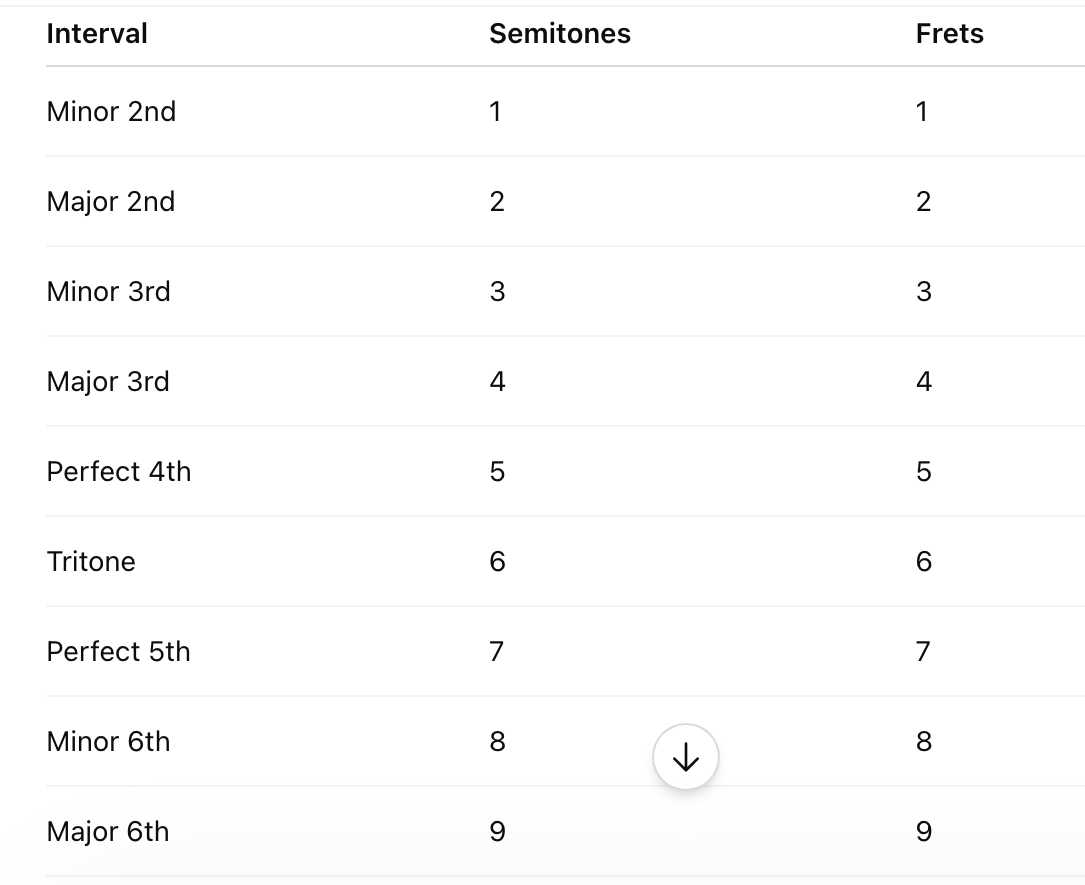
are there any apps that will help with this? i go away for a week soon so it would be useful to get some practice like this in. i get the advice to just listen to songs and try and figure out the bass lines, but i wouldnt be able to tell what intervals the notes are without more practice, so itd be good to be laid on the beach listening to an app thats testing my knowledge.
thank you