I have absolutely no doubt you will do just that, @Al1885. 
4 Likes
I would rock on of those on a street corner with a $5 Joyo battery amp 

2 Likes
@Whying_Dutchman ,
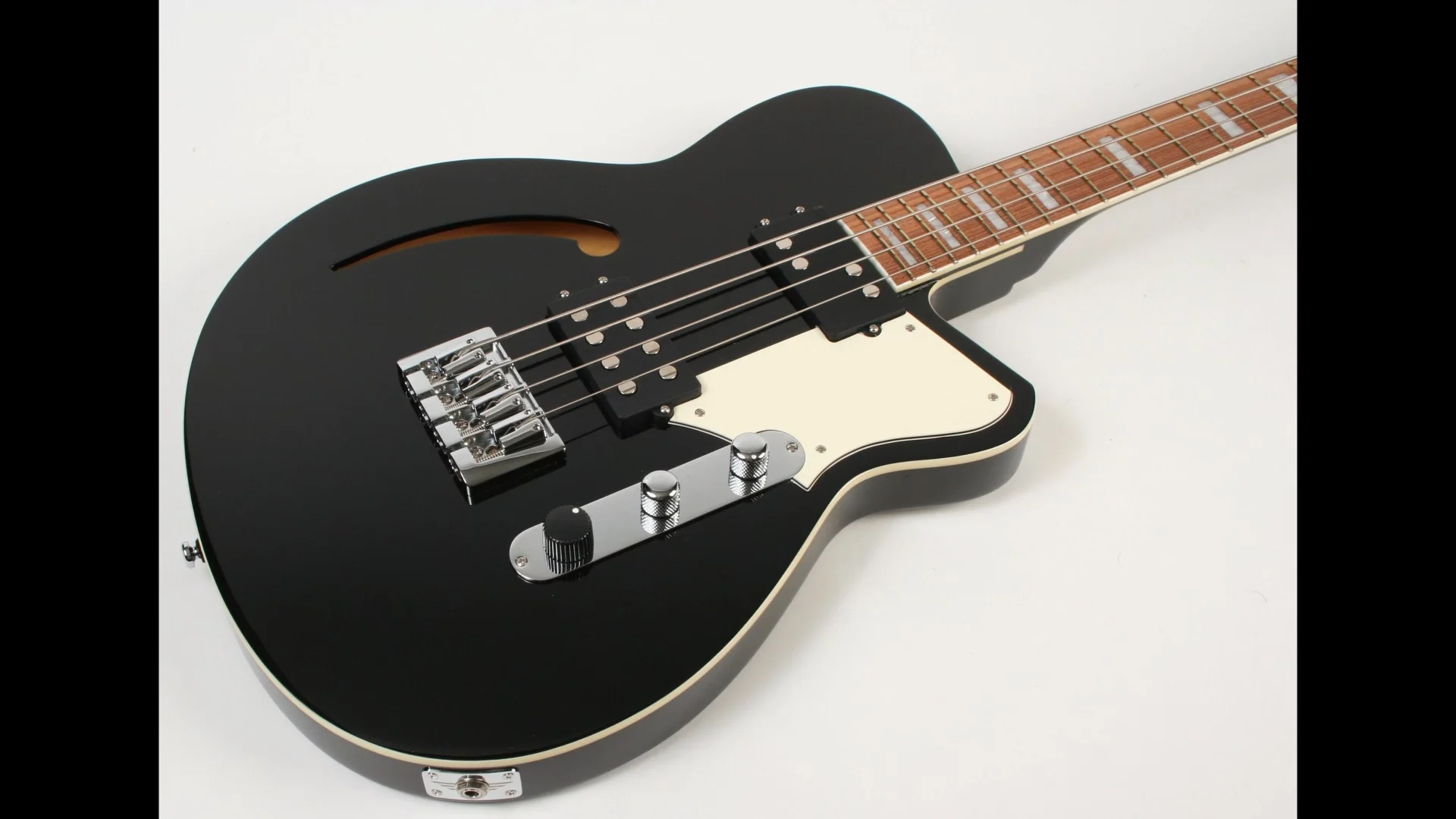
I’m no gear reviewer, but here is quick demo of the Reverand Dub King. The volume and tone controls are at 100% and the blend pot is midway. Bass is plugged directly into the DAI and no plugins were used on the track. I hope this helps.
11 Likes
Ooooooh … it has a nice, organic and deep, almost double bass-like quality.
I like it very much!
What’s your impression? How does it “feel”?
2 Likes
I love the tone. It’s just great. It does have a little bit of neck dive, not as much as the Hofner, but just a bit. And I’m still getting used to the large body.
4 Likes
OK, sorry for the late replies, was out camping this weekend and didn’t have much chance to mess around with the bass.
Here’s the thing - this is NOT a fret issue. It’s a dead note on the neck caused by the resonant frequency of the neck itself. Leo Fender would demonstrate this with a C-clamp on the headstock. Here, I’ll use a camera-mount clamp:

What you’ll see and hear in the video is that once the clamp is on, the extra mass changes the resonance of the neck and immediately the note rings out clearly and sustains. Take it off, and it chokes and dies.
Yeah, it has to go back. 
6 Likes
If not I would usually lube the nut when I encounter “Sitar” phenomenon. It’s the sound when the string release a fraction too late.
But yeah send it back. Does fretting C on B string or F on E string bother you with the nut so high.
The action is fine across the fingerboard. The nut isn’t especially high. In this case, where the extra mass makes it disappear as though by magic (as shown in my second video above), I’m not sure that nut lube would sort this one out.
I found some interesting reading about the subject here:
His web design puts an image right over top of the text, though, so if you’re not sure how to hide that, here’s the full text:
Summary
Deadspots
…and how to remove them
The dreaded deadspot. Even the word itself sounds negative. Not much good comes from most things that are ‘dead’, and ‘spots’ aren’t thought of as very positive either, so this article will show how I removed one of them on one of my personal basses.
What is a deadspot?
On a stringed instrument, it probably could best be described as a note (or a couple of notes) on the neck that don’t have as much sustain as the all of the others, often jumping to the harmonic before quickly dying out. On a Fender 34" scale bass, these notes are most often found on the G string anywhere from the 5th, 6th or 7th fret, probably most often on the 7th (the note ‘D’). In my experience, ALL basses have them, it’s just that one some basses, they are more noticeable than others.
What Causes a deadspot?
The deadspot is caused by a neck’s resonant frequency. You can actually feel them as well as hear them, When you play the note that is dead, you can feel the neck vibrate (shake) more than on the notes that don’t have one. What the neck is doing is resonating the note, so it’s energy is being ‘absorbed’ by the vibration. The neck’s stiffness, wood type, hardness, weight, density, type of truss rod, the tension of the trussrod all play a role with a neck’s resonant frequency. Even composite graphite necks can have them, but due to their stiffness, they are often at a higher frequency, and beyond the range of a bass guitar.
How I removed mine:
I was noticing that one of my Jazzmaster basses (the featherweight, 7lb 9 oz shoreline gold one) had a slight dead spot on only one note. It was the very common ‘D’ on the G string (7th fret). The surrounding notes were ringing out and sustaining fine, but when I played the D, I could actually feel the neck shake/resonate and it slightly choked out. Since the swamp ash body on this particular bass was so light, I made a point of selecting the lightest weight neck that I could find for it which weighed only 1lb 6 oz (most fender type necks are 1lb 8oz - 1lb 13oz).
Way back in 1979, when i discussed this issue that’s very common on Fender basses with Leo Fender, he pulled out a small C clamp, clamped it on the headstock and said, ‘play it now’. Sure enough, it was gone, and although it probably moved to a lower or higher note, I sure as heck couldn’t find it. This is also the same premise/solution that the ‘fathead’ (brass plate on the back of the headstock) and later ‘fatfinger’ (a small c clamp), both of which have been discontinued, were based on, which is adding mass to the headstock to change the neck’s resonant frequency.
So, knowing that, i started experimenting with various sized (and weight) C clamps to see if I could solve the dead D problem on my bass (or at least move it to a note ‘in between’ the fretted ones. Since its body is so lightweight, I wanted to make sure that i added only enough weight to solve the problem and not create any neck dive/balance issues. I’m using gotoh’s Res-o-lite vintage style reverse tuning heads on it, which made it balance perfectly. After a bit of experimentation, I found that the smallest 3 oz C clamp that I had, completely eliminated it. I figured that if I installed a standard weight set of heads (or just two of them) it would solve the problem, but I didn’t want two of one type, and two of the other. I also didn’t want to just replace the Res-o-lites with a whole set of standard weight ones, since 6.5oz would surely create neck dive, plus the Res-o-lites are so much smoother and have no slop in them whatsoever. So, I went to my local hobby shop and bought a pack of tungsten 3/8’ cylinder weights that are used for pinewood derby cars.
Tungsten is the new replacement for lead, since it’s non toxic and actually weighs 1.7 times more than the same size piece of lead (which I learned 8 years ago when i was making and balancing my own r/c micro helicopter blades).
Anywhow, figuring that it was going to take at least 2 oz of weight to solve it, I removed two machine heads and bored two 3/8" holes under each of them to inlay the 1/2oz tungsten cylinders (see pic below with all four inlaid and an extra one laying on top to show it’s size). To bore the holes cleanly, I used a 1/4" Forstner drill bit for most of the depth, and then used a Dremel #155 bit to make the bottom of the hole perfectly flat. You just have to be careful not to go all the way thru the headstock (I left .125" of wood from the bottom of hole to the face of the headstock)
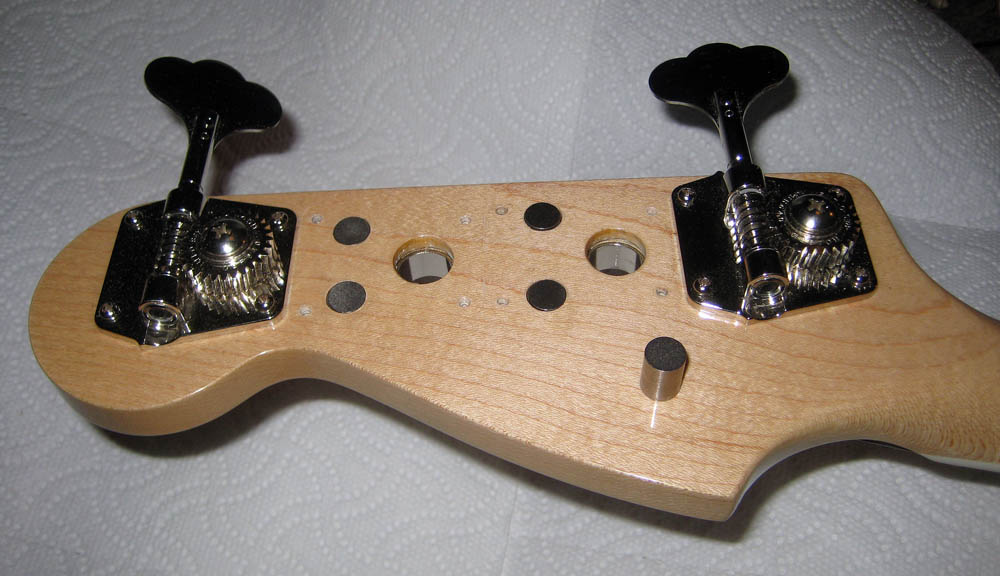
I first tested it with only 1 oz added (under the A string key), and while it was a bit better, the dead spot was still there, but not as dramatic. While testing, I left the holes slightly shallow so that the base plate of the tuning key would ‘clamp it in place’. I ended up using four cylinder weights (two under the D key and two under the A key). I tested it again and the dead spot was not only gone, but it didn’t seem to affect any of the other notes, so I bored the holes so the weights would sit flush and epoxied them in. The 2oz of added weight has not upset the balance of the bass at all, it’s still very lightweight at 7lbs 11oz, and all of the notes sustain and ring out beautifully (running a set of TI Jazz flats on it. I couldn’t be happier with the bass now that it is rid of them.
Thanks for taking the time to read this, and I hope that you found this article useful. -keep on rockin’- johnk
3 Likes
If it’s like my Reverend, try rolling the tone knob to about 75%. There’s this magic sweet spot around there that I get the nicest tone from.
3 Likes
If I were to ever get a fiver, this would be high on my list. It compares very favorably to others costing 5+ times more.

3 Likes
Ohhh. I’m pretty sure all adults consider this good decision making.
6 Likes
This reminds me, I learned a little about Sire today that you probably know but was new to me. Basically, they are owned by the same guy as Dame Guitars in Korea, and there’s lots of similarities.
Not sure if they make any in Korea but if so I would expect MIJ or near MIJ quality.
They are very inexpensive - about $300 - so I doubt they are MIK.
Yep, the founder of Sire did a video interview where he told the whole story, including the early Dame days. He is Korean, a serious bass player, and Dames have been built in Korea.
After Dame, he built his own factory in Indonesia and started Sire. The factory is dedicated to building nothing else but Sire instruments. He has made Sire’s guiding principle top-level quality control.
2 Likes
I don’t know why but I have started looking at amps, I don’t need one, my Rumble does everything I need it to.
But…I find myself looking at bigger speakers and Orange amps etc.
I admit I would like to feel more air move as I play, but I don’t need a bigger amp.
3 Likes
This is true. Keep saying that.
3 Likes
I hear someone needs a bigger amp.
3 Likes
Can I wire in a 15" speaker to a Rumble 25?
asking for a friend.
3 Likes
There’s no external speaker out on the 25, or at least there was not on mine. And there is not room in its enclosure for a 15" speaker 
2 Likes
Hmmm, not enough room you say
4 Likes
Rumble 25 use 8”speaker putting a 15” is almost physically impossible and electronic is just not possible either.