The guy from Crimson Guitars rebuilt his daughter’s heavy AF Strat and put holes all through it. Here’s a link to the playlist if you’re interested.
The guy from Crimson Guitars rebuilt his daughter’s heavy AF Strat and put holes all through it. Here’s a link to the playlist if you’re interested.
They’re speed holes. Well known fact. Enough speed holes and you can shred 1/32 notes at 231 bpm for 9m 17s straight.
I popped out the ferrules on the SRC6 like I should have done in the first place, sanded back, stained again… and it still seems I didn’t get off enough lol, but I guess I’ll find out tomorrow.
…I also found a 30" scale neck on Amazon that is an oddball. It’s 42mm wide at the nut but 65mm at the heel, but some people said it came with a 4-string bass nut, others with a 6-string guitar nut and that it was meant for baritone guitars. who knows!?
but it’s only $70 and now saved to my wishlist for a future project… SRC6 uses a 10.8mm spaced Ibanez Tight End guitar bridge, but it’s also 10mm or so narrower at the heel end.
I saved a bookmark for some single bridges that do 15mm spacing, and I swear I found something else with adjustable widths that got a little tighter. Ibanez makes a Gerald Veasely GVB36 6-string with 14mm bridge spacing with a 54mm nut. I briefly owned one and returned it due to the color just not vibing with me. Of course now I would just gleefully take a sander to a brand new $1300 bass  (assuming I just really liked the rest).
I dunno. I could take that 30" neck and do a narrow 5 shorty with those 15mm spaced singles. But why. and the answer is not “why not” I really have no reason or want to do it, specifically, I’m just spit-balling when I have 2.5 projects to finish already.
But a 5-string neck built into a narrow 6, or even 7, is kinda appealing 
I could squeeze 7 into that 65mm heel (maybe) but the nut end would be really tight…
Anyway… at least I made progress on my SRC6. It’s been in pieces far too long.
How much weight did that drilling shave off?
If the parts get here, a weekend project.
Ordered my PV 63 pickup, and will swap out the Quarter Pounders on my FGN.
I promised the Quarter Pounders to someone, who was that? I am terrible with names
The D5 will stay the same for now. My teacher today said he thought it perfect tone for punk, so I will leave it until GAS strikes again
The Stream will get the EMG 35CS and 35DC back in, and will get my Stringjoy Stainless strings, and that will be my metal bass
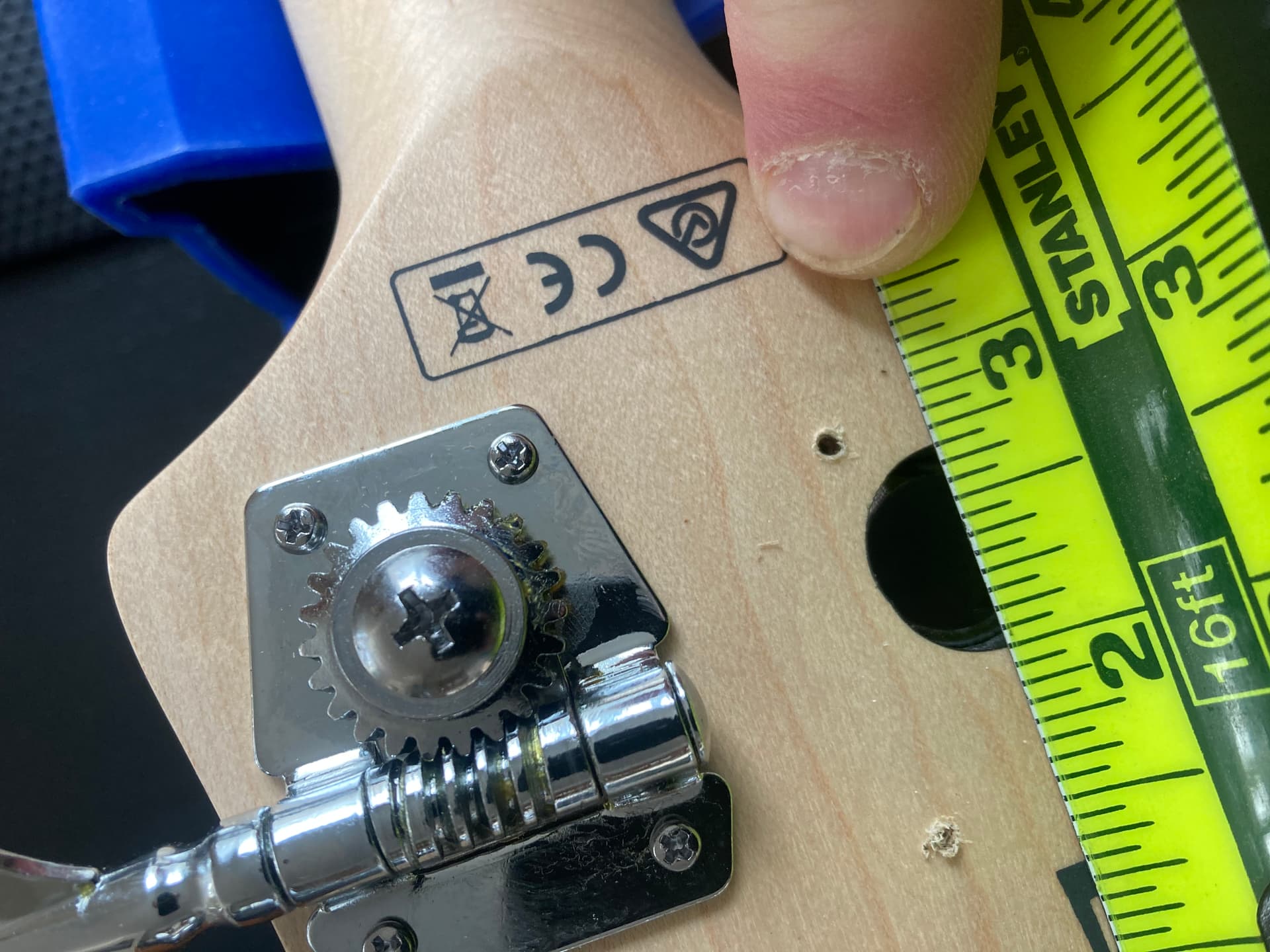
How do I measure my tuners? Just a ruler against the hole? On the lookout for lightweight tuners for the Warmoth
That’s my plan
Yes sir. Then check against the drawing / specs. Hipshot always has a detailed drawing you can reference on their website.
Me, pr’aps? I got chicken nuggets for your 

That’s right, by day I am a mild mannered bass player, by night an international pickup smuggler trying to corner the market for nuggies.
about 220-250 grams, which is not that much but better than nothing, considering that only the zone under the pickguard is chambered.
But… But… The tonewood! 
Cavities to add resonance
Tone Holes!
That works. However for measuring round things it’s worth spending a little on a cheap caliper. You can get a perfectly fine one for under $10.
Like even a digital one 
Here is a bone nut for The Duke, that I finished adjusting yesterday. Then I tainted it with black coffee to make it match the aged white (yellowish) parts of the bass.
Akshully, it’s not a micrometer. Its a Vernier caliper, called the “very near” caliper by machinists.
It’s reasonably accurate for OD, but pretty hit and miss for ID. If you want exact speed holes or tuner apertures, you want a telescoping gauge and a genuine micrometer. The Vernier is great for scribing an offset to the inside of an edge though.
I have 3 days off this weekend thanks to the holiday on Monday, so maybe I’ll make some progress with the Moolah Bass, maybe even to the point where I can show the progress on the Live Hang Sunday
I have a lot of bookmarked products and YouTube videos for exactly this sort of thing. It’s shocking what you can make aluminum, iron, steel, etc look like by just applying a chemical to it and wiping it off. Inexpensively, too.
I think I am dreading picking up a router. Because I know that once I start it into the wood, that’s it. That’s where something goes without extensive repairs lol… oof.
I have the router attachment for my dremel, and since dremels work using speed vs torque the reasoning is it will force me to go more slowly 
I need to make or get together some templates, too… or more-likely just trace things on the body…
A palm router with a 1/4" collet is the best for this sort of thing in my humble.
You get a much more complete collection of bits, and enough torque to actually get work done.
If you use a template, guide bearings and remember to always move right if milling on the opposite side of the router and left on your side you’ll be fine. Practice on scrap
I love that it’s only $5 more for a stainless steel one.